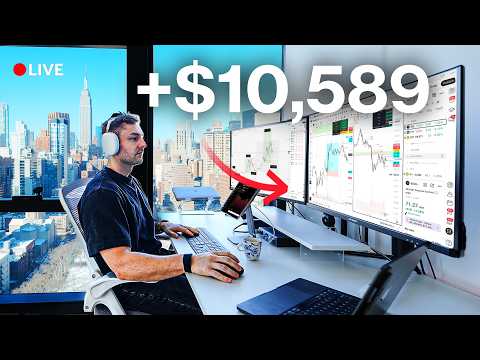
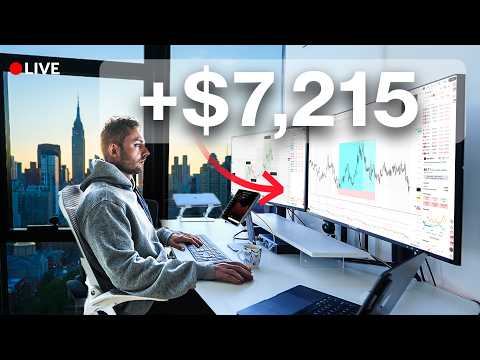
Day trading is often portrayed as a high-octane sprint toward profits, but in reality, it's a disciplined marathon of risk management, technical precision, and emotional control. This deep dive into a live trading session reveals the mechanics behind consistent profitability—even when only 25% of trades are winners.
The session unfolded during a critical macro event day, with Federal Reserve interest rate decisions and inflation data releases on the calendar. The trader's goal: $10,000 in profit, risking $2,000 per trade, while navigating volatile crypto markets—specifically Solana.
🔍 Pre-Market Setup: Building the Framework
Before the first trade, the trader establishes a comprehensive market overview across multiple monitors:
- TradingView for charting and technical analysis
- Exchange platform for trade execution
- Trade journal for real-time performance tracking
- Community Discord for collaborative market insights
- Macro-level market view on a dedicated monitor to assess daily bias
The strategy revolves around identifying change of character (CHoCH) patterns—moments when a trend shows signs of reversal through the formation of a higher high in a downtrend or lower low in an uptrend. The trader then targets fair value gaps (FVGs) on the 1-minute timeframe, aligning them with 15-minute fair value gaps for confluence.
"I'm trying to play into reversals in trends, find really high impact momentum areas, and trade into that for the day. Keep the losses small with the 2K risk and allow the winners to run."
📉 Trade #1: Long Position - Break Even with Fees
Out of the gate, Solana presented a technical dilemma. Price action showed a clear order block candle—a pattern where price sweeps a low, then sharply reverses higher. However, the market remained range-bound, unable to break above a key resistance level.
Decision: Wait for confirmation. No bias yet.
Eventually, momentum pushed into a higher timeframe fair value gap, triggering a long entry. However, the trader missed the opportunity to use a post-only order, resulting in significant slippage and fee costs. Price briefly moved favorably but failed to break key resistance.
Outcome: Exited at break even, but paid fees—resulting in a small loss. This is logged as the first trade of the day.
"Traditionally, I lose the first trade of most sessions, which is funny."
📈 Trade #2: Short Position - Liquidity Sweep Rejection
After the failed long, the trader noticed a breakdown below a liquidity inflection level—a price zone that had previously acted as support. Price retested this level from below, entering a fair value gap aligned with the 61.8% Fibonacci retracement zone.
Entry logic: If the market is going to roll lower for the session, it should respect this high-impact reversal area.
The trade initially showed promise, with price beginning to move down. However, a sudden, explosive move—likely driven by an unexpected fundamental catalyst—caused massive volatility. Price spiked dramatically lower, then reversed just as quickly, returning to the entry zone.
"That's why I don't get too excited with stuff like this because now we're back at entry and it's probably going to come up and stop us out for break even after that big move."
Outcome: Another break-even exit. More fees paid. No profit locked in.
⚡ Trade #3: News-Driven Long - The Big Winner
With the Federal Reserve interest rate decision and press conference approaching, the trader shifted strategy. Instead of playing pure technicals, the focus turned to volatility-based positioning around major news events.
The key level: a previous day low that had been identified in the morning session as critical support. Price dropped into this zone following the Fed announcement, which revealed that rates would remain unchanged.
Entry: Long position targeting equal highs and potentially previous day highs. The trader acknowledged this was a riskier, news-driven play but felt the technical confluence justified the trade.
Price responded aggressively, moving up through the fair value gap. The trader locked in partial profits at a key resistance zone, then trailed stops below structure.
Outcome: Price reversed after the Fed press conference, but partials had already been taken. The remaining position was stopped out at break even. However, the partials represented a 6.2x risk factor gain on the $2,000 risk—translating to approximately $12,400 in profit on this single trade.
"We got a little pop from the fundamentals and it was nice to play but it didn't end up running to be a mega Goliath trade which is all right because we still were able to lock in about 6.2 risk factors off of 2,000."
This one trade pushed the daily P&L to $11,000, exceeding the $10,000 daily goal.
🌙 Trade #4: Asia Session Short - Another Break Even
After returning from dinner, the trader identified a structural shift to the downside during the Asia session. Price was rejecting off a higher timeframe fair value gap, aligned with a 61.8% Fibonacci level and a bearish fair value gap on lower timeframes.
Entry: Short position targeting lower support levels.
The trade initially responded perfectly, confirming the technical setup. However, price stalled at a midpoint of a bullish gap, which represented heavy support. The trader reduced risk to break even and was eventually stopped out as price reversed.
Outcome: Break even. Another round of fees paid.
💡 Key Lessons: Win Rate vs. Risk-Reward
Despite a 25% win rate (only 1 out of 4 trades won), the day ended with a $10,500 profit. This underscores a critical principle in professional trading:
- Win rate is not the primary metric for success
- Risk-reward ratio and risk management drive profitability
- Break-even trades, while frustrating, protect capital and preserve opportunity
- One well-executed, high-conviction trade can offset multiple small losses
"The most important thing that I like to showcase is that all I'm doing is opening myself up to opportunity and keeping risk contained. Not worrying about if you're right, not worrying about if your ideas are working, rather if you're making money at the end of the day."
🎯 Macro Context: Fed Policy and Crypto Volatility
The session occurred on a day with significant macroeconomic events:
- Federal Reserve interest rate decision: Rates held steady, as expected
- Inflation data release: Scheduled for 2:00 PM
- Fed press conference: Followed the rate decision, adding volatility
The trader noted that any surprise rate hike discussion would likely be harmful to the crypto market, as higher rates typically reduce risk appetite. This informed the decision to play more defensively ahead of the announcement and then risk-on into the volatility once the news was digested.
📊 Final Performance Summary
- Win Rate: 25% (1 win, 3 break-even trades)
- Daily Profit: $10,500
- Risk Per Trade: $2,000
- Largest Winner: 6.2x risk factor (~$12,400)
- Strategy: Change of character, fair value gaps, liquidity sweeps
- Key Edge: Risk management, partial profit-taking, and event-driven positioning
🔑 Takeaways for Traders
This session highlights the importance of discipline over prediction. The trader didn't force trades when bias was unclear, accepted break-even outcomes without revenge trading, and capitalized aggressively when a high-probability setup aligned with fundamental catalysts.
Modern trading success isn't about being right most of the time—it's about being right when it counts, managing risk relentlessly, and staying emotionally neutral through volatility.
For those navigating macro-driven markets, this session serves as a reminder: opportunity favors the prepared, and profitability favors the patient.