🎯 The Core Problem: Overcomplication
After nine years in the markets, one truth stands out: trading success is not achieved by building increasingly complex strategies. The vast majority of struggling traders fall into the trap of treating trading like brain surgery — layering indicators, analyzing dozens of variables, and drowning in information.
The reality? More information rarely leads to better decisions. Instead, what separates consistently profitable traders from those who struggle is not the sophistication of their system, but the repeatability and manageability of their process. This is where trades are truly won or lost.
"You need less information, but more of the right information."
The approach outlined here has enabled traders — regardless of starting skill or account size — to identify daily opportunities with just 1-2 hours of focused work, using two time frames and a straightforward model.
📈 The Framework: A Simple, Repeatable Trading Model
This strategy revolves around three core steps that work together to identify high-probability setups with favorable risk-reward profiles:
Step 1: Higher Time Frame Analysis (15-Minute Chart)
Start by examining the previous 1-2 days of price data on the 15-minute time frame. The objective is to mark out 15-minute fair value gaps — areas where a sequence of three candles leaves a space between the first candle's wick and the third candle's wick.
Why fair value gaps matter:
- They represent pockets of liquidity where orders were left behind during rapid price movement
- The market constantly seeks equilibrium, and these zones act as magnets for price
- Valid gaps (those not yet violated by price) serve as either entry confirmation zones or profit targets
Additionally, identify liquidity inflection levels — areas where price repeatedly tested a boundary before finally breaking through. When price returns to test these levels from the opposite side, they often act as strong support or resistance.
Step 2: Lower Time Frame Entry Criteria (1-Minute Chart)
Once the higher time frame structure is established, drop down to the 1-minute chart to find precise entries. This is typically done at market open (New York session in this case) when volume surges and creates the most movement.
Entry criteria checklist:
- Change of Character (CHoCH): Identify when a trend structure breaks — for example, when an uptrend (higher lows, higher highs) produces a candle close below a previous higher low
- Fibonacci Retracement: Apply a Fibonacci tool from the pivot point to the extreme of the move. Look for retracements into the 50-78.6% zone, with the 61.8% golden ratio being ideal
- 1-Minute Fair Value Gap: Find a gap on the 1-minute chart that aligns with the Fibonacci zone
- 1-Minute Liquidity Inflection Level: Confirm that price is responding to a key structural level that previously acted as support/resistance
This multi-layered confirmation process filters out low-probability setups and ensures alignment between time frames.
Step 3: Position Management and Risk Control
Once entry criteria are met, position construction follows a disciplined framework:
- Entry: Target the midpoint (50%) of the identified fair value gap
- Stop Loss: Place the stop outside of the fair value gap's producing candle — ideally beyond any nearby gaps or key structural levels to avoid premature stop-outs
- Breakeven Rule: Once price closes below the entry pivot low (in a short setup), move the stop loss to breakeven, eliminating risk
- Take Profit: Initially set at 4R (4x risk), targeting the midpoint of higher time frame fair value gaps. Advanced trailing techniques can extend winners to 20R or more
"Stop losses should be placed where the chart tells you, not where you want them to be."
This approach prioritizes reducing risk quickly on winning trades while allowing them to run, creating an asymmetric risk-reward profile that withstands losing streaks.
🧪 Real-World Application: Chart Walkthrough
To demonstrate how this plays out in practice, consider a recent trading session:
On the 15-minute chart, several fair value gaps were identified from the previous day's price action. A liquidity inflection level was marked where price repeatedly bounced before breaking lower. The bias was clearly bearish with multiple unmitigated gaps below.
Switching to the 1-minute chart at market open, price first exhibited a change of character — breaking above a previous high, indicating a potential short-term uptrend. A Fibonacci retracement was drawn from the low to the high of this move.
Price then retraced into the 61.8% Fibonacci level, coinciding perfectly with:
- A 1-minute bearish fair value gap
- The liquidity inflection level from the 15-minute chart
- Alignment with a 15-minute fair value gap above
An entry was placed at the gap midpoint, with a stop positioned above the gap structure. Once price closed below the entry pivot, the stop was moved to breakeven — eliminating all risk.
Price then proceeded to move lower, respecting intermediate fair value gap levels as partial profit targets. The position was trailed using market structure, ultimately delivering a 9R return before being closed.
💰 Performance and Practical Results
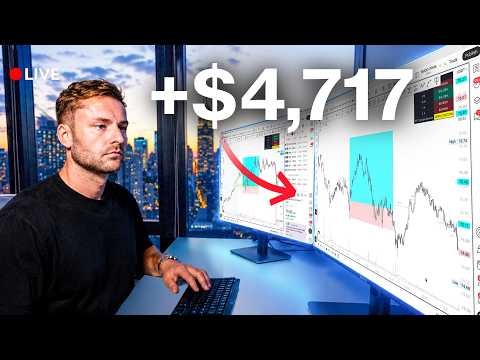
This isn't a theoretical exercise. In a live trading environment, this exact setup produced a $15,300 profit on a single trade. The entry aligned with all criteria, the stop was reduced to breakeven after confirmation, and the position was managed dynamically as price moved through multiple fair value gap targets.
Traders using this framework have demonstrated consistent results:
- One trader scaled a $1,000 account to $8,000
- Another captured an 8.8R trade (meaning $100 risk generated $880 profit)
- Multiple instances of 10R+ trades by allowing winners to run while keeping losses contained
The key insight: even a 50% win rate becomes highly profitable when winners consistently exceed 4R and losers are capped at 1R or less through disciplined breakeven management.
🔍 Filtering for Quality Over Quantity
Not every setup meets all criteria — and that's intentional. The goal is not to trade constantly, but to wait for high-conviction alignments where multiple factors confirm the same directional bias.
In reviewing several trading sessions:
- Some days offered multiple aligned setups with clear structure
- Other days showed price action that didn't meet full criteria — gaps without liquidity confirmation, Fibonacci levels without fair value gaps, or trending markets without retracements
Experienced traders may choose to take setups with 3 out of 4 criteria met, but beginners should require full alignment until they build a robust sample size and understand which filters add the most value.
"It's better to have tight filtration at first and become more liberal with experience than to start loose and struggle to tighten your process."
🛠️ Tools and Execution
The execution of this model is aided by simple tools:
- Trading View charts with 15-minute and 1-minute time frames side by side
- Fair value gap indicator to automatically highlight gaps (eliminating manual drawing)
- Session indicator to mark New York (or London) market open
- Fibonacci retracement tool built into most charting platforms
The total time commitment: 1-2 hours per day, focused primarily around the market open when volume and volatility are highest.
✅ The Fundamental Principle
This approach works not because it predicts the future, but because it aligns risk management with probability. The market moves in probabilistic terms — no strategy wins 100% of the time. The edge comes from:
- Letting winners run (4R, 9R, 20R+)
- Cutting losses quickly (often at breakeven)
- Creating asymmetric risk-reward profiles
- Following a repeatable, rules-based process
A trader following this model can lose 10 trades in a row and still be breakeven if one winner delivers 10R. That's the power of managing risk systematically rather than trying to be right all the time.
🎓 Final Takeaway
Trading does not require sophistication. It requires simplicity, discipline, and repeatability. The most successful traders are not those with the most indicators or the most complex algorithms — they are those who execute a straightforward process consistently, manage risk intelligently, and allow the mathematics of asymmetric risk-reward to work in their favor over time.
The framework outlined here — higher time frame structure, lower time frame precision, and systematic risk management — is accessible to any trader willing to focus on doing less, but doing it better.