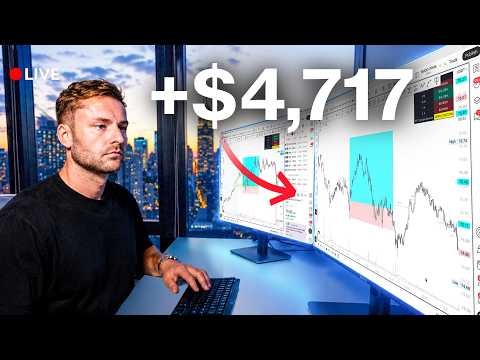
The session opened with a clear objective: $10,000 in profit, risking $2,000 per trade, with a focus on execution and risk management. What unfolded was a masterclass in discipline, patience, and the emotional cost of leaving profit on the table — ending the day with $7,215 in gains after nine total trades and a 33% win rate.
🧭 Market Context: Bearish Bias on Bitcoin
Before executing any trades, the macro analysis centered on Bitcoin, which had just broken beneath a critical support level. After struggling to break above resistance and failing to hold structure, the sentiment was clearly bearish — setting the tone for the session. While this didn't lock in a directional bias for every trade, it informed the initial lean toward short setups.
The focus was on Ethereum (ETH) and Solana (SOL), monitoring both pairs for optimal entries using 15-minute fair value gaps, proprietary indicators, and 1-minute micro entries. The strategy revolved around identifying liquidity inflection points, change-of-character moments, and gap responses to position into high-probability trades.
📉 Trade #1: ETH Short — Break-Even After Early Promise
The first trade came 10 minutes into the session, with ETH showing temporary support at a 15-minute bullish fair value gap. The setup focused on a liquidity inflection level where price repeatedly failed to break through. After tapping into the gap and rejecting lower, the short was triggered.
Initial momentum was strong, but as the trade moved in favor, the stop loss was adjusted to break-even to protect against whipsaw. A strong bullish candle reversed the move, ultimately stopping the position out at break-even. No profit, no loss — just execution and patience.
🔄 Trade #2: SOL Long — Another Break-Even in Barcode Conditions
Switching to Solana, the setup emerged after a sweep of lows and a response off overlapping fair value gaps. The entry targeted a potential reversal after a change of character above a key high. Despite initial movement, price stalled and eventually came back to stop the position out at break-even once again.
"It's really easy to take it personally in trading where you think that you were wrong about an idea... but sometimes you just have to allow the market to shake out and be able to give you the opportunities when the market is ready."
📊 Trade #3: ETH Short — Reduced Risk Loss
Back on ETH, price ran into a pre-market resistance level and a bearish fair value gap. The short was triggered at the 61.8% retracement level, anticipating rejection and a move lower. The trade initially worked, gaining $2,500 in unrealized profit, but reversed aggressively. Risk was reduced by moving the stop loss below the recent high, but the position was ultimately stopped out for a $1,300 loss.
🚀 Trade #4: ETH Long — The Accidental Winner
This was the defining trade of the session. After sustained downward movement, ETH finally broke structure to the upside with a change of character and a buy signal from proprietary indicators. The entry came at a fair value gap with strong confluence.
The trade moved quickly, gaining $2,200 in profit. However, an accidental take-profit order set at $2,000 triggered prematurely, locking in $3,874 before the real move even began. Recognizing the setup was still valid, a re-entry was executed at break-even risk.
The second leg of the trade delivered a strong push higher. Partials were taken at a 1:4 risk-reward ratio, locking in $1,500. The remainder was closed near the target zone for a combined $5,339 profit on the second entry — bringing the session halfway to goal. The trade ultimately delivered a 5.54x risk multiple, despite the mishap.
"Obviously, we have a long way to go for that. But if the market does want to make that move, now we'll be able to capitalize on it."
⚠️ Trade #5: ETH Short — Early Entry, Full Loss
After ETH surged into a bearish fair value gap, a short was attempted on a change in state of delivery — a more aggressive, early signal that doesn't wait for full trend confirmation. Price continued to push higher, stopping the position out for a $2,391 loss.
Lesson reinforced: patience pays. Early entries without confirmed structure breaks carry higher risk.
💰 Trade #6: ETH Short — Locking in the Daily Goal
Finally, price broke below a critical level with a confirmed close beneath structure. The short entry was timed at the gap where character changed, targeting a move back down into support zones.
The trade worked beautifully. Risk was reduced to break-even quickly, and the position was closed at the 1:4 level, locking in $7,428 in profit — bringing the session within striking distance of the $10,000 daily goal.
"Notice how we didn't have any change of character until we had this close below this low. And that's the level that we came up to before making a move down."
😤 Trade #7: ETH Long — The One That Got Away
After stepping away to the gym, a long setup formed as price pulled back into a higher timeframe fair value gap and produced a buy signal. The entry was clean, targeting a move back into resistance.
The trade moved perfectly to the take-profit level — but was stopped out at the last second by a wick, only to immediately reverse and hit the full target without the position. The trade would have added $11,000 to the session, bringing the total to nearly $19,000. Instead, it resulted in a $2,000 loss.
This was the emotional gut-punch of the day.
📈 Session Summary: Discipline Over Perfection
- Total Trades: 9
- Win Rate: 33%
- Net Profit: $7,215
- Wins: 3 (including the accidental early exit)
- Break-Evens: 2
- Losses: 4
Despite a low win rate, risk management and position sizing kept the session profitable. The biggest wins came from letting momentum trades run, even after early exits or re-entries. The session also highlighted the cost of taking profit too early — particularly on Trade #4 and the final setup, where patience could have added thousands more to the bottom line.
🧠 Key Takeaways
- Barcode price action requires patience: Not every session will deliver clean, trending moves. The ability to stay disciplined through chop is what separates consistent traders from reactive ones.
- Risk management is everything: Moving stops to break-even and taking partials preserved capital and locked in gains, even when full targets weren't hit.
- Early exits cost more than you think: The accidental take-profit and the decision to close early on the final trade left significant profit on the table — a reminder to trust the process and the setup.
- Confluence matters: The best trades came from fair value gaps + change of character + proprietary signals — not isolated indicators.
🔚 Final Thoughts
Was it a perfect session? No. Was it a disciplined one? Absolutely. With a 33% win rate and $7,215 in profit, the session demonstrated that trading is not about being right every time — it's about managing risk, staying patient, and capitalizing when the market finally cooperates.
The painful reality? The session could have easily been a $19,000 day with better hold discipline. But that's the game. And every session is a lesson.