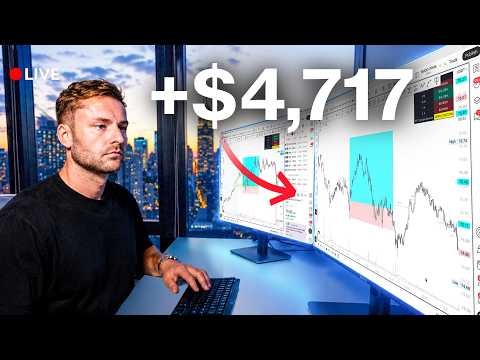
📉 A Real Day Trading Session: $4,700 in Profits After Five Losses
⚡ The Day Trading Blueprint: Tools, Setup, and Execution
The morning started at 9:15 AM with a clear structure in place. Three core components formed the foundation of the session: TradingView for charting and technical analysis, Bybit or Blowfin for trade execution, and a Notion-based trading journal to track performance throughout the day. The risk parameter was straightforward: $2,000 per trade, with a daily target of $10,000.
On the charting side, two key indicators were deployed: the IT Foundation Indicator, which marked the New York open, and the Lux ALGO Fair Value Gap indicator. The strategy centered on identifying moments where the market could break its current trend and move into these gaps, creating asymmetric risk-reward opportunities. The goal was simple: make more money than lost by following strict rules and letting price action dictate entries and exits.
"All I'm generally looking to do is see where the market can sort of break its current trend and then with certain conditions move into these gaps, allowing me to play outside of them, be able to potentially make more money than what I'm risking."
📊 Trade #1: Solana Long — Break Even After Early Promise
The first trade came shortly after the New York open on Solana. The setup was technically sound: on the 15-minute chart, price had followed a strong upward trend with a massive impulse, pulling back into a 15-minute fair value gap and responding well out of the open. On the lower timeframe, a change of character appeared — price swept below a previous low, then closed above it, breaking through a key liquidity inflection level.
Entry was taken at the confluence of multiple factors: sitting on a previous untested level, inside a fair value gap, with support after a sweep, and higher timeframe alignment. The position initially moved favorably, climbing over $2,300 in unrealized profit before reversing sharply. Risk was reduced to break even, and the trade ultimately closed flat — a frustrating outcome given the strong technical setup and initial momentum.
The result was logged as a break even, and the session moved forward. Despite the statistical pattern of losing first trades on Wednesdays, discipline held firm.
🔻 Trade #2: Another Break Even — Midpoint Rejection
Trade #2 emerged as price pulled down into another gap structure. On the higher timeframe, there was potential for price to reach a larger fair value gap, but on the shorter term, a more immediate gap presented itself. Price responded off a 1-minute area, creating a change of character after attempting a low. Entry was taken at the midpoint of the 15-minute fair value gap with a green signal on a proprietary order block indicator.
The position opened slightly in profit, but momentum stalled. Price rejected the gap negatively and failed to sustain the move. The trade was closed for a minimal loss — described as a "paper cut" — bringing the session tally to approximately $155 down after two trades.
❌ Trade #3: Ethereum Long — Full Loss
The third trade setup appeared on Ethereum. Price was in the middle of a higher timeframe fair value gap, with momentum building after sweeping a low. A gap at critical support had been left behind, creating a technical entry point. The expectation was for a break of session highs or a retest of the high established right after the New York open.
However, the market continued to pull lower, and the position was stopped out for a full loss. This brought the total drawdown deeper into negative territory, highlighting the harsh reality of trading: not every setup works, and losses are part of the process.
"This is the important part to understand about trading... I'm not going to just sit here and show you guys me winning every single trade. This is the realities of how we actually get to a point where we're consistent in our trading."
✅ Trade #4: Partial Win — Locking in $3,700, Then $1,700 More
Trade #4 marked the turning point. Entry was taken at a lower sweep level inside a fair value gap after price action confirmed the technical response. The entry was slightly late due to order fills, but momentum quickly validated the setup. Partial profits were taken at a key level, locking in $3,700. This move brought the session back to approximately $400 positive on the day, despite earlier losses.
Risk was reduced to break even on the remainder of the position, ensuring no further downside. The trade was allowed to run, targeting a larger higher timeframe move. As price continued to develop, an additional $1,700 was captured, bringing the total gain from this trade to around $5,400. The session now stood at roughly $2,000 positive.
This trade exemplified core principles: minimize downside, allow upside to run, and avoid chasing profit. The structure and patience paid off, even after multiple earlier setbacks.
📉 Trade #5: Solana Short — Stopped Out
With momentum shifting, Trade #5 targeted a short on Solana. The higher timeframe showed a bearish fair value gap that price tested, prompting a drop to the lower timeframe. A change of character appeared below a key level, and a gap formed at the intersection point — a technically clean setup.
The expectation was for price to break below a low and continue lower, targeting a gap retest with a potential 3.7x risk-reward ratio. However, the market remained indecisive, treading water as volume dried up ahead of a bank holiday. Price eventually failed to break lower, instead reversing and stopping out the position for a full loss.
🎯 Trade #6: The Redemption Trade — $4,700 Day Saved
The final trade of the session came late in the evening. Entry was taken off a respected bearish fair value gap with a precise technical setup. The expectation was for a quick pullback to retest an untested gap on the opposite side — a high-probability, low-risk scenario.
The response was immediate and clean. Price rolled over sharply, hitting the target gap and invalidating the bullish structure. The move happened quickly, and risk was systematically reduced as the trade developed. The result: a highly successful execution that captured significant downside momentum.
This single trade turned the session around, adding substantial profit and bringing the final daily result to $4,700 — representing 2.5 risk factors.
"That's how we do it. Sometimes it pays out in our favor."
📈 Session Summary: Discipline Over Outcome
The day ended at 10:30 PM with a net gain of $4,700. The path to this result was anything but linear:
- Trade #1: Break even
- Trade #2: Small loss (paper cut)
- Trade #3: Full loss
- Trade #4: Significant win (~$5,400 total)
- Trade #5: Full loss
- Trade #6: Large win
Out of six trades, four resulted in losses or break-evens, yet the session still closed significantly positive. This outcome underscores the fundamental truth of risk management and trading psychology: it's not about win rate, it's about keeping losses small and letting winners run.
The journal captured the full picture: two full losses, two break-evens, and two strong trades that more than compensated for the drawdowns. The $2,000 per trade risk remained consistent throughout, and the systematic approach to reducing risk ensured that capital was preserved even when setups failed.
🔍 Key Takeaways: What Made This Session Work
1. Structure and Preparation
The session began with a clear plan: tools in place, indicators configured, and risk parameters defined. The use of fair value gaps, changes of character, and confluence from multiple timeframes created a repeatable framework.
2. Emotional Discipline
Despite early losses and break-evens, there was no revenge trading or deviation from the plan. Each trade was logged, reviewed, and approached independently.
3. Risk Management as the Core Edge
By reducing risk to break even on winning trades and accepting full losses on setups that failed, the overall exposure remained controlled. This allowed two strong trades to offset multiple smaller losses.
4. Realistic Expectations
The session didn't hit the $10,000 target, but it didn't need to. The $4,700 result represented solid performance given the market conditions and trade outcomes. Flexibility and acceptance of variance are part of long-term consistency.
5. Transparency and Process Over Highlight Reels
Unlike many trading content creators who only showcase wins, this session laid bare the full spectrum of outcomes — losses included. This authenticity is critical for anyone learning to trade: consistency comes from process, not perfection.
🧭 Final Thoughts: Trading as a System, Not a Sprint
The session concluded with a reminder that trading is not about winning every trade or hitting daily goals every time. It's about executing a system with discipline, managing risk intelligently, and allowing the probabilities to play out over time.
The day started with a $2,000 per trade risk, encountered multiple setbacks, and still ended with a 2.5x return on risk. That's the power of structured decision-making, emotional control, and letting strong setups do the heavy lifting.
As the session wrapped at 10:30 PM, the takeaway was clear: some days the market gives, some days it takes, and on days like this — it gives just enough if you stay patient and trust the process. 📊
More from Perico

How to Build a Small Trading Account into an Income-Generating System Using Risk
💰 The Reality Behind Three-Month Returns Over the last three months, a disciplined trading approach generated just shy...
Anatomy of a Live Trading Session: Navigating Crypto Volatility with Structured
🎯 Session Overview: Testing Discipline Through Market ChopFollowing a 15% surge in the crypto market, the trading sessi...

How Stripping Back to Pure Price Action Eliminates Trading Noise and Delivers Cl
The retail trading trap is well-documented: add more indicators, refine the analysis, search for the perfect signal. Yet...

From 10,000 Hours of Screen Time: Why Most Traders Fail Before They Start
The confusion is the point. The frustration is part of the process. And the hard truth? 90% of traders fail — not becaus...

How to Trade with Market Structure and Momentum — A Complete Framework
Most trading strategies fail not because they're wrong, but because they're unnecessarily complex. The more moving parts...
How Professional Traders Build Scalable Systems Without Chasing Profits
🎯 The Core Philosophy: Process Over ProfitsThe difference between consistently profitable traders and those who perpetu...