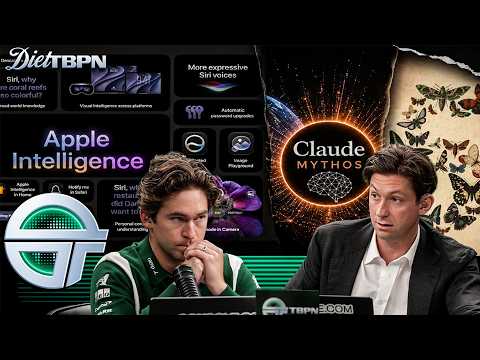
🚀 Apple's Siri Reboot, Meta's Welding Academy & The Pyongyang Miracle
📱 The 15-Year Arc: Siri's Full-Circle Moment
Tim Cook's final WWDC keynote landed with a touch of poetry: Siri, front and center, just as it was at his first as CEO in 2011. The original Siri pitch promised a device that could understand natural language — "What's the weather going to be like today?" — without rigid syntax or memorized commands. At the time, it was revolutionary. But the technology needed 15 years to catch up to the vision.
What's striking is the timing. Apple spent roughly 12 years building the infrastructure while the broader AI industry needed about the same timeline to reach large language model maturity. In that context, Apple is only about three years behind — or roughly 10% slower than the cutting edge. Not an eternity in absolute terms, but in AI development cycles, it felt like one.
"Steve Jobs passed away the day after the 'Let's Talk iPhone' event where Siri was announced. Tim Cook's tenure at Apple is bookended by Siri — on one side, its debut; on the other, its reinvention."
During Cook's reign, the company executed brilliantly on operations, monetization, and ecosystem expansion. The stock soared. Earnings compounded. But Siri languished through what can only be described as the greatest AI winter in history — from 2011 until the LLM explosion circa 2022-2023. It wasn't until ChatGPT and similar chatbots arrived that the gap became undeniable. By then, Apple was visibly behind. Now, they're catching up — and branding the resurgence as Siri AI, a nod to the original Stanford Research Institute roots that gave Siri its name.
🛡️ Parental Controls Take Center Stage
Apple devoted 12 minutes of a notably short keynote to child safety and parental control features — a significant allocation that signals where leadership sees both societal concern and business opportunity. The company rolled out:
- Brainwax child accounts with built-in age protections, limiting adult websites and curating age-appropriate media
- Ask to Browse, which sends a notification to parents before a child can visit a new website
- Communication controls that manage who children can contact and require confirmation before adding new contacts
This move comes as reasonable observers increasingly link smartphones to broader societal issues — including fertility decline, attention erosion, and youth mental health challenges. Derek Thompson and others have explored this terrain, with some estimates suggesting phones may account for roughly 30% of modern fertility decline factors.
Apple's approach is solution-first. Rather than fear-mongering about doom scenarios or apocalyptic forecasts (the way Tim Cook never discussed climate catastrophe before rolling out renewable energy for data centers), the company simply built robust tools and showcased them. The message to hesitant parents: you can trust us with your child's device. It's a smart hedge against the growing "dumb phone for kids" market and a values play that reinforces Apple's privacy-forward brand.
📸 Spatial Reframing: AI in the Camera Roll
Apple unveiled spatial reframing, a new photo editing tool that uses AI to adjust the angle of a photo after it's been taken. Shoot at an awkward tilt? The software can reframe it to appear straight-on. This feels less like "generative slop" and more like a natural evolution of computational photography — Apple's DNA of understanding emerging tech and deploying it elegantly.
That said, the feature sparked debate. Some see it as a welcome convenience. Others worry it blurs the line between reality capture and reality fabrication. Instagram's AI labeling policies will soon face a reckoning: when does a color grade become an AI edit? When does spatial reframing cross into "this photo never existed"? The answers remain fuzzy, but the questions are getting louder.
"Pretty soon, you take a photo in low light, upres it, apply a color grade, spatially reframe it, remove background clutter — and wind up with a completely different image. Some people are fine with that. Others are not."
🔐 Private Cloud Compute Goes Multi-Cloud
Apple extended its Private Cloud Compute infrastructure into Google Cloud, leveraging Nvidia GPUs while maintaining the same privacy guarantees Apple has staked its reputation on. The third iteration of Apple Foundation Models, AFM3 Cloud Pro — a reasoning model built in collaboration with Google and fine-tuned on or alongside Gemini — now runs in this expanded environment.
This is a quiet but significant shift. Apple, the privacy purist, is vending its trust model into Google's infrastructure. The optics could be tricky, but the execution appears rigorous. Apple's brand relies on users feeling confident that everything on their iPhone is secure — and they're extending that confidence into third-party compute environments.
⚙️ The Siri Button Controversy: Gurman vs. Gruber
A skirmish erupted between Bloomberg's Mark Gurman and Daring Fireball's John Gruber over Apple's strategy for integrating third-party AI assistants with Siri. In March, Gurman reported that Apple would open Siri to rival AI models like Claude, Gemini, and ChatGPT, allowing deeper integration beyond the existing "Hey Siri, ask ChatGPT" workaround.
Gruber suggested Apple either ran out of time, forgot to announce it, or scrapped and rebuilt the feature in the final weeks. Gurman fired back with screenshots showing a model picker dropdown in the Siri app, evidence that the integration exists in some form.
The real question isn't who's right — it's about expectations vs. reality. Hardcore AI users hoped they could fully remap the Siri button to their preferred model (e.g., ChatGPT by default). Currently, the workflow is clunky: ask Siri to relay a query to another model, then tap "OK" on a pop-up. The model picker suggests improvement is coming, but it's unclear whether the selection persists or resets per query. Either way, Apple's "Golden Gate" OS (a reference to maintaining their walled garden while mining endless value within it) keeps tight control over the experience.
🏗️ Meta Launches a Workforce Academy (Learn to Weld, Literally)
Meta announced a workforce academy to train Americans in skilled trades — specifically, to build data centers. The five-week program, offered free of charge in partnership with CBRE and the Associated Builders, guarantees participants a job upon completion.
This follows Meta's recent layoffs of 8,000 employees. The optics are stark: forget learning to code; it's time to pick up a wrench. As AI inference demands explode and data center construction becomes a bottleneck, skilled trades workers are now a sought-after commodity. The "learn to weld" meme has become corporate policy.
🏙️ North Korea Builds 10,000 Homes (More Than Los Angeles)
In one of the year's more surreal data points, North Korea's economy is booming — at least by its own standards. The regime reportedly built 10,000 homes, outpacing Los Angeles in new housing construction. The country is generating revenue by selling arms to Russia and China, expanding its nuclear arsenal, and evidently reading Abundance by Derek Thompson.
If the world's most sanctioned and isolated economy can out-build American cities on housing, the contrast is difficult to ignore. As one observer put it: "If they're doing it over there, what are we doing here?"
🤖 Claude Fable 5 Arrives; Test-Time Compute Keeps Scaling
Anthropic launched Claude Fable 5, its latest consumer-focused model, alongside Mythos, a variant optimized for cybersecurity applications. Early feedback highlights Fable 5's ability to run for extended periods — nine hours straight, entire weekends — without losing coherence or context.
Pricing stands at $10 per million input tokens and $50 per million output tokens. For heavy users, costs can rack up quickly, but the capabilities justify the expense for certain workflows.
Noam Brown's recent analysis on large-scale test-time compute offered a striking insight: performance plateaus are very far out, and sometimes don't appear at all within practical budgets. Andre Karpathy observed this in auto-research experiments where performance continued improving even after hundreds of iterations. Brown noted that a model might run longer than it takes to train the next version — a bizarre feedback loop where inference outlasts the training cycle of its successor.
"You launch a product, set it to work, and before it finishes the job, the next model is already trained and released. That's the world we're living in now."
🚨 Flock Safety's Real-World Impact: "Can't Even Do Drive-Bys Anymore"
A viral podcast clip featuring two individuals discussing crime in San Francisco revealed the on-the-ground impact of Flock Safety's surveillance and drone technology. One of the speakers, described as "one of the most prolific criminals in San Francisco," candidly explained that traditional methods — stealing a car, committing a crime, ditching the vehicle — no longer work.
Why? Drones immediately begin tracking stolen vehicles from thousands of feet up, invisible to those on the ground. Law enforcement can monitor in real time and box in suspects when they stop, eliminating the chance to flee. The speakers concluded: "You can't do crime in San Francisco anymore."
It's a stark data point on how AI-powered surveillance infrastructure is reshaping urban safety — and criminal strategy. Whether this clip will also serve as evidence in future cases remains an open question.
💰 Pat McAfee's $60M Deal & The ESPN Omni-Strategy
Pat McAfee is negotiating a contract extension with ESPN that could pay him more than $60 million per year, according to The Athletic. The 39-year-old host, who currently has two years remaining on his existing deal, could take on expanded responsibilities across NFL coverage and other programming.
McAfee already hosts a three-hour daily show, with the first two hours airing on ESPN and all three available on YouTube. He's also a panelist on College GameDay and has appeared across ESPN's portfolio. The new deal would be structured as both a production contract and a separate talent agreement — a model that differentiates McAfee from traditional on-air personalities and reflects his hybrid creator-broadcaster role.
His rise mirrors a broader shift in sports media: personalities who own their distribution, cultivate direct audience relationships, and negotiate leverage across traditional and digital platforms.
🔮 Final Thoughts
This week's developments underscore a few themes:
- Apple's patient build — waiting for the technology to mature, then executing with polish and privacy-first principles
- The convergence of AI, parental responsibility, and societal well-being — no longer abstract concerns, but features in a keynote
- Test-time compute scaling — performance improvements that seem endless, with plateaus perpetually out of reach
- Real-world AI deployment — from drones tracking stolen cars to models running longer than training cycles
As Tim Cook takes his final bow and Siri comes full circle, the industry is sprinting forward. The gap between vision and execution has never closed faster — and the stakes have never been higher.
More from TBPN
Travis Kalanick's Comeback: Building the Future of Physical AI with a $1.7 Billi
💼 The Deal: From Separate Companies to One Unified VisionTravis Kalanick announced a $1.7 billion fundraising round for...

The Great AI Trade War Heats Up: Open-Source vs. Security, Distillation Scandals
🔥 The Chinese AI Model ControversySilicon Valley and Washington are locked in a heated debate over a multi-billion doll...
Open-Source AI Shakes Markets, Compute Constraints Intensify, and Netflix Goes A
🔥 The Kimmy K3 Arrival: Open-Source AI's Frontier MomentThe AI community spent the weekend in heated debate following t...
Tyler Cowen on Open Source AI, The Rise of Teenage Entrepreneurs, and Why Europe
📊 Open Source AI: The Battle Already LostThe debate around open-source AI models like DeepSeek's latest release has spa...
Inkling Takes on the Frontier: Open-Weight AI, Distillation Drama, and TSMC's $1
📊 The Big PictureThe AI landscape shifted this week as Thinking Machines Lab, led by former OpenAI CTO Mira Murati, lau...
Fintech M&A Heats Up: Stripe's Bold PayPal Play, Consumer Hardware Ambitions, an
🔥 Stripe Makes $53 Billion Offer for PayPalIn a significant development for the fintech sector, Stripe has extended a f...