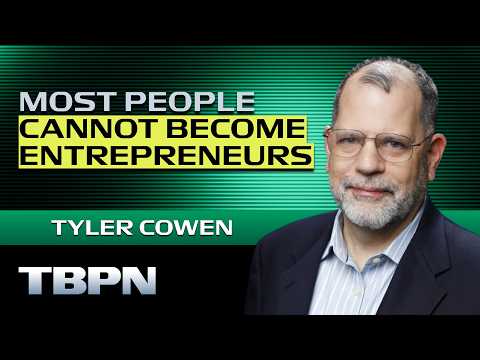
🧠 AI Maniacs, Vibes Sessions, and Why Coffee Addiction Is a Choice
📊 Open Source AI: The Battle Already Lost
The debate around open-source AI models like DeepSeek's latest release has sparked intense policy discussions, but economist Tyler Cowen argues the attempt to regulate or ban open-source AI is fundamentally doomed. Open source is coming whether policymakers like it or not — much of it from China — and American competitors should be allowed to compete on equal footing rather than face sanctions that simply won't work.
"What about multinationals? What about companies whose affiliates use open source? What about all the major US companies that use open-source Chinese products right now?"
The infrastructure requirements for running cutting-edge models — server racks full of NVIDIA chips, massive data centers — might seem like potential choke points for enforcement. But Cowen dismisses this leverage as temporary. When AI runs on-device, which may not be far off, even hardware-based restrictions become meaningless. The question isn't whether to ban it, but why go down that path at all when it's destined to fail.
Interestingly, Cowen frames open-source models as complementary to American AI dominance rather than competitive. People fear having American models "yanked" from them — partly due to US policy decisions — making them more willing to adopt open-source alternatives as insurance. Major American companies already use significant amounts of Chinese open-source code, often without advertising it. Pulling that out of their systems would be nearly impossible.
🏗️ Data Centers, Tariffs, and Europe's Pickle
The conversation turned to industrial policy and the physical infrastructure supporting AI development. Cowen lives in Northern Virginia, right next to major data center clusters, and he's enthusiastic about their presence. These facilities pay for half the taxes in their county, and he sees no reason to oppose their expansion despite public pushback elsewhere.
When asked about the automotive industry's lessons for this moment — particularly regarding tariffs and China's rise in electric vehicles — Cowen was blunt: "If Europe starts a major trade war with China, Europe will lose."
This assessment reflects poorly on Europe's inability to pivot from declining automotive manufacturing into other competitive sectors. Simply erecting tariff walls won't help Europe get where it needs to go — in fact, it will postpone necessary transitions. Those tariffs eventually apply to inputs for other industries, making them less competitive over time. Europe is, as Cowen puts it, "really in a pickle" with no obvious way out.
🚀 The Rise of AI Maniacs
Perhaps the most striking theme was Cowen's concept of "AI maniacs" — young people, often teenagers, who spend their spare time mastering AI, building models, and starting companies. These individuals know far more than their teachers and represent the future of medicine, law, business, consulting, and banking — wherever they're allowed to compete.
"I spoke to two teenagers this morning. One was 13, one is 17. Abu Dhabi, Finland. They're AI maniacs... They realize this is the future."
For AI maniacs to thrive, they need more than just access to models and compute. They need to be respected, allowed to rise to positions of authority, and given opportunities — whether that's buying computers, receiving grants, or having their expertise taken seriously rather than being looked down upon for their age. It's not automatic; countries vary widely on these metrics.
The United States does well here. Estonia, known for major government investments in high-speed bandwidth, also performs strongly. But many parts of the world remain too conservative to embrace young technical talent in meaningful ways. Not all countries will produce great AI innovation, just as not all countries made great rock and roll, even though the underlying technology is straightforward.
🇪🇺 Europe's Unexpected AI Maniac Advantage
Cowen revealed he's become more optimistic about Europe over the past six months, specifically regarding AI development. This comes as a surprise given Europe's historical pattern of losing top technical talent to America — the Collison brothers and Spotify being notable exceptions.
The difference? These young Europeans may yet move to America, but they're too young to go now. European kids weren't particularly interested in chatbots, but agents represent something genuinely new — a chance to do something that competes with established culture and institutions. Meanwhile, American kids have had opportunities for years. For European youth, AI agents represent something fresh and exciting.
Cowen expects "a lot of new companies from quite young people coming out of all of Europe, including Eastern Europe" and has adjusted his grant-making strategy accordingly: "With AI maniacs, I'm going younger and weirder."
😤 The Vibes Session Continues
The discussion touched on what Cowen calls "negative emotional contagion" — the disconnect between objective economic indicators and public sentiment. Wealth accumulation, job markets, stock prices, and real wages look okay to fine, yet consumer confidence remains deeply negative.
This phenomenon, sometimes called the "vibe session," shows up in polling where people report their neighbors are doing fine economically but claim they themselves are struggling. Trust in institutions has collapsed, partly because people were told "everything's okay" during COVID and the financial crisis when it wasn't.
"Right now people are just negative about many many things. They're negative about their country. They're negative about social institutions except the military."
Cowen sees parallels in other historical periods of negative emotional contagion. Once it takes hold, it's incredibly hard to reverse. Sometimes only a war or catastrophe can break the cycle — though he hopes that won't be necessary.
Paradoxically, this widespread negativity might make the economy more resilient if an actual downturn occurs. If everyone already thinks things are terrible, a brief recession might be met with: "Well, I already thought it was bad. It got a little worse, but I'm ready to reinvest." The cognitive dissonance between market performance and sentiment would finally resolve, potentially allowing people to move forward.
📈 AI's Economic Impact: Still Waiting
About a year ago, Cowen wrote that AI is real and amazing, but the economy would likely continue growing at roughly its historical pace — perhaps slightly faster. So far, he feels vindicated. Many people express surprise that despite having access to extremely capable models, "the world is not totally different."
Looking back to the productivity gains from IT advances between 1995 and 1998, the economy extracted about half a percentage point of extra growth — and those advances seemed less impressive than current AI capabilities. Cowen expects similar or slightly better gains from AI over time, though with "some slowness."
But there's a crucial caveat: "For all this talk of the leisure dividend from AI, right now we're still in a setting where most people have to work some amount harder." That will change eventually, but not immediately. The message for now? Get to work.
💼 Jobs, Sectoral Shifts, and Status Reallocation
The labor market data shows unemployment holding relatively steady, with significant hiring concentrated in healthcare — consistent with the "messy jobs" thesis. Notably, unemployment for 18 to 24 year olds has returned to pre-LLM levels, suggesting AI isn't destroying entry-level employment markets as feared.
Recent slowdowns in hiring are partly attributable to fewer immigrants entering the workforce. Overall, Cowen has been "pretty happy" — no recession on the horizon, and the economy keeps moving forward.
Yet complaints about job markets from educated young people remain loud. Cowen attributes this to major sectoral shifts creating jobs that educated, high-class workers may not want or be good at. These vocal complainants have the ear of the media, but "in the aggregate, a lot of other people are doing better."
The real disruption is coming: "The AI maniacs are about to take a huge leap upwards... There'll be this massive reallocation of status. It'll be very hard for our politics to handle that."
🎲 The Gambling Problem
When asked how big gambling could get, Cowen's response was stark: "It's already too big. I don't know how we pull it back in."
People obviously enjoy gambling — those who don't wreck their lives with it — or it wouldn't be so popular. But it's genuinely addictive for many. Unlike smoking, which created negative externalities (secondhand smoke) that built political will for restrictions, gambling happens privately on phones. Your neighbor could be gambling on a plane, and you'd never know.
Cowen wouldn't push a button to ban gambling even if he could; prohibition wouldn't work. Instead, he hopes norms will change, though he'd like to see an honest cost-benefit analysis weighing enjoyment against harm — something no one wants to do for obvious reasons. Restricting advertising, similar to tobacco, might help rein in the most aggressive growth, but the genie is largely out of the bottle.
🎬 Cultural Notes: The Odyssey Disappoints
Cowen saw Christopher Nolan's The Odyssey and found it disappointing relative to expectations, despite being "fantastic" compared to other movies. The dialogue felt lame, and the casting choices didn't work — Matt Damon "is not Odysseus," the actress playing Calypso "seemed like a suburban housewife," and Zendaya had no real role.
Still, everyone should see it, and the film's attention has pushed different translations of Homer's Odyssey onto bestseller lists. Classicists are "delighted to have any attention at all," so they won't complain too loudly. What's their alternative?
🔮 Looking Ahead
Several themes emerged that point toward significant structural shifts:
- Young founders will launch companies with very small employee counts but substantial revenue
- Religious and cultural fragmentation will accelerate as AI enables anyone to create custom belief systems with rituals, sacred texts, and practices
- Status hierarchies will be upended as AI maniacs compete in traditional professions
- Entrepreneurship remains the domain of a small, ambitious minority — most people prefer working in large institutions with better pay and lower risk
For those in organizations watching AI transform their industries, the advice is clear: Learn to work with leading models, follow developments closely, and embrace messier roles. It requires significant time investment because everything changes rapidly, but falling behind isn't an option.
As for billionaires concerned about public perception? Cowen quotes Jonathan Swift: "Censure is the tax a man pays to the public for the privilege of being eminent." Success breeds resentment. Building parks and monuments might help, but it won't make them loved. Better to keep going and not apologize.
☕ Final Thoughts
Tyler Cowen has only had coffee twice in his life — both times during traditional ceremonies in rural Ethiopia. He saw it as a peak experience he couldn't top and decided to avoid the addiction cycle entirely. Why create a dependency when you might find yourself in a hotel room making "crummy coffee" just to avoid a headache?
It's a fitting metaphor for his approach to technology, economics, and society more broadly: avoid false dependencies, stay intellectually nimble, and focus on what actually matters rather than what's merely habitual or fashionable.
More from TBPN
Inkling Takes on the Frontier: Open-Weight AI, Distillation Drama, and TSMC's $1
📊 The Big PictureThe AI landscape shifted this week as Thinking Machines Lab, led by former OpenAI CTO Mira Murati, lau...

Fintech M&A Heats Up: Stripe's Bold PayPal Play, Consumer Hardware Ambitions, an
🔥 Stripe Makes $53 Billion Offer for PayPalIn a significant development for the fintech sector, Stripe has extended a f...

Trillion-Dollar Club Expands, Zuckerberg's AI Gambit, and the Battle for Attribu
💾 SK Hynix Makes History with Record-Breaking U.S. DebutSouth Korean memory chip giant SK Hynix executed the largest-ev...

Markets Digest AI Chip Giant's Debut, Zuck's Data Moat & the Week's Wildest Stor
💎 SK Hynix Makes History with Record-Breaking NASDAQ DebutSK Hynix completed the largest-ever first-time US share sale ...

Blue Origin's Historic Fundraise, Getty's Failed Merger, and the Great GPT-5.6 S
🚀 Blue Origin's $10 Billion Raise: Jeff Bezos Doubles Down on SpaceAfter 25 years of self-funded development, Blue Orig...
From DirectX Dominance to Game Pass Disaster: The Strategic Unraveling of Xbox
📊 The Three Screens Strategy That Never WasMicrosoft's Xbox journey represents one of corporate tech's most fascinating...