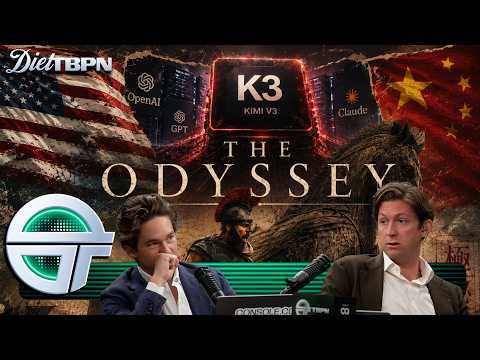
🤖 Kimmy K3 Drops, AI Cold War Heats Up, and Hollywood's Director-Driven Renaissance
🔥 The Kimmy K3 Arrival: Open-Source AI's Frontier Moment
The AI community spent the weekend in heated debate following the unveiling of Moonshot's Kimmy K3 on Thursday. While the model's weights remain gated behind an app—with an expected Monday release—the benchmarks have already sparked intense discussion about the trajectory of open-source AI and the widening gap (or lack thereof) between frontier labs and Chinese competitors.
The headline performance metrics are impressive but not wildly surprising based on current trend lines. What's notable is that Kimmy K3 appears to invalidate the thesis that open-source models would fall permanently behind closed counterparts. Previous government projections showed closed models accelerating ahead, but Kimmy represents a proper catch-up moment—something many lab leaders predicted would maintain a stable gap of three to nine months rather than widening indefinitely.
📊 Two Narratives: Innovation vs. Geopolitical Warfare
There are two dominant interpretations of what Kimmy K3 represents:
- The Bull Case: A team of highly talented AI researchers marshaled enough compute to release a great model. Open-sourcing drives attention, attracts talent, and fuels demand for hosted API services—a proven business model exemplified by Red Hat Linux, which IBM acquired for approximately $30 billion. Companies pay for consulting, hosting, and managed services around open-source software.
- The Bear Case: Compute may have been smuggled into China against chip controls. Training data could have been exfiltrated from frontier lab APIs through intermediary companies. Some speculate this is a distillation attack—or even deliberate geopolitical warfare designed to undermine American AI companies. There are whispers of potential espionage and IP theft.
The reality is likely a mix of both scenarios. Over time, more statements from labs and participants will clarify the situation. Early claims that Kimmy would identify itself as "Claude" or "GPT" when prompted appeared dubious—some examples seemed photoshopped, and such issues are trivially fixable through fine-tuning or prompt engineering.
⚡ Compute Constraints and Capacity Crunch
Over the weekend, Moonshot posted on X that Kimmy K3 has received far more love than expected, pushing demand close to the limits of current GPU capacity. To protect the experience of existing subscribers, the company temporarily paused new subscriptions, prioritizing compute for current members while adding capacity in batches.
This underscores a broader reality: the world remains severely compute-constrained. Despite limited mainstream AI adoption, capacity bottlenecks are already hitting hard across land for data centers, permits, electricity, grid connections, chips, construction, and cooling. Demand is growing far faster than supply, and expanding infrastructure is insanely expensive.
"Almost nobody is seriously using AI today and we're already hitting capacity. Everything is a bottleneck." — Nicholas Bamonte, Microsoft
In this environment, companies with massive net income from non-AI products—like Microsoft—hold a structural advantage. They can fund hundreds of billions in capex to build out the necessary infrastructure.
🛡️ Cybersecurity Implications and the Safety Debate
One area where Kimmy K3 has drawn particular attention is cybersecurity. Early testing suggests the model is top-tier at cyber tasks, raising questions about what happens when these capabilities become widely accessible. Fortunately, defenders have had roughly six months of frontier exclusivity with tools like GPT Cyber and Mythos, allowing time to patch vulnerabilities.
Still, the implications are significant. A highly intelligent model capable of reasoning traces and customized research means phishing attacks and spam can become far more sophisticated. Instead of generic messages, hackers could craft highly personalized attacks—knowing your insurance provider, your agent's name, and other contextual details. While advanced defense layers will emerge, the arms race is accelerating.
From a broader safety perspective, the AI safety community has been notably quiet. It's reasonable to expect that the "stop AI" protests might eventually redirect their attention toward Beijing and Moonshot directly—though regulatory pressure on open-source AI remains a thorny issue.
🌐 Open Source: Punk Rock or Strategic Blindness?
There's something culturally appealing about open-source AI. It evokes the early internet ethos—liberating information, empowering individuals, and democratizing access. The idea of a solar-powered server rack serving unstoppable intelligence feels aligned with both American ideals and the cryptonative mindset.
"It feels like the Second Amendment for intelligence."
Yet this cultural alignment creates tension with national security concerns. Dean Ball noted his surprise that the Chinese state continues to allow open-sourcing of models this capable, given potential risks. He speculates that 75% of the reasoning is strategic blindness or lack of AGI awareness within the CCP, which maintains a "lean" view of AI. The remaining 25% may be explained by compute constraints for customer inference—making open-source an unintended byproduct of U.S. export controls.
China's open-source strategy also reflects a pragmatic reality: few people would pay for sub-frontier models from China. Sending corporate data to an American frontier lab already raises concerns—uploading an entire codebase to a Chinese API would be an even harder sell for most enterprises.
💰 The Capex Debate: Does Open Source Deter Investment?
One controversial take from Dean Ball: open-weight models are inherently decelerationist. His argument is that while open models create a cloak of ungovernability—which accelerationists appreciate—they also deter further AI capex.
The logic: if frontier models can be distilled or copied within months, the incentive to fund massive training runs weakens. Moonshot recently raised approximately $1 billion, and while training runs are expensive, the core runs may not yet be approaching the $50 billion scale some have speculated about. Investors may hesitate to fund such runs if the window for monetization is shrinking.
That said, there remains strong demand for frontier intelligence, near-frontier models, and ultra-cheap older models baked down to "intelligence too cheap to meter." Even companies that rank tenth in their category are growing faster than almost any company that existed six years ago—suggesting the deployment gap remains massive.
🎬 Hollywood's Director-Driven Renaissance
While AI dominated the weekend discourse, Christopher Nolan's The Odyssey also made waves. The film opened to an estimated $264 million worldwide, with a domestic debut of $124 million—the third-biggest opening of the year for any film, trailing only animated releases like Toy Story 5 and Super Mario Galaxy.
What's striking is that 53% of attendees cited the director as their number one reason for attending—not the actors, not the IP, not the spectacle. This marks a shift in Hollywood's power dynamics. For years, franchises dominated: Marvel, Star Wars, Fast and Furious, and Transformers. But audiences—especially Gen Z—have grown skeptical of aging brands and technology-driven filmmaking.
"Gen Z is more drawn to stories told by an authentic, recognizable filmmaker with a point of view."
Studios are responding by devoting more energy to signing promising filmmakers. Warner Brothers gave Black Panther and Creed director Ryan Coogler a generous deal for his original horror film Sinners, which became a hit. Barbie director Greta Gerwig is now adapting The Chronicles of Narnia for Netflix.
Nolan's latest success underscores this trend. With a $375 million budget ($250 million production, $125 million marketing), The Odyssey is projected to generate approximately $250 million in pre-tax lifetime profit for Comcast and Universal—though this represents just 0.2% of Comcast's market value.
🎥 Netflix Goes All-In on Generative AI
Netflix disclosed that it has used Generative AI in approximately 300 productions this year, spanning the entire production life cycle from concept and previsualization through post-production and delivery.
"Generative AI workflows have been used in roughly 300 of our titles, with the largest concentration of work in post-production."
One clear example: The American Experiment, a docuseries about the American Revolution, included 17 minutes of AI-enhanced footage. Co-CEO Ted Sarandos said the AI work expanded the scale of the project in ways that would not have been financially feasible using traditional methods.
Netflix insists AI is not replacing writers, directors, actors, or other creative professionals. Instead, the company positions the technology as the next evolution of filmmaking software—allowing productions to create shots and sequences that were previously impossible or prohibitively expensive.
🔮 What's Next?
All eyes are on Monday—the day Moonshot is expected to release the Kimmy K3 weights. If the U.S. government intends to take action—whether a hard ban, soft ban, or messaging campaign—this is the week to do it. Meanwhile, the compute crunch intensifies, the cybersecurity arms race accelerates, and the debate over open-source AI's role in the broader geopolitical landscape continues to evolve.
In Hollywood, the director-driven renaissance is underway, and in streaming, generative AI is becoming a standard production tool. Across markets, the message is clear: we are supply-constrained, demand is surging, and the infrastructure to support it all is struggling to keep pace.
More from TBPN
Tyler Cowen on Open Source AI, The Rise of Teenage Entrepreneurs, and Why Europe
📊 Open Source AI: The Battle Already LostThe debate around open-source AI models like DeepSeek's latest release has spa...
Inkling Takes on the Frontier: Open-Weight AI, Distillation Drama, and TSMC's $1
📊 The Big PictureThe AI landscape shifted this week as Thinking Machines Lab, led by former OpenAI CTO Mira Murati, lau...

Fintech M&A Heats Up: Stripe's Bold PayPal Play, Consumer Hardware Ambitions, an
🔥 Stripe Makes $53 Billion Offer for PayPalIn a significant development for the fintech sector, Stripe has extended a f...

Trillion-Dollar Club Expands, Zuckerberg's AI Gambit, and the Battle for Attribu
💾 SK Hynix Makes History with Record-Breaking U.S. DebutSouth Korean memory chip giant SK Hynix executed the largest-ev...

Markets Digest AI Chip Giant's Debut, Zuck's Data Moat & the Week's Wildest Stor
💎 SK Hynix Makes History with Record-Breaking NASDAQ DebutSK Hynix completed the largest-ever first-time US share sale ...

Blue Origin's Historic Fundraise, Getty's Failed Merger, and the Great GPT-5.6 S
🚀 Blue Origin's $10 Billion Raise: Jeff Bezos Doubles Down on SpaceAfter 25 years of self-funded development, Blue Orig...