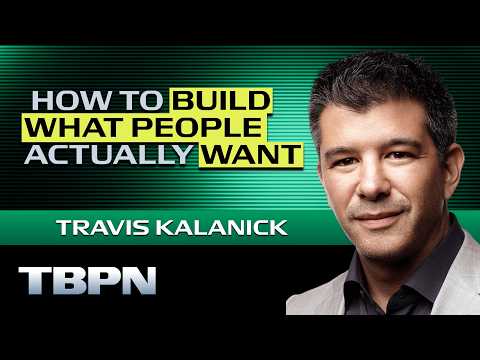
🚀 Travis Kalanick Returns: $1.7B Raise, Mining Robots & The Next Industrial Revolution
💼 The Deal: From Separate Companies to One Unified Vision
Travis Kalanick announced a $1.7 billion fundraising round for his latest venture, marking one of the largest capital raises in the physical AI space. The round consolidates what were previously separate operating entities—spanning food automation, autonomous mining, and transport—into a single corporate structure.
The consolidation came after investor feedback revealed a clear pattern: investors wanted exposure to Kalanick himself rather than picking individual verticals. "They're just like, 'We want to invest in you,'" Kalanick noted, describing how the first five potential investors all expressed the same sentiment.
The round was led by Andreessen Horowitz (a16z), with Kalanick calling it "unfinished business"—a reference to the fact that a16z never invested in Uber during his tenure. The capital raise isn't finished either: Kalanick hinted at a likely second close, noting his phone was "blowing up" post-announcement.
⛏️ The Mining Play: Autonomous Operations in Extreme Environments
The most developed piece of Kalanick's industrial AI empire is Pronto, an autonomous mining operation that's already generating significant traction. The value proposition is straightforward but powerful: mines can increase their output by 20-40% while simultaneously reducing operating expenses and improving safety.
How it works: Pronto retrofits existing mining equipment—some machines over 20 years old—with sensors, compute systems, and mechanical actuators to enable autonomous operation. This approach avoids the massive capital expenditure of replacing entire fleets, instead making existing assets dramatically more productive.
"Would you like to have 20% more gold per year? We haven't heard no."
The go-to-market strategy involves physically deploying to remote mining sites around the world. Kalanick described recent trips to deep northern Brazil to work with Vale at what he called "the world's largest iron ore mine"—a site so vast that a helicopter tour takes 30 minutes to cover just one section. He also visited a phosphate mine on the Saudi-Iraqi border, where GPS jamming required pilots to land using visual navigation.
The technology has crossed a critical threshold: Pronto's autonomous systems now exceed human-level productivity. This milestone has changed the sales dynamic entirely. The company is moving from pilot programs to full fleet deployments as mines recognize the proven benefits.
🏭 The Business Model: Enterprise Software Meets Heavy Industry
Kalanick applies lessons from enterprise software to the mining industry. The approach mirrors traditional SaaS pricing but adapted for physical operations:
- Baseline pricing for the autonomous system installation and operation
- Performance-based upside when productivity gains are demonstrated
- Standard enterprise negotiations around value capture versus value creation
The key principle: "You never go to a customer and say, 'Give me a percentage of your stuff.'" Instead, the model focuses on fixed pricing with potential bonuses for exceptional outcomes.
The productivity gains come from multiple sources:
- Per-hour efficiency: Machines operate more effectively when autonomous
- Uptime improvements: Elimination of shift changes, callouts, and human scheduling constraints
- Safety protocol optimization: Reduced risk enables operational changes that further boost efficiency
For gold, lithium, and other high-value minerals, the math is compelling. For lower-margin operations like quarries (primarily serving the cement industry), the play shifts more toward operating expense reduction since there are practical limits to production volume based on customer demand.
🤖 The Technology Stack: Making Old Iron Smart
The technical challenge is substantial. Most mining equipment wasn't designed for autonomy—these are 2-million-pound machines moving at 35 miles an hour in off-road conditions. Many use mechanical or hydraulic steering systems rather than drive-by-wire technology.
Pronto's solution involves:
- Physical actuation systems that interface with mechanical controls
- Sensor arrays for perception and navigation
- Onboard compute for real-time decision making
- Orchestration systems that coordinate multiple autonomous vehicles across the mine site
The deployment process includes installation, commissioning (ensuring the system works correctly in each new environment), and change management—helping mine operators transition from human-centered workflows to autonomous operations.
The ultimate vision is what the mining industry calls a "no entry mine"—a facility where humans never enter the actual pit. People might work in control centers, but the dangerous, physical work happens entirely through autonomous systems covering drilling, blasting, loading, hauling, and crushing.
🍕 The Food Play: End-to-End Automation
While less discussed in this conversation, Kalanick's food automation business represents a parallel bet on industrial AI. The strategy is full-stack transformation: automated manufacturing of food, robotic facilities, and autonomous delivery.
The delivery component involves what Kalanick calls "autonomous burritos"—temperature-controlled boxes on wheels that can deliver food at a fraction of current costs. While platforms like Uber Eats or DoorDash might charge around $12 per delivery, Kalanick suggests the autonomous version could operate at $0.75 per drop.
🚚 The Transportation Thesis: Wheelbase for Everything
Underpinning both mining and food is what Kalanick calls "wheelbase for robots"—the fundamental technology for specialized industrial robots that move and act in the physical world.
The approach is explicitly non-humanoid. For high-scale industrial tasks, specialized wheeled robots make more sense than general-purpose humanoid forms. This leads to a portfolio of autonomous vehicles:
- Freight vehicles for supply chain and long-haul transport
- Last-mile delivery robots for food and goods
- Mining haul trucks for moving materials
- Specialized equipment like graders, water trucks, and forklifts
Kalanick pointed to forklifts as a massive opportunity, noting he's aware of a company spending $3.5 billion annually on forklift labor across their facilities.
📊 The Economic Philosophy: Jobs, Tasks, and Jevons Paradox
Kalanick's view on automation and employment centers on a fundamental economic principle: when prices fall, demand expands, creating new opportunities.
The logic chain:
- Automation reduces the cost of production
- Lower costs mean consumers have more disposable income
- That surplus capital flows to other goods and services
- Since robots don't have bank accounts, all that money ultimately goes to humans
- New categories of work emerge that we can't predict today
"The things that get automated go down in price, which then creates surplus to do other things... And as long as humans still have things that we do that robots cannot, it's go-time."
He acknowledged the distinction between jobs and tasks—noting that many roles involve multiple functions beyond the automatable core. A truck driver doesn't just steer; they provide security (30% of truck drivers are armed), perform maintenance, and handle logistics. Automation of one task doesn't necessarily eliminate the entire job.
🎯 The Hiring Philosophy: Problem Solvers Over Process Managers
Kalanick shared a clear framework for executive hiring that prioritizes problem-solving ability over organizational management.
The challenge: executives typically excel at either strategic problem-solving or organizational management, but rarely both. Kalanick believes "the most important thing" is problem-solving capability, because organized execution of bad solutions is worse than messy execution of good ones.
His management philosophy: "The only constraint on your imagination is management capacity." But he redefines management capacity as "problem solving at scale."
This leads to a "problem solver in chief" model:
- Kalanick focuses on the most impactful unsolved problems
- Direct reports become deputized problem solvers for their domains
- This cascades through the organization
- Time allocation shifts based on where problems emerge
For interviewing, the approach is to simulate actual working conditions during the hiring process. The goal: make day one feel like week two, so candidates arrive already excited and calibrated to the actual work.
⚖️ On Regulation: Federal Preemption and Regulatory Capture
Kalanick offered a blunt take on regulatory strategy: "Federal preemption is good when you are pro-regulatory capture. When you want to squeeze others out, you should get federal regulatory bigness going for you."
He contrasted this with Uber's approach, claiming the company "basically never proposed or pushed any rule that would be beneficial to us versus somebody else." Instead, the strategy was to open markets and compete on merit.
He warned about "closeweight things"—likely a reference to AI companies that simultaneously claim their technology is dangerous enough to require heavy regulation while positioning themselves as the solution. This creates a convenient barrier to competition.
On transportation specifically, Kalanick argued that "every bad thing that you see in transport, like systemically, anything in transport that you view as systemically bad was most likely pushed by the trial lawyers and the insurance companies."
The mechanism: both groups benefit from accidents. Trial lawyers profit from litigation, while insurance companies make margin on claims within their actuarial tables. He recalled how DC taxi liability was capped at around $25,000 per ride, but regulations pushed Uber's coverage to $1.5 million—creating a larger target for litigation while generating more insurance premiums.
🎨 The Inspiration: Science Fiction as Blueprint
When asked about science fiction as inspiration, Kalanick cited Isaac Asimov's Foundation series as a favorite, particularly for its treatment of robotics and AI.
On the Three Laws of Robotics and AI safety, his view is pragmatic rather than philosophical: "If you build something that people don't like, I don't think you're going to succeed."
This ties to his entrepreneurial experience: failed products fail because nobody wants them. He extends this to AI safety—if you build something anti-human or that doesn't serve people's interests, market forces will kill it.
"If you make something that is anti-human, if you make something that doesn't serve people, I don't think you're going to make it."
He noted that current AI systems are "almost too eager" to please humans, which provides a natural alignment mechanism—at least for now.
🌊 The Lifestyle: Jet Skiing to Work at 70 MPH
Perhaps the most memorable detail: Kalanick claims a 5-minute commute to work on a jet ski, sometimes reaching speeds of 70 miles per hour. He's looked into it and believes he's the "only CEO at a thousand-person-plus company commuting to work on a jet ski."
This isn't just a transportation choice—it's become a team-building activity. Kalanick is teaching engineers and founders how to water ski and wake surf, with sessions at 7:30 AM most mornings, often followed by another session at 8:30 PM after leaving the office.
He even taught someone who didn't know how to swim to wake surf (with a life jacket). It's a distinctive approach to company culture—literally pulling people behind boats on the lake as preparation for building the future of industrial automation.
🔮 What's Next: Industrial AI Goes Mainstream
With $1.7 billion in capital (and likely more from a second close), Kalanick is positioned to execute on a vision of industry-by-industry transformation through physical AI.
The thesis is clear:
- Start with proven verticals where the technology exceeds human performance
- Deploy full-stack solutions rather than point products
- Scale through enterprise sales with clear ROI metrics
- Expand to adjacent use cases using shared technology platforms
The rebranding from "physical AI" to "industrial AI" signals a focus on large-scale, high-stakes applications rather than consumer robotics or humanoid development. This is about automating entire industries—mining, food production, logistics—with specialized machines optimized for specific tasks.
The ultimate vision echoes Asimov but with a distinctly Kalanick twist: a world where robots handle the dangerous, repetitive, large-scale work, freeing humans to focus on what robots can't do—while ensuring that all the economic surplus flows back to people, not machines.
It's an ambitious bet that the future of AI isn't in chatbots or humanoid assistants, but in 2-million-pound trucks autonomously hauling gold through the Amazon.
More from TBPN

The Great AI Trade War Heats Up: Open-Source vs. Security, Distillation Scandals
🔥 The Chinese AI Model ControversySilicon Valley and Washington are locked in a heated debate over a multi-billion doll...
Open-Source AI Shakes Markets, Compute Constraints Intensify, and Netflix Goes A
🔥 The Kimmy K3 Arrival: Open-Source AI's Frontier MomentThe AI community spent the weekend in heated debate following t...
Tyler Cowen on Open Source AI, The Rise of Teenage Entrepreneurs, and Why Europe
📊 Open Source AI: The Battle Already LostThe debate around open-source AI models like DeepSeek's latest release has spa...
Inkling Takes on the Frontier: Open-Weight AI, Distillation Drama, and TSMC's $1
📊 The Big PictureThe AI landscape shifted this week as Thinking Machines Lab, led by former OpenAI CTO Mira Murati, lau...

Fintech M&A Heats Up: Stripe's Bold PayPal Play, Consumer Hardware Ambitions, an
🔥 Stripe Makes $53 Billion Offer for PayPalIn a significant development for the fintech sector, Stripe has extended a f...

Trillion-Dollar Club Expands, Zuckerberg's AI Gambit, and the Battle for Attribu
💾 SK Hynix Makes History with Record-Breaking U.S. DebutSouth Korean memory chip giant SK Hynix executed the largest-ev...