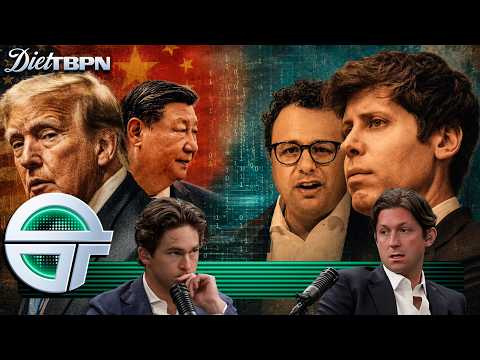
🇨🇳 Chinese AI Models Trigger DC Panic — Plus: Houseboats > Rent & Airplane Seat Recline Ethics
🔥 The Chinese AI Model Controversy
Silicon Valley and Washington are locked in a heated debate over a multi-billion dollar question: Should American companies be allowed to use Chinese artificial intelligence models?
For years, this hasn't been controversial. But now, with China releasing increasingly powerful and inexpensive AI models, the calculus has shifted. Open AI and Anthropic executives are sounding alarms, warning that cheap Chinese AI could lead to what one executive called "a dystopian AI future" and present "unacceptable security risks without regulation."
At the center of the storm are two newly released Chinese models: Moonshot AI's Kimmy K3 and Alibaba's Qwen 3.8 Max. Both models are described as "openweight" — not yet fully open-source, but available for users to download and customize with company data for specific tasks. Early benchmarks show Kimmy K3 is competitive with leading US models on some tests.
Dean Ball, OpenAI's head of strategic futures: "One probable outcome of an openweight model dominant world is full AI communism, which is precisely what China proposes rather than a market product. AI is a public good, which will ultimately be provided by the state as a kind of digital public infrastructure."
Ball, a former Trump administration official, later clarified that he wasn't advocating for US government intervention to discourage Chinese AI, but was simply outlining a likely scenario. His comments sparked significant backlash online, with critics accusing OpenAI of regulatory capture — using policy advocacy to eliminate competition.
🛡️ Security Hawks vs. Open-Source Advocates
The Trump administration remains divided on how to respond. David Sacks, the venture capitalist and White House AI advisor, pushed back hard against Ball's framing, calling it a "confession to a regulatory capture strategy." He argued that "the weaponization of regulatory uncertainty as a competitive tool should be completely unacceptable."
Meanwhile, Treasury Secretary Scott Bessent weighed in on Fox News, offering a middle path:
"This administration supports open source models, but what we do not support is IP theft. If we see, especially that overseas models are stealing from our great companies, we have the ability to sanction them because of this theft."
Security-focused officials have reportedly considered a range of countermeasures, including:
- Adding Chinese AI companies to trade blacklists
- Issuing security warnings on Chinese AI firms
- Drafting a potential executive order targeting open models
However, enforcement remains a major challenge. As one industry observer noted, "the solution to piracy was not really to ban piracy" — instead, services like Spotify and Netflix offered better user experiences that rendered piracy largely irrelevant. The question is whether a similar dynamic could play out here, or whether national security concerns will drive harder regulatory action.
📊 Distillation Debate: Did China Copy US Models?
A new controversy emerged when AI researcher Lissan Algib shared analysis suggesting that Kimmy K3 may have been distilled from leading US models, including Anthropic's Opus and Claude Sonnet variants.
The analysis used semantic similarity metrics — essentially comparing the "diction and phrases" models use when responding to prompts. The results showed strong correlations between Kimmy K3 and several Anthropic models (Opus 4.7, Opus 4.8, Sonnet 5, and Fable 5), while OpenAI's GPT models appeared more distinct.
Important caveats: The analysis was based on a limited set of prompts and doesn't definitively prove distillation occurred. Models could show similarity simply by using similar post-training techniques or architectural choices.
Still, the debate underscores a key tension: distillation violates the terms of service of most frontier AI models, but enforcement against Chinese companies would be extremely difficult. As one analyst put it, enforcement would require serving legal papers to Chinese executives — "a complete and total waste of time. Ask anyone who's built a product that's been knocked off or farmed."
🇨🇳 China Considers Export Controls of Its Own
In a twist, China's Ministry of Commerce (MOFCOM) has reportedly held discussions with AI companies including Alibaba, ByteDance, and others about limiting the transfer of key training data overseas and restricting how their model weights can be downloaded.
According to the Financial Times, China would still allow overseas customers to access the models and services, but may not make the weights fully open. This would mirror the approach taken by US companies like OpenAI and Anthropic, which offer API access but don't release full model weights.
The critical test will come next week, when Kimmy K3 is expected to potentially release its weights. Whether China follows through on full open-source or pulls back will send a strong signal about the future of the AI race.
💸 The Economics of Open vs. Closed AI
At the heart of this debate is a fundamental business model question: If everyone uses AI systems that people largely don't pay for, there would be no way to finance continued frontier AI development.
Top-tier AI companies have raised billions of dollars to pay for the vast computing resources needed to train cutting-edge models. If open-source models from China or elsewhere undercut their pricing power, the logic goes, private investment in frontier AI could dry up.
However, advocates of open-source AI argue that value will still accrue elsewhere in the stack — particularly to compute infrastructure and data centers. Even in an "AI communism" scenario at the model level, cloud providers and specialized compute vendors would still earn reasonable margins.
Use of Chinese models, which are far cheaper than US counterparts, is already surging at US companies, prompting investors to question the staying power of leaders like Anthropic and OpenAI. The threat of new players vastly undercutting pricing pushed down some tech and AI company stock prices last week.
🔒 Cyber Defense: The Flashpoint Issue
One area where there's broader consensus on risk is cybersecurity. Open models with advanced cyber capabilities that are free to download could enable sophisticated attacks with minimal barriers to entry.
Anthropic CEO Dario Amodei has repeatedly warned about this risk, recently telling Bloomberg that "having AI models with advanced cybersecurity capabilities that are free to download could be harmful."
The good news: closed-source models have been available to cybersecurity firms and major enterprises for months. Finance industry players, for example, have had access to tools like Anthropic's Mythos and GPT Cyber for almost six months. Just this week, Google announced Flash Cyber, a fine-tuned model designed to bring down the cost curve for cyber defense.
While early versions like Mythos GPT Cyber delivered impressive results — one executive reportedly spent "a million dollars to find some zero-day bug and it was totally worth it" — that price point is prohibitive for smaller companies. Google's Flash Cyber aims to democratize access at a fraction of the cost.
🤖 The "Great Slop Wars" Continue
Shifting gears to content quality, Substack announced a new AI detection feature via an integration with Pangram. Users will soon be able to scan posts, replies, and comments on the Substack app to see an estimate of how much content was written by a human versus AI.
"We care about this at Substack because it gets to the core of our mission to build an economic engine for culture."
The move reflects growing concern about AI-generated content flooding platforms. However, the revealed preference of readers may be more pragmatic: if the content is good and they enjoy it, they may not care whether it's human-written.
The broader question of disclosure remains thorny. Should Substack writers disclose when they use AI assistance or hire ghostwriters? Some argue yes — after all, book authors don't always disclose ghostwriters, but transparency is increasingly expected in digital media. Others suggest putting it somewhere — like mentioning you have a team of people helping create your work — without necessarily leading with it.
📚 "No One Will Read AI Novels"
Dave Eggers, the acclaimed author of A Heartbreaking Work of Staggering Genius and The Circle, took to the Financial Times with a bold prediction: "Gullible and ridiculous. No one will read AI novels."
The reality, however, is that people are already reading AI-generated novels — whether they know it or not. Perhaps Eggers means that "no one cool" or "no one serious about literature" will read them. But as AI writing tools improve, the line between human and machine authorship will only blur further.
Eggers made these comments from an appropriately unconventional setting: aboard his 23-foot sailboat moored in the shadow of San Francisco's Golden Gate Bridge, where birthing fees are negligible — making it "one of the cheapest places to live in uber-wealthy Silicon Valley."
🏠 Houseboats: The Ultimate Bay Area Housing Hack?
Speaking of creative housing solutions, the newsletter took a detour into what may be the ultimate cost-saving move for Bay Area tech workers: living on a houseboat.
A brand-new 2022 houseboat can be financed for approximately $1,483 per month through Boat Trader, significantly less than the average one-bedroom rent in San Francisco, which runs $2,000 to $3,000 per month. For around $200,000, you can secure a floating home with features like:
- Two cabins and one head (bedroom/bathroom)
- Air conditioning with reverse cycle heat
- Heated floors
- LED lighting throughout
- Upper deck terrace with flexi-teak flooring
- Foam-filled composite floats and galvanized steel subframe for durability
For those willing to go bigger, a 36-foot 2024 La Mer Modern 11 houseboat — complete with two Yamaha 25 high thrust engines providing 50 horsepower — can be financed for just $2,259 per month with $52,000 down.
This might just be where the next great startup is born. Garages are out; houseboats are in.
✈️ Airplane Seat Etiquette: The Great Recline Debate
Finally, the newsletter tackled one of modern travel's most contentious questions: Should you recline your airplane seat?
A 2014 survey by 538 found that 41% of flyers thought reclining was rude. By 2020, that number had jumped to 77% in a similar survey conducted by travel statistics writer Eric Jones.
The argument against reclining: "Just because you can do it doesn't mean you should." Reclining infringes on the limited space of the person behind you, particularly on long flights when everyone is cramped.
The argument in favor: "They put the button there. If they didn't want you to use it, they'd just take it away." Plus, if everyone reclines, it's a conservation of space — everyone gets the same amount of room, just at a more comfortable angle.
The verdict? The pro-recline camp argues that the vertical seat is objectively less comfortable than the reclined position. If the feature exists, everyone should commit to comfort. The anti-recline camp counters that it's antisocial behavior regardless of whether the button exists.
Either way, the debate rages on — much like the broader questions of AI regulation, open-source vs. closed models, and the future of innovation in an increasingly fractured global tech landscape.
🚀 Ramp Launches Model Router
In product news, Ramp announced the launch of a model router, a move that has industry observers excited about potential new product categories.
Ramp's core promise has always been to save CFOs time and money. Increasingly, finance leaders are frustrated by the complexity and cost of token routing — using expensive frontier models for trivial tasks like checking the weather burns through budgets unnecessarily.
Ramp's model router aims to intelligently route queries to the most cost-effective model for the task at hand. The product is currently in alpha with select customers and is reportedly available to non-Ramp customers as well, meaning you can use the router as a standalone product.
One observer called it "god tier product expansion," noting that "this is the first time I've looked at a launch and went, 'Wow, this might be the start of a new core product.'"
The AI trade war is heating up. Open-source advocates and security hawks are squaring off. Distillation scandals are brewing. And through it all, the fundamental question remains: In a world of cheap, powerful AI models, how do you sustain the economics of frontier research?
Stay tuned. This story is far from over.
More from TBPN
Open-Source AI Shakes Markets, Compute Constraints Intensify, and Netflix Goes A
🔥 The Kimmy K3 Arrival: Open-Source AI's Frontier MomentThe AI community spent the weekend in heated debate following t...
Tyler Cowen on Open Source AI, The Rise of Teenage Entrepreneurs, and Why Europe
📊 Open Source AI: The Battle Already LostThe debate around open-source AI models like DeepSeek's latest release has spa...
Inkling Takes on the Frontier: Open-Weight AI, Distillation Drama, and TSMC's $1
📊 The Big PictureThe AI landscape shifted this week as Thinking Machines Lab, led by former OpenAI CTO Mira Murati, lau...

Fintech M&A Heats Up: Stripe's Bold PayPal Play, Consumer Hardware Ambitions, an
🔥 Stripe Makes $53 Billion Offer for PayPalIn a significant development for the fintech sector, Stripe has extended a f...

Trillion-Dollar Club Expands, Zuckerberg's AI Gambit, and the Battle for Attribu
💾 SK Hynix Makes History with Record-Breaking U.S. DebutSouth Korean memory chip giant SK Hynix executed the largest-ev...

Markets Digest AI Chip Giant's Debut, Zuck's Data Moat & the Week's Wildest Stor
💎 SK Hynix Makes History with Record-Breaking NASDAQ DebutSK Hynix completed the largest-ever first-time US share sale ...