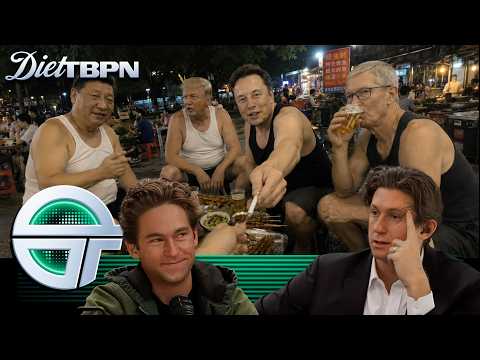
🌐 Trump-Xi Summit in Beijing: Tech Titans, Tariff Truces & The Taiwan Question
🛫 The Power Players Land in Beijing
The biggest geopolitical event of the week unfolded on the cover of the Wall Street Journal: the Trump-Xi Summit in Beijing. President Trump arrived with an unprecedented delegation of America's most powerful business leaders, creating what may be the most significant US-China diplomatic moment of his second term.
The roster reads like a who's who of American corporate power:
- Elon Musk (Tesla)
- Tim Cook (Apple)
- Jensen Huang (Nvidia)
- Kelly Ortberg (Boeing)
- David Solomon (Goldman Sachs)
- Steven Schwarzman (Blackstone)
- Larry Fink (BlackRock)
- Jane Fraser (Citi)
- Dina Powell McCormack (Meta)
The selection itself sends a clear message: this isn't just about diplomacy — it's about technology, manufacturing, finance, and the future of American competitiveness.
🎯 The Jensen Huang Mystery
Perhaps the most intriguing subplot was Jensen Huang's presence on the trip. Early reporting suggested he wasn't invited, but Trump corrected the record via Truth Social, stating he had personally invited the Nvidia CEO. Jensen reportedly joined the delegation in Alaska, boarding Air Force One alongside Trump and Musk for the final leg to Beijing.
His presence carries particular weight. Nvidia sits at the absolute center of US-China tech tensions — more than any other company on that plane. While Apple conducts massive manufacturing operations in China, Nvidia has been the primary focus of chip export restrictions and semiconductor sanctions. The AI chip supply chain is perhaps the single most contentious issue in the bilateral relationship, making Jensen's seat on Air Force One deeply symbolic.
"That is the company that has maybe the most tension between the trade deals with China... having Jensen there is a little bit more of a discussion point."
📊 The Stakes: What the Wall Street Journal Gets Right
The Wall Street Journal's editorial board provided a sobering analysis of what's actually at stake in Beijing. Their framing: the United States seeks stability, while Xi Jinping has larger ambitions.
On Trade:
The best realistic outcome may simply be ratifying the status quo — a tariff truce with Beijing promising not to hold the world's rare earth supply hostage again. Markets and business leaders don't want chaos; they can work around a predictable tariff structure if it remains stable over time.
On AI and Technology:
Xi views artificial intelligence as a decisive theater in US-China competition. China trails the US in frontier AI development, but not by much — perhaps six months by most estimates. The administration wants dialogue about AI guardrails, but the Journal warns against expecting meaningful AI arms control. Beijing will make pronouncements about responsible stewardship while pursuing its interests with little regard for international norms.
The Justice Department has documented what it calls "industrial-scale theft of American AI models" by Chinese entities, including sophisticated chip-diversion operations involving fake shipping labels and front companies.
🤔 The Missing Voices
Notably absent from the Beijing delegation: the leaders of America's top AI labs. No Dario Amodei from Anthropic. No Sam Altman from OpenAI. No Demis Hassabis or Sundar Pichai from Google/DeepMind.
While Elon Musk provides AI representation through xAI and Tesla, and Jensen Huang is deeply embedded in AI infrastructure, the absence of frontier model developers is conspicuous. Each of these leaders has complicated relationships with both the federal government and the Trump administration, so their absence isn't shocking — but it does reveal a disconnect.
The big questions about superintelligence, post-AGI geopolitics, and fast-takeoff scenarios won't be answered in Beijing. This summit focuses on semiconductor supply chains and export restrictions, not the existential questions about US-China cooperation in a world of advanced AI systems.
🇹🇼 The Taiwan Trap
According to the Journal's analysis, the most dangerous element of the summit involves Taiwan. Xi is pressing for two concessions:
- US veto power over arms sales to Taiwan
- Formal US opposition to Taiwanese independence (versus the current posture of simply not supporting it)
Xi will frame these as minor diplomatic adjustments that could bring peace to the region while stroking Trump's ego as a peacemaker. But the Journal warns this would disrupt decades of carefully calibrated US policy that has maintained peace in the Taiwan Strait.
"Taiwan is not the aggressor in the Taiwan Strait. Xi's fiction that opposing independence would indulge... Trump may not care about Taiwan's freedom or its example that a prosperous Chinese democracy is possible. But the president doesn't want a crisis on his watch, which would be an economic and geopolitical catastrophe."
Japan and other regional allies are watching with anxiety. The Journal notes that one diplomatic mistake was not stopping in Tokyo before Beijing as a signal of solidarity with Japan — a misstep that may have sent the wrong message about US priorities in the region.
🔐 Meanwhile: Japan Gets Claude Opus
In related AI diplomacy news, Anthropic granted Opus (Mythos-level) access to three major Japanese banks — MUFG Bank, Sumitomo Mitsui Banking Corp, and Mizuho Bank — with access expected by the end of May.
This marks the first time a company from an East Asian nation has received access to the powerful AI model, which can discover and exploit software security flaws far faster than earlier technology. Previously, Opus had been restricted to approximately 50 organizations worldwide, primarily US firms and UK government entities.
Treasury Secretary Scott Bessent likely informed the Japanese banks of this decision during meetings in Tokyo. The move came after Japanese Prime Minister Shigeru Ishiba instructed cabinet members to ramp up efforts to identify cyber security vulnerabilities in Japan's infrastructure.
The policy contrast is striking: the US Treasury Secretary personally vets each company receiving Opus access due to national security concerns, while simultaneously, Jensen Huang flies to Beijing on Air Force One to discuss selling China the AI chips it needs to develop its own Opus-equivalent models.
"The administration's AI policy remains inconsistent and incoherent. It is impossible to justify these two approaches simultaneously."
🇨🇳 China's Coming "Opus Moment"
An underexplored question: What will China's Opus moment look like?
In America, Anthropic's release of Opus triggered intense government scrutiny, debates with the Department of Defense, and threats of supply chain designations. The episode raised fundamental questions about private sector authority versus government oversight in a democratic system.
China will face similar inflection points as DeepSeek and other Chinese AI companies approach Opus-level capabilities. But the governance structure looks radically different. DeepSeek's founder reportedly invested two billion dollars of his own capital in a very low-dilution round, maintaining majority control as a solo founder. This stands in stark contrast to Anthropic's structure — 15 co-founders, multiple dilutive funding rounds, diverse stakeholders, and a potential path to public markets with SEC oversight.
If DeepSeek reaches Opus-level capabilities (and Dario Amodei himself suggests Chinese labs are only six months behind), the CCP will have a decision to make about a much more closely-held private company. The dynamics of that confrontation — and what we learn about it — could prove dramatic.
The timeline matters. Even if the six-month estimate extends to a year, something significant will happen when China achieves its own Opus moment. The question is whether China's more centralized system can consolidate resources effectively, or whether the US model of distributed innovation maintains its lead.
🛰️ SpaceX & Google: Data Centers in Orbit
In a development that sounds like science fiction, SpaceX and Google are in talks to launch data centers into orbit. The deal would position the two tech giants as both partners and competitors in what Elon Musk has called "the next frontier" for his rocket company.
Google is pursuing multiple launch partners as part of Project Suncatcher, a moonshot initiative announced last year. The company plans to launch prototype satellites by 2027, working with Planet Labs to build tiny racks of machines for initial orbital testing before scaling.
Sundar Pichai's timeline is notably cautious: "There's no doubt to me that a decade or so away, we'll be viewing it as a more normal way to build data centers."
The partnership has interesting financial dimensions. Google was an early SpaceX investor and currently owns 6.1% of the company ahead of what's expected to be the largest IPO of all time this summer. Through various investment vehicles — including the OpenAI Startup Fund's early position in Cursor, which itself invested in SpaceX — the web of cross-ownership in frontier technology companies grows increasingly complex.
📈 Inflation Anxiety Returns
While tech executives negotiated in Beijing, Wall Street confronted an unwelcome reality: inflation is accelerating.
April's producer price index rose 6% year-over-year, significantly above the 4.8% estimate. Consumer prices also came in hot, pushing investor inflation expectations to multi-year highs.
The gap between ordinary US Treasuries and Treasury Inflation-Protected Securities (TIPS) — known as the break-even rate — recently hit its highest level since October 2022. This suggests investors expect annual inflation to average around 2.7% over the next five years.
The closure of the Strait of Hormuz due to the US-Iran conflict has created energy shocks rippling through supply chains. Even products far removed from the Middle East — aluminum smelters, for example — face supply constraints, driving shortages and price increases across consumer goods.
The real concern: stagflation. GDP growth appears concentrated in AI capital expenditure and data center construction, not evenly distributed across the economy. If the real economy grows at just 0.1% while facing 2.7% inflation over five years, the result is economic stagnation combined with rising prices — a toxic combination for consumers and a nightmare scenario for policymakers.
"In some ways, Powell landed the plane... and then we get war in the Middle East. Kevin Walsh in some ways looks like he'll have just as tough of a job."
🎯 The Bottom Line
The Trump-Xi Summit represents a high-stakes attempt to establish stability in the US-China relationship at a moment of maximum tension. Trade, technology, Taiwan, and AI dominance all hang in the balance.
But the contradictions in US policy remain unresolved. The administration simultaneously restricts AI model access for national security while negotiating chip exports that enable Chinese AI development. Frontier AI lab leaders remain conspicuously absent from diplomatic efforts that will shape their industry's future.
Meanwhile, inflation threatens the economic stability that makes all of this possible. Rising prices, energy shocks, and stagflation risks could constrain both countries' ability to invest in the technologies that will define the next decade.
The summit's success won't be measured in joint statements or photo opportunities on Beijing's red carpet. It will be measured in whether the two superpowers can navigate the next phase of AI development without catastrophic conflict — and whether they can do so while their domestic economies face mounting pressures.
What happens in Beijing this week won't answer the biggest questions about AI, geopolitics, and the future. But it might determine whether we get the chance to answer them at all.
More from TBPN

Beijing Summit Takes Center Stage as AI Infrastructure Race Intensifies
🇨🇳 Trump Lands in Beijing with Tech Titans in TowThe global business world turned its attention to Beijing this week a...
The Great Lock-In Continues: How Intel's Comeback, AI Dominance, and Economic Sp
🚀 Intel's Historic TurnaroundIntel shares surged nearly 20% in a single session following a Wall Street Journal report ...
How Airbnb Accelerated Growth, Rebuilt Startup Intensity, and Why Chatbots Won't
Airbnb CEO Brian Chesky returned to share how the company reignited growth, why "founder mode" actually works, and what ...
Inside the eBay-GameStop Deal, AMP's Billion-Dollar Compute Strategy, and Why AI
🎯 The eBay-GameStop Deal: A $2 Billion Efficiency Play Disguised as a Merger The market's reaction to Ryan Cohen's pro...

Tech's Big Four Report: Cloud Dominance, Capex Surges, and the Fracturing AI Nar
💰 The Quad Kill Returns: Four Tech Giants, One Day, Massive ImplicationsTech earnings season delivered a rare phenomeno...

Fed Holds Steady as Big Tech's $200B+ Capex Bets Face Their Biggest Test
📊 A Watershed Day for Markets and Technology Financial markets faced a convergence of major events that will shape the...