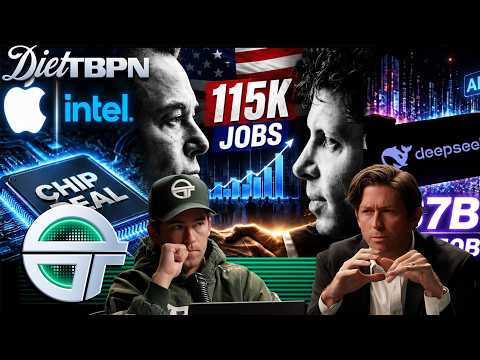
🎢 The Great Lock-In: Intel's Revival, AI vs. Reality & Economic Divergence
🚀 Intel's Historic Turnaround
Intel shares surged nearly 20% in a single session following a Wall Street Journal report that the company has reached a preliminary chipmaking deal with Apple. The stock has rallied from $21 per share when the Trump administration took a roughly 10% stake last summer to $125 per share—a dramatic reversal for a company that spent the last decade falling behind TSMC and Samsung.
"Intensive talks between the two companies have been ongoing for more than a year."
The deal marks a potential revival of the Apple-Intel relationship, which began in 2006 when Apple adopted Intel CPUs for Macs, but fractured in 2020 when Apple transitioned to its own custom ARM-based silicon and began sourcing chips directly from TSMC. While it remains unclear which exact Apple products Intel will manufacture—possibly involving both Intel's own designs and its foundry services—the preliminary agreement signals renewed confidence in Intel's ability to compete at the cutting edge.
Key Context:
- Intel hired new CEO Tan in March 2025 to replace ousted chief executive Pat Gelsinger
- The Trump administration struck a deal converting nearly $9 billion in federal grants into Intel equity at $21 per share
- Commerce Secretary Howard Lutnick met repeatedly with Tim Cook, Elon Musk, and Jensen Huang to convince them to partner with Intel
- Nvidia invested $5 billion at $23 per share, now sitting on roughly a 5x return
- Intel has signed partnerships with Nvidia, Apple, and SpaceX over the past year
Intel is betting heavily on its most advanced manufacturing process, known as 14A, which it hopes will attract a wave of customers looking to dual-source and reduce dependence on Taiwanese supply chains. CEO Tan has been aggressively reshaping leadership, hiring former TSMC executive Wii Jen Loh (prompting a lawsuit from TSMC) and bringing in new executives to lead data center, client computing, and custom silicon divisions.
"As soon as we went in, Apple went in, Nvidia went in—a lot of smart people went in." — President Trump, January 2025
For Apple, the deal addresses a critical constraint: chip shortages that have prevented the company from meeting iPhone demand. On recent earnings calls, CEO Tim Cook blamed lack of availability of advanced chips for iPhone supply issues, with constraints expected to persist for Mac Mini and Mac Studio models for several months. TSMC's manufacturing capacity is now dominated by surging demand from Nvidia and other AI chip designers, reducing Apple's leverage to secure the supplies it needs.
📊 The Magnificent Concentration: AI vs. The Real Economy
The American economy is increasingly split into two parallel universes: the booming AI sector and everything else. According to back-of-the-envelope calculations by Greg Ip at the Wall Street Journal, the AI economy grew roughly 31% while the non-AI economy expanded just 0.1%.
Recent economic data reveals this divergence:
- Personal consumption (the largest component of GDP) grew a relatively muted 1.6%
- Investment fell in housing, business structures, and transportation equipment
- Investment soared 43% in tech equipment (primarily chips and GPUs)
- Software investment jumped 23%
- Intellectual property investment rose 22%
Market concentration has reached historic levels. The so-called "MAG 10"—the Magnificent 7 plus AMD, Broadcom, and Micron—now represents approximately 40% of the entire market. For perspective, railroads at their peak (1835–1910) made up 63% of the market. Current concentration levels echo Japan's bubble era, the Nifty Fifty, and various tech and telecom booms throughout history.
Yet unemployment remains remarkably stable. The US added 115,000 jobs in April, more than double the 55,000 analysts polled by the Wall Street Journal expected. Job gains were broad-based across retail, transportation, warehousing, and healthcare—sectors largely untouched by AI disruption. March saw 185,000 jobs added, indicating resilience despite anxiety about tariffs and economic uncertainty.
"It's still a high-anxiety job market. Those who have a job are clearly clinging on, while those who are looking for a job are feeling frozen out." — Diane Swank, Chief Economist at KPMG
🎢 K-Shapes Within K-Shapes: Whirlpool vs. Six Flags
Economic divergence isn't limited to AI versus non-AI. Within the "real economy," stark differences emerge between companies facing similar consumer dynamics. Two recent earnings reports illustrate this phenomenon: Whirlpool and Six Flags.
Whirlpool: The appliance giant, a dividend aristocrat that has paid dividends consistently since the 1950s, cut its dividend for the first time in over 70 years. The stock is down 80% over the past five years. The company faces brutal global competition from LG and Samsung, declining existing home sales (down 3% month-over-month), and consumers deferring big-ticket purchases like refrigerators and washing machines.
Six Flags: The theme park operator (ticker: FUN) reported higher first quarter revenue with growing attendance and customer spending. Despite being worth only $2.3 billion and down roughly 50% over two years, the business is expanding. Travis Kelce and a group recently invested $200 million, and the stock has recovered substantially since November.
The contrast is striking: refrigerators are necessities, roller coasters are discretionary luxuries—yet roller coasters are thriving while appliances struggle. The explanation lies in deferrability and competition. Consumers can postpone appliance upgrades indefinitely and repair old units when money is tight. But children are only roller coaster age for a limited window, creating urgency around experiences. Additionally, Whirlpool faces fierce international competition while Six Flags operates in a more protected domestic market.
💡 The Barbell Thesis: Long Slop, Long Anti-Slop
This economic split has given rise to what can be called the "barbell strategy"—being positioned at both extremes of the AI transformation:
- The Ellison Family: Massive infrastructure investments in AI through Oracle, plus legacy media (Batman, Superman) through Warner Brothers
- Josh Kushner: Invested in OpenAI and the San Francisco Giants
- Experiences vs. Automation: "You can't vibe code Space Mountain"—physical experiences and live entertainment represent the anti-slop investment thesis
Ryan Peterson shared a chart from the Financial Times mapping possible economic futures ranging from human extinction to the end of scarcity. In the bull case, real GDP per capita could eventually exceed $1 million. In the doom scenario, it goes to zero. The chart captures the dual anxiety gripping markets: if AI gets too good, mass unemployment; if AI is a bubble, economic collapse and mass unemployment. Both outcomes carry similar risks to economic stability.
🏛️ Inside the Elon Trial: Opening Day in Oakland
The Elon Musk vs. OpenAI trial kicked off with opening statements in Oakland federal court. Public seating was extremely limited—only 20 to 30 seats available, with a portion reserved for media. The line began forming around 5:30 AM, with proceedings starting at 8:30 AM and running until approximately 2:00 PM, with two 20-minute breaks.
What happened in court:
- Proceedings opened with a video deposition of Mira Murati, covering the timeline of Sam Altman's brief ousting in November 2023
- Text message exhibits were displayed, including the now-famous exchanges between Sam Altman and Mira Murati (yes, someone turned those texts into a 2011-style emo teen anthem using AI)
- Shivon Zilis testified in person—she served as an OpenAI board member from 2020 to 2023, leaving in February 2023 (months before the November ousting) when Elon started xAI
- An hour-long video deposition of Helen Toner focused on the events surrounding Altman's removal
The judge expressed concern about jury boredom during lengthy video depositions, offering coffee to jurors. New York Times reporter Mike Isaac arrived around 7:30–8:00 AM with a media pass, having traded coverage shifts with colleague Cade Metz. The courtroom was packed with journalists—many who didn't secure official media credentials simply lined up with the public to gain entry.
🇨🇳 DeepSeek Raises $7B at $50B Valuation
In a stunning display of conviction, DeepSeek is reportedly raising $7 billion at a $50 billion valuation—China's largest-ever AI fundraise. The most remarkable detail: the founder is personally contributing 40% of the round—roughly $3 billion—and owns approximately 90% of the company.
DeepSeek was founded inside one of China's most successful hedge funds. The massive capital raise is aimed at acquiring compute to push out new frontier models. Recent benchmarking suggested Chinese open-source models were falling behind on performance trajectories, but this investment signals DeepSeek's intention to close the gap within months.
🤝 Anthropic Secures xAI Compute via SpaceX Deal
In a move few predicted given the public tension between Elon Musk and the Anthropic team, Anthropic struck a deal to access compute through SpaceX infrastructure. The arrangement was rational from a business perspective—xAI/SpaceX has built industry-leading infrastructure at remarkable speed, with multiple Colossus data centers coming online—but cultural differences seemed insurmountable just months ago when Musk was publicly criticizing Anthropic leadership.
The deal validates the thesis that xAI/SpaceX could become a "neo-cloud" provider, leveraging Elon Inc.'s ability to rapidly deploy power and infrastructure. While the Cursor deal was once seen as the long-term solution for xAI's excess compute capacity, there are now multiple clusters serving different customers. Demand for compute, it turns out, finds a way.
📈 Texas Roadhouse: The Kyrgyoku Filter
In lighter market news, Texas Roadhouse surged approximately 15–20% on strong earnings, prompting jokes about the "Kyrgyoku filter"—a memetic framework for evaluating American economic resilience through casual dining performance. The meme format, which originated as an inside joke, has fully broken containment and become a widely recognized cultural reference point for assessing real economy strength.
🎯 What This All Means
The American economy is experiencing an unprecedented divergence. A handful of companies are driving the vast majority of market returns, yet job growth remains steady across non-AI sectors. Within the real economy, competitive dynamics and consumer behavior create winners and losers in unexpected places. Traditional necessities face pressure while experiential spending shows resilience.
Market concentration is at historic levels, valuations are elevated, but revenue growth—particularly in AI infrastructure—remains robust. The dual anxiety persists: fear of AI-driven displacement and fear of an AI bubble collapse leading to recession. Both scenarios carry similar risks to economic stability, creating tension in how investors, policymakers, and companies position for the future.
The "great lock-in" continues—semiconductor supply chains are being re-shored, AI infrastructure is being rapidly deployed, and a barbell strategy of betting on both full automation and anti-slop experiences is emerging as the dominant positioning framework. Whether the path leads to the end of scarcity or economic disruption, the next 12–24 months will be defining.
More from TBPN
How David Holz Built a $40B Business Without VCs — And Now He's Reinventing Medi
🚀 The Founder Who Refused to Follow the RulesDavid Holz has done something rare in Silicon Valley: he built a generatio...
Inside Jake Paul's New $100M Fund: Strategic Allocation, Netflix Disruption, and
🥊 From Content Creator to Institutional CapitalJake Paul and his partner Jeff Woo announced they've successfully raised...
Market Turbulence as Fed Pivots Hawkish, AR Glasses Struggle, and the Battle Ove
🔴 Fed Turns Hawkish: Markets Sell Off as Rate Hikes LoomMarkets pulled back sharply following signals from the Federal ...

SpaceX's Historic Run, the Biggest VC Exit Ever, and the Battle for Wearable Com
🚀 SpaceX Surges Into the Elite ClubSpaceX delivered one of the most dramatic after-hours rallies in recent memory, clim...
Freedom 250, Anthropic's Compliance Crisis, and the Great Token-Maxing Debate of
🎯 When Bread and Circuses Actually WorkUFC Freedom 250 at the White House wasn't just unprecedented — it might have bee...
The SpaceX IPO: How a $135 Share Price Became a $2.28 Trillion Success Story
🚀 A Historic Launch DaySpaceX priced its IPO at $135 per share, opened at $150, and quickly climbed to $172 — represent...