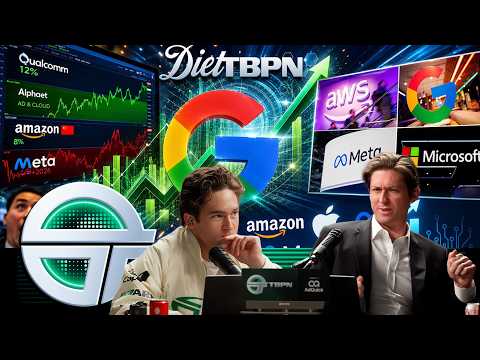
🚀 Tech Earnings Quad Kill: The Great Cloud Acceleration & AI Capex Debate
💰 The Quad Kill Returns: Four Tech Giants, One Day, Massive Implications
Tech earnings season delivered a rare phenomenon: four major technology companies reporting on the same day. This alignment, last seen in 2020, offered a comprehensive snapshot of the AI infrastructure buildout, enterprise adoption dynamics, and the diverging strategies among hyperscalers.
The market's response was decisive but nuanced. Google surged 10% on exceptional cloud performance, while Meta dropped nearly 10% despite posting phenomenal revenue growth. Microsoft and Amazon showed solid execution but faced investor scrutiny over their escalating capital expenditure commitments.
🔥 Google: The Full-Stack AI Winner
Google emerged as the clear earnings winner, delivering results that silenced persistent concerns about AI disruption to its core search business.
Key Numbers:
- Google Search revenue: $64 billion, up 19% year-over-year
- Google Cloud revenue: $20 billion, up 63% year-over-year
- Cloud backlog: Nearly doubled to more than $460 billion
- Cloud operating income: $6.6 billion
The search durability story remains intact. Two years after widespread speculation about Google search's demise, the business continues to accelerate. The 19% year-over-year growth in search revenue demonstrates that AI chatbots have not materially impacted Google's core revenue engine.
But the real narrative centers on Google Cloud. The 63% growth rate significantly outpaced expectations, with analysts initially targeting around 40% growth. More importantly, over half of the massive backlog is expected to be recognized within the next 24 months, providing exceptional revenue visibility.
"Take him when he did his earnings recap, he didn't even talk about toplines at Google, Amazon, and Microsoft. He just says Google Cloud revenue 63% year-over-year. Amazon Web Services 28% year-over-year. Azure 40% year-over-year."
The market's message was clear: higher capex at Google is fully justified in a world of accelerating cloud demand and strong margin expansion in the cloud business.
⚡ Microsoft: Enterprise AI's Steady March
Microsoft demonstrated solid execution but didn't dramatically shift any narratives. The company remains the enterprise AI play, though deployment continues at the naturally measured pace of large organizations.
Key Numbers:
- Total revenue: $82.9 billion, up 18% year-over-year
- Azure growth: 40% year-over-year
- Copilot seats: 20 million total, adding 5 million in the quarter
- Total Microsoft 365 paid seats: 450 million
The Copilot adoption story shows promise but remains in early stages. With 20 million Copilot seats against 450 million total paid seats, the penetration rate sits around 4.4%. The long-term opportunity requires converting a substantial portion of that 450 million seat base to Copilot subscribers.
Market reaction was choppy, partly due to ongoing digestion of the renegotiated OpenAI relationship. Microsoft no longer holds exclusive access to OpenAI models—AWS now offers them as well. This creates a tension: Azure loses its exclusive sales advantage, but Microsoft's equity stake benefits from OpenAI's expanded distribution.
The renegotiation appears to have resolved cleanly, with the arbitrary AGI clause replaced by IP sharing arrangements and an extended partnership timeline through 2032. For Azure sales teams, the loss of exclusivity stings, but the broader business relationship remains intact.
📦 Amazon: The Capex King Keeps Building
Amazon topped capex forecasts while delivering AWS reacceleration—a combination the market rewarded with modest gains.
Key Numbers:
- Q1 2025 total sales: $181.5 billion for the quarter, up 17% year-over-year
- AWS growth: 28% year-over-year (beating expectations of 25%)
- Ads business: $17.2 billion in revenue
- Custom chips (Trainium): Crossed $20 billion run rate
AWS beating growth expectations at this scale represents significant reacceleration. The company maintains the most aggressive infrastructure buildout, supported by major partnerships with both OpenAI and Anthropic. Unlike Google's DeepMind or Microsoft's internal AI research, Amazon's less competitive relationship with external AI labs provides flexibility in capital deployment.
The advertising business continues to perform strongly, and the custom chip initiative has reached meaningful scale at a $20 billion run rate. Amazon's positioning allows it to justify massive capex investments across multiple use cases: partner workloads, internal services, and infrastructure-as-a-service offerings.
📱 Meta: The High-Growth Enigma
Meta posted spectacular revenue growth but suffered a sharp selloff, highlighting investor concerns about capex justification and strategic clarity.
Key Numbers:
- Q1 revenue: $56.3 billion, up 33% year-over-year
- Ad impressions: Up 19%
- Average price per ad: Up 12%
- Capex outlook: Raised by $10 billion on both ends of the range, now $125-145 billion
The core advertising business remains extraordinarily strong. Growing at 33% year-over-year on a $200+ billion run rate represents one of the most impressive business performances in history. Ad impression growth combined with pricing power demonstrates continued platform strength.
Yet the stock dropped nearly 10%. The primary concern: Meta lacks a clear enterprise AI revenue story comparable to Google Cloud, Azure, or AWS. The elevated capex must ultimately show up in Meta's own services—primarily advertising optimization and AI-powered features.
"Can you imagine just take one second and imagine that Meta is a private company and their pitch is that we make AI agents for selling products. They're at a $200 billion run rate, growing 33% a year. How is it priced? Probably 20 trillion with those operating margins."
An additional concern emerged: Daily Active People (DAP) declined sequentially for the first time since Meta began reporting the metric. Management attributed this to internet disruptions in Iran and WhatsApp restrictions in Russia, rather than fundamental user behavior shifts. No emerging social platform currently threatens Meta's family of apps.
Meta represents a unique investment thesis: a dominant advertising business combined with a high-risk call option on frontier AI. If the company's deep research investments yield breakthrough models competitive with OpenAI or Anthropic, shareholders could effectively own two exceptional businesses. This dual nature creates valuation complexity that the market continues to digest.
🔍 The Fracturing AI Narrative
A critical theme emerging from this earnings cycle: the unified AI narrative is fracturing into distinct strategies.
For the past 12 months, the playbook was simple: announce the biggest capex number, report the largest deals, and demonstrate aggressive growth. Now each hyperscaler pursues a differentiated approach:
- Google: Full-stack AI platform with integrated models and cloud infrastructure
- Microsoft: Enterprise AI adoption and distribution through existing customer relationships
- Amazon: Infrastructure-focused partnerships with both OpenAI and Anthropic
- Meta: Advertising optimization combined with frontier AI research optionality
The market increasingly demands short-term revenue evidence for capex justification. Simply announcing investment plans no longer suffices—companies must demonstrate how capital deployment translates to revenue growth and margin expansion.
📊 Valuation Reality Check
Comparisons to the dot-com bubble continue to surface, but the numbers tell a different story:
Current Price-to-Earnings Ratios:
- Meta: 16x
- Google: 17x
- Amazon: 24x
- Microsoft: 25x
Dot-Com Bubble Peak Comparisons:
- Microsoft (2000): 73x
- Cisco (2000): 200x+
- Yahoo (2000): 800x
- NASDAQ overall: 200x
Today's leading technology companies trade at 16-25x earnings while generating hundreds of billions in real cash flow. Even in a severe AI downturn scenario, these businesses would retain dominant positions in digital advertising, cloud computing, and enterprise software.
However, the comparison has limitations. Many newer AI companies in private markets carry valuations with no earnings, trading on pure growth potential—a dynamic more reminiscent of late-1990s excess. Additionally, companies like Palantir trade at 220x earnings and Intel at 900x, suggesting pockets of extreme valuation remain.
💡 The Jobs Debate: Jevons Paradox Revisited
NVIDIA CEO Jensen Huang addressed the persistent concerns about AI-driven job displacement with characteristic directness:
"If we convinced everybody not to be radiologists and we now need radiologists, that actually is hurtful to society. It is hurtful if we convinced all the young college graduates to not be software engineers. And it turns out United States need more software engineers than ever."
Huang criticized doom-laden predictions as counterproductive, arguing that they risk creating actual harm by discouraging people from entering fields that will remain in high demand. He specifically called out claims about existential threats and blanket job destruction as "nonsensical" and "not helpful."
The pattern across industries suggests automation increases demand rather than destroying it entirely. Tasks get automated, but jobs evolve. Radiologists use AI to read more scans more accurately. Truck drivers remain essential for security, logistics coordination, and complex decision-making beyond simply steering vehicles.
The key insight: efficiency gains typically expand total activity rather than contract it. Make something 10% faster, and usage increases by 5%. Jevons Paradox—where efficiency improvements increase total consumption—appears to hold for knowledge work as well.
🎯 What's Next
Several themes will define the coming quarters:
Enterprise AI Adoption: Microsoft's Copilot penetration rate and similar enterprise tools will indicate whether businesses accelerate AI spending or maintain cautious deployment.
Capex Justification: Markets will demand clearer connections between capital expenditure and revenue growth. The era of "trust the process" appears to be ending.
Model Competition: Google's next Gemini release and ongoing competition between frontier labs will shape cloud demand and partnership dynamics.
Meta's Frontier Play: Whether Meta's research investments yield competitive frontier models remains a high-stakes question for shareholders.
The AI infrastructure buildout continues at unprecedented scale, but the market now applies more scrutiny to how capital translates to earnings. Companies that can demonstrate clear revenue pathways from their investments will likely outperform those relying on narrative alone.
The bottom line: Tech's quad kill revealed robust underlying businesses with diverging AI strategies. Google's full-stack dominance, Microsoft's enterprise focus, Amazon's infrastructure partnerships, and Meta's dual-track approach each represent distinct bets on AI's evolution. The unified "bigger is better" narrative has fractured—and that's probably healthy for the ecosystem.
More from TBPN

Fed Holds Steady as Big Tech's $200B+ Capex Bets Face Their Biggest Test
📊 A Watershed Day for Markets and Technology Financial markets faced a convergence of major events that will shape the...

Beijing Flexes Power Over AI, Science Says Mindset Beats Reality, and Meta Beams
🚨 The Musk vs. Altman Showdown BeginsElon Musk's $134 billion lawsuit against Sam Altman officially kicked off in Oakla...

AI’s Big Build: Amazon’s capex math, data center politics, cyber-AI containment—
⚡ The State of Play Thursday, April 9, 2026 delivered a dense cross-current of AI scale-up, data center politics, cyber-...

Muse Spark, Mythos, and the Compute Scramble: Inside a New Phase of the AI Cycle
🔥 Meta’s Closed-Source Turn Lands With Muse Spark — And Markets Cheer Meta Platforms unveiled Muse Spark, its first maj...
Risk-On Rally Meets AI Arms Race: Meta’s Muse Spark, Anthropic’s ‘Mythos,’ Predi
Market Snapshot 🚀U.S. equities ripped higher: Dow +2.68%, S&P 500 +2.46%, NASDAQ +2.9%.Gains came on ceasefire head...

Tokens, Fabs, and Frontiers: Costs, Capacity, and Control in AI’s Next Leg
In a week defined by scale, incentives, and geopolitics, three threads tied the AI macro picture together: an internal t...