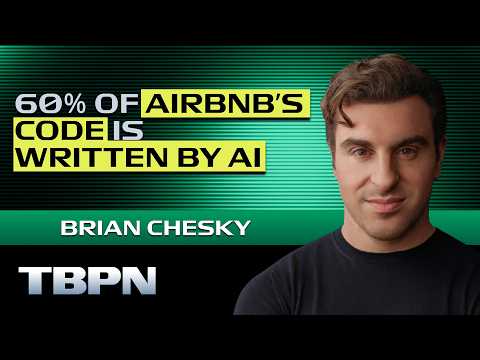
🚀 Airbnb's Founder Mode Playbook: From 10% to 18% Growth & The Future of AI Commerce
Airbnb CEO Brian Chesky returned to share how the company reignited growth, why "founder mode" actually works, and what comes next for AI-powered consumer experiences. In a sprawling conversation covering everything from organizational transformation to the future of travel interfaces, Chesky laid out a masterclass in scaling without losing intensity—and offered one of the sharpest takes yet on where AI meets consumer products.
📈 Revenue Acceleration: From 10% to 18%
Airbnb's turnaround is real—and the numbers prove it. After growing 10% in revenue last year, the company announced 18% growth this quarter, marking the first acceleration since the pandemic. For a marketplace doing roughly $100 billion in gross bookings annually, reversing gravity at this scale is no small feat.
"Once a marketplace at our size starts to come down, it's really hard to tip that curve. This has been a pretty big feat for the team."
But the story isn't just about the numbers—it's about how they did it.
🏗️ Project Hawaii: How to Act Like a Startup at Scale
As Airbnb grew, Chesky noticed the company was losing its startup intensity. His solution? Project Hawaii—a small, handpicked team focused obsessively on conversion rates and the guest journey, operating as if they were back at the apartment on Rausch Street where Airbnb began.
The approach was radical in its simplicity:
- Small, focused teams working on narrow service areas
- Daily or weekly reviews to instill intensity and perfection
- Direct CEO involvement to clear obstacles and eliminate bureaucracy
- High standards, high pace—not everyone liked it, and some left
Chesky's philosophy: "Great leadership is presence, not absence." Rather than trusting teams from a distance, he partnered with them on the field—like a cavalry general on horseback, not issuing orders from overseas.
"I don't think trust and getting out of the way are the same thing. Leadership is presence. You should be on the battlefield with your people."
The model worked. After a few years of building muscle memory across teams, Airbnb now operates with startup velocity—without Chesky needing to review every detail.
🤖 AI's Impact: 60% of Code Written by AI
Airbnb's AI adoption is aggressive—and effective. Today, 60% of the company's code is written by AI, roughly twice the benchmark of competitors. The results extend beyond engineering:
- Cost per customer service ticket is down 10%
- 40% of users who contact support have their issues resolved by AI
- AI has been integrated throughout the entire customer journey
Chesky sees AI as a continuation of founder mode, not a replacement for hands-on leadership. In the AI era, he argues, everyone should be hands-on—there's no room for pure people managers when data and agents are so accessible.
💬 Why Chatbots Won't Win Travel (And What Will)
Despite the hype, Chesky is skeptical that chatbots are the right interface for travel or e-commerce. His critique is specific:
- Text-based: Photos and visuals are an afterthought
- No direct manipulation: Every action requires typing a prompt—no filters, no clicks
- Poor comparison shopping: Hard to browse thousands of options meaningfully
- Single-player: Most AI experiences aren't collaborative, yet 85% of Airbnb users send messages
"I do not think a chatbot is the right interface for travel or e-commerce. The future are agents, but they're not going to be text-forward—they're going to be really rich user interfaces."
Chesky draws a parallel to the iPhone: imagine if every app had to be accessed through iMessage. The App Store succeeded because each app had a unique, rich interface tailored to its function. He believes AI-powered travel will follow the same pattern—agentic, conversational, but far more visual and immersive than today's chatbots.
He also notes that when OpenAI launched third-party apps in March last year, they shut them down shortly after—partly because the SDK wasn't rich enough to support meaningful commerce experiences.
🌍 The Six-Step Travel Journey (And Where AI Fits)
Chesky breaks down the travel journey into six stages:
- Destination discovery: Where should I travel?
- Flights: How do I get there?
- Accommodations: Airbnb or hotel?
- Activities: What do I do when I arrive?
- Logistics: Car rentals, services
- Spontaneous needs: In-the-moment decisions while in the city
AI and LLMs, he argues, will be revolutionary for steps one and two—destination discovery and flights. These are areas where conversational search excels, especially for nuanced queries like "somewhere like Paris but more affordable, good for August, with Opera."
However, he believes current chatbots lack the rich maps, visual depth, and immersive video capabilities needed to truly disrupt travel. The next generation will likely blend conversation with video-based, photo-forward interfaces.
🎨 A Call to Designers and Creatives
Chesky is concerned that an entire generation of designers and creative people might sit out the AI revolution—just as many prestigious designers once avoided "web design" in favor of print. That gap, he argues, led to the rise of product management as a function, filling the void left by narrow web designers.
"If I were starting Airbnb today, I'd be vibe coding with Claude. All designers should think of themselves as product people and front-end design engineers."
The opportunity for creatives is massive. With image and video generation models advancing rapidly (he specifically mentions the Kling dance video models), the next wave of consumer experiences will be highly visual—and that requires designers, not just engineers.
Chesky's prediction: the next two years will see a massive consumer AI revolution, led by companies that blend world-class product thinking with breakthrough AI capabilities.
📊 Enterprise AI vs. Consumer AI: The Great Imbalance
Almost every AI company today is focused on enterprise—particularly coding and developer tools. Chesky notes that in a recent Y Combinator batch, only 16 out of 175 companies were consumer-focused. That ratio hasn't changed much since.
He attributes this to a few factors:
- Trend-following: Enterprise is hot, so everyone chases it
- Y Combinator's own network effects: Startups sell to each other, making enterprise sales easier
- Risk aversion: Consumer is harder, so fewer people attempt it
But Chesky sees an opening: "Consumer is hard, but you know what's also hard? Competing with 10 other companies doing your idea in enterprise."
He believes the enterprise wave has crested, and consumer is next—especially as image and video generation models (like the progress seen with Imagen 2) unlock real-time, AI-generated interfaces.
🚀 Growth Beyond STR: Where Airbnb Goes Next
While Airbnb's core short-term rental business could eventually double (for every person staying in an Airbnb, eight or nine stay in a hotel), Chesky sees multiple expansion opportunities:
- Hotels: About half the hotels globally are independents and boutiques, unhappy with OTA commissions. Airbnb can offer better distribution.
- Services: There's no Amazon for services. Imagine hitting a button for 80 different service verticals—from home repair to personal training.
- Long-term stays (30+ days): As more people work via laptop and live nomadically, this is a growing, underserved market.
"For Airbnb, we're looking at expanding to a lot of different categories. That's where most of the growth is going to be in the future."
📢 Marketing in the Age of Banner Blindness
Chesky acknowledges that CMO is one of the highest-turnover roles in Silicon Valley—and for good reason. What works in marketing changes every few years. Tactics that once drove growth (like influencer marketing) become stale as everyone adopts them, leading to "banner blindness."
His approach: do something different. The Barbie Malibu Dreamhouse activation had a better ROI than any traditional ad campaign Airbnb has run. Being "slightly unhinged" and surprising works—until it doesn't, and you need the next new thing.
"The key to marketing is to be different because you got to stand out."
Chesky admits that while traditional advertising still works (Airbnb spends roughly $1 billion annually on ads), breakthrough ideas deliver exponentially better returns—like Red Bull's Felix Baumgartner space jump, which cost less than a million dollars but generated over a billion views.
🎈 The Future: Agents, Not Apps
Chesky's most provocative prediction: "The future are agents, but I don't think they're going to be text-forward."
He envisions a world where AI-powered experiences are:
- Highly visual and immersive (video-based, photo-forward)
- Agentic and conversational (you can talk to them, they can talk back)
- Collaborative (designed for multiple users, not just solo interaction)
- Rich in direct manipulation (filters, maps, comparisons—beyond typing prompts)
The exact interface is still being figured out—but Chesky is clear that it won't be a chatbot in the way we understand them today. Think less ChatGPT, more Minority Report-style interaction blended with real-time AI generation.
🔮 Final Thoughts: Competition, Creativity, and the Next Era
Chesky remains paranoid about disruption. He admits that a younger version of himself—armed with today's AI tools—could cause serious problems for Airbnb. But he's betting that the company's brand (a noun and a verb), global network effects, and operational complexity create a moat that's hard to replicate with software alone.
His advice to entrepreneurs:
"Don't try to change the whole company. Pick one room and make it perfect, then go room to room. Zig when everyone else is zagging. Claim a space for your own."
As for what's next? Chesky is confident: the consumer AI revolution is coming. It's just waiting for the right team to build the right interface—and he's determined that Airbnb will be part of it.
Oh, and there's a blimp partnership in the works. Stay tuned. 🎈
More from TBPN

How David Holz Built a $40B Business Without VCs — And Now He's Reinventing Medi
🚀 The Founder Who Refused to Follow the RulesDavid Holz has done something rare in Silicon Valley: he built a generatio...

Inside Jake Paul's New $100M Fund: Strategic Allocation, Netflix Disruption, and
🥊 From Content Creator to Institutional CapitalJake Paul and his partner Jeff Woo announced they've successfully raised...

Market Turbulence as Fed Pivots Hawkish, AR Glasses Struggle, and the Battle Ove
🔴 Fed Turns Hawkish: Markets Sell Off as Rate Hikes LoomMarkets pulled back sharply following signals from the Federal ...

SpaceX's Historic Run, the Biggest VC Exit Ever, and the Battle for Wearable Com
🚀 SpaceX Surges Into the Elite ClubSpaceX delivered one of the most dramatic after-hours rallies in recent memory, clim...

Freedom 250, Anthropic's Compliance Crisis, and the Great Token-Maxing Debate of
🎯 When Bread and Circuses Actually WorkUFC Freedom 250 at the White House wasn't just unprecedented — it might have bee...

The SpaceX IPO: How a $135 Share Price Became a $2.28 Trillion Success Story
🚀 A Historic Launch DaySpaceX priced its IPO at $135 per share, opened at $150, and quickly climbed to $172 — represent...