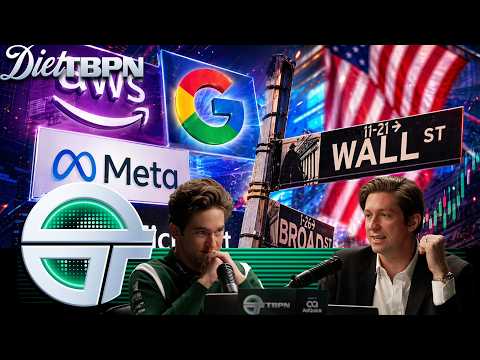
🔥 The Super Bowl of Big Tech: Fed Decision + $2 Trillion in Market Cap Reports
📊 A Watershed Day for Markets and Technology
Financial markets faced a convergence of major events that will shape the trajectory of both monetary policy and the AI investment thesis. The day delivered a carefully choreographed sequence: the Federal Reserve's rate decision at 2 p.m. Eastern, followed by Jerome Powell's remarks at 2:30 p.m., and culminating in simultaneous earnings reports from Google, Amazon, Meta, and Microsoft at 4 p.m. — companies representing just under 20% of the total S&P 500 market capitalization.
🏦 Fed Holds Rates in Expected Range
The Federal Reserve kept interest rates on hold at a range of 3.5% to 3.75% at Wednesday's meeting, meeting market expectations but disappointing those who had hoped for a cut. The decision was largely anticipated, though the lack of immediate relief underscored the Fed's cautious stance amid persistent economic uncertainties.
💰 The AI Capex Question: Can $200B+ Spending Translate to Durable Returns?
The central question facing Big Tech is whether massive AI infrastructure investments can convert into proprietary distribution, higher customer retention, and measurable revenue growth before depreciation catches up. This represents a fundamental shift from the previous software era's dream of building websites with 80% margins to something resembling capital-intensive industries like railroads or oil.
"The ice is thin, the leash is very tight. Any evidence that would come out that would add doubt about OpenAI, Anthropic, or any of these companies is obviously going to create a sell-off." — Dan Morgan, Portfolio Analyst at Senovas Trust
According to Semi-analysis, hyperscaler capex is expected to be revised upwards and beat street expectations as hyperscaler cloud revenue accelerates and positive ROI on cloud investments becomes evident.
📈 Google: The Fully Integrated AI Stack
Google arguably possesses the most comprehensive AI infrastructure, spanning consumer distribution, model training with DeepMind, custom chips (TPU), and numerous product surfaces including Google Workspace, search, YouTube, Android, and cloud services.
Key Questions for Investors:
- Does AI change the unit economics of search too quickly?
- Can AI search overviews and Gemini monetize fast enough to offset potential declines in traditional search ad revenue?
- Are AI overviews expanding search usage and increasing ad ROI, or compressing the financial model?
🖥️ Microsoft: The Enterprise AI Bellwether
Microsoft entered earnings off a strong quarter with revenue up 17%, while its cloud business (including Azure and M365) grew 26%. Azure specifically accelerated at 39% growth, supported by capex running at approximately $150 billion.
The standout metric: Remaining Performance Obligations (RPO) reached $625 billion, up 110%, with approximately 45% attributed to OpenAI and other partners signing long-term compute contracts. This provides tangible evidence that industry-wide growth forecasts justify current capex levels.
Critical Data Points to Watch:
- Azure growth rates — the clearest indicator of enterprise AI adoption
- Microsoft Cloud gross margins — will compression appear if customers demand discounts?
- Copilot adoption metrics — are enterprises willing to pay incrementally for AI features?
- M365 seat growth — does this represent hiring strength or potential displacement by AI agents?
- GitHub Copilot momentum — despite competition from Windsurf, Cursor, and others, is the market large enough for multiple winners?
Microsoft's enterprise sales motion and go-to-market capabilities may provide an advantage similar to how Teams ultimately succeeded against the initially more hyped Slack.
🛒 Amazon: Justifying $200B in Capex
Amazon guided to $200 billion in capex for 2026, making AWS acceleration critical to justify these unprecedented spending levels. Q4 showed healthy momentum with net sales up 14% and AWS growing 24%.
The company's advertising business proved remarkably robust, growing 23% to $21.3 billion — approaching a $100 billion annual run rate that provides substantial cash flow to fund AI initiatives. Operating income reached $25 billion, though free cash flow of $11.2 billion declined due to increased AI spending.
Market Expectations: Consensus for AWS revenue is around $36.7 billion with growth in the mid-20% range, but investors are hoping for acceleration into the 30%+ range to validate the massive capex deployment.
📱 Meta: AI Already Working at Scale
Meta entered earnings with the least to prove, having delivered a "super clean Q4" with 3.58 billion daily active users and revenue growth of 24% to almost $60 billion.
The advertising engine demonstrated remarkable strength:
- Ad impressions rose 18%
- Average price per ad increased 6%
- Family of apps operating income reached $30.8 billion
- Reality Labs losses of $6 billion became almost negligible against core profitability
Capex increased from $72.2 billion last year to a guided range of $115-135 billion for this year — approaching a near-doubling of infrastructure investment.
Meta's Unique Advantage: No diffusion problem. AI improvements in ad placement deliver results immediately across the entire family of apps. Better recommendation algorithms don't require enterprise sales cycles, change management, or gradual rollouts — they simply make ads more relevant, driving incremental billions in profit without consumers even noticing the improvement.
"Every company is trying to answer the same question: Can you turn AI capex into proprietary distribution, higher customer retention, measurable revenue growth before the depreciation catches up? It's the Super Bowl for big tech."
🎯 The Broader Context: AI Jitters Return
The Wall Street Journal captured the market mood: "AI worries have returned to Wall Street." News surrounding OpenAI's capital needs initially caused shares of Oracle, CoreWeave, and SoftBank to slump, though CoreWeave recovered 8.4% after dropping at least 4% in after-hours trading.
However, positive signals emerged from other quarters. Companies including IBM, Texas Instruments, and Intel reported strong earnings, with Intel surging 40% over the week and adding another 10% gain on the day of these tech earnings. The emerging narrative of a potential CPU shortage is being digested by markets as investors recognize new supply chain constraints in the AI infrastructure buildout.
OpenAI defended its position, stating: "The business is firing on all cylinders and the mood internally is incredibly positive."
🔴🔵 The Red Button vs. Blue Button Thought Experiment
A viral thought experiment swept through markets and tech communities, originating with Tim Urban and amplified by Mr. Beast:
The Scenario: Everyone must vote by pressing either a red or blue button. If more than 50% press blue, everyone survives. If less than 50% press blue, only red button pressers survive. Which do you choose?
The Debate:
- Red button logic: The "hyperrational" choice guarantees personal survival regardless of others' decisions. If everyone thinks this way, 100% survival is achieved.
- Blue button logic: Requires faith in collective action but only needs 51% participation for universal survival, versus red's requirement of 100% for the same outcome.
In Tim Urban's poll, 58% chose blue. In Mr. Beast's version, 55.7% went blue. Both results meant everyone survived. A subsequent survey of 14,000 nationally representative Americans showed blue winning by a 3-to-1 margin.
Personality analysis revealed the top predictor of button choice was agreement with the statement "I tell the truth" — those who strongly agreed were significantly more likely to choose blue.
The exercise became a metaphor for the current market environment: Do you make the individually rational choice (secure your position, be selective) or do you maintain faith in collective growth (stay invested in the AI thesis alongside everyone else)?
✅ What This All Means
The convergence of Fed policy stability and Big Tech earnings creates a critical inflection point. Investors are looking for concrete evidence that:
- Cloud revenue is accelerating — particularly Azure and AWS growth into the 30%+ range
- Enterprise adoption is real — M365 seats, Copilot uptake, and incremental spending prove willingness to pay for AI
- Margins are holding — no compression despite massive infrastructure deployment
- Cash conversion is visible — the pathway from capex to cash flow is becoming clearer
- Diffusion is happening — especially at Meta and Google where improvements translate immediately to financial results
With interest rates held steady and capital remaining available, the question is no longer can Big Tech afford these investments, but rather will these investments deliver the transformational returns that justify current valuations and spending levels.
The answer arrives in stages: first in today's earnings reports, then in the quarterly cadence ahead, and ultimately in the multi-year arc of AI infrastructure paying dividends across the economy. For now, the market waits — popcorn ready — for the Super Bowl of Big Tech earnings to reveal whether the biggest capex bets in corporate history will prove prescient or premature.
More from TBPN

Specs Launch Analysis, Paramount's Exodus, and OpenAI's Latest Alignment Disclos
📱 Snap Specs Launch: The AR Reality CheckSnap officially unveiled its latest Specs AR glasses yesterday, drawing a crow...
War, AI, and the End of Easy Money: Unpacking the High Interest Rate Phenomenon
The zero interest rate policy (ZERP) era has officially ended. Welcome to what some are calling the HIRP — the high inte...

The Weekend That Shook AI: A Timeline of the Frontier Pacing Debate
What started as a quiet weekend turned into one of the most consequential debates in AI policy history. Between early Sa...

Inside the AI Doomer Playbook: How Governments Plan to Control the Race to Super
The AI doomer movement is no longer just about sounding alarms — it's about concrete policy proposals. As Congress begin...

AI Extinction Bets, YC's Latest Batch, and a $17B Valuation Collapse
📊 AI Doomsday Predictions Take Center StageThe AI safety conversation reached a fever pitch this week as prominent figu...

Apple Finally Launches a Foldable iPhone, Meta Rolls Out Muse AI Agent, and P(do
📱 Apple's iPhone Duo: The Foldable Era BeginsApple officially unveiled the iPhone Duo, the company's first foldable dev...