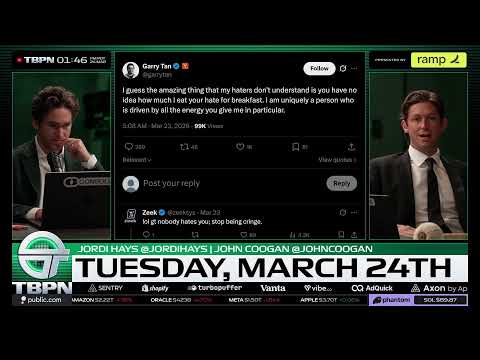
⚡ AI’s Energy Rush, Private Credit Redemptions, and a Moonshot: Hill & Valley Highlights
Why this matters
AI is colliding with energy, finance, and industrial policy all at once. Data centers need power, grids need upgrades, balance sheets need liquidity, and Washington is dusting off moonshot muscle memory. This recap distills the most consequential market, policy, and tech signals from a full slate of Hill & Valley conversations and breaking headlines.
Private Credit: Gates inch tighter as redemptions mount
- Ares Management and Apollo Global limited investor withdrawals amid elevated redemption requests, a notable signal in a $1.8 trillion private credit market.
- Ares Strategic Income Fund (about $10 billion) capped withdrawals at 5% after clients sought to redeem 11.6%.
- Apollo Debt Solutions imposed the same 5% cap following redemption requests of 11.2%.
- At one point Tuesday, investor jitters wiped out $10 billion in market cap across Ares, Apollo, Blackstone, and KKR as shares fell more than 2%.
- Investment in non-traded business development companies was down around 43% last month versus a year prior.
- Ares said granted redemptions would total roughly $524.5 million and emphasized about $5 billion in undrawn capacity; both Ares and Apollo plan to offer up to 5% withdrawals again next quarter.
Actionable takeaways: Expect fundraising to slow, underwriting to tighten, and liquidity management to stay front-and-center across private credit vehicles. Family offices and selective regional flows featured heavily in redemptions. Watch for asset sales, employee capital injections, and continued gating to balance flows.
AI’s energy imperative: Build fast, build local, protect ratepayers
Crusoe: Power, not chips, is the bottleneck
Crusoe’s vertically integrated AI infrastructure lens was unambiguous: energized capacity is scarce. The ratepayer protection pledge and behind/across-the-meter strategies are emerging as practical frameworks to add supply while insulating consumers.
“Data center capacity at large is absolutely a bottleneck… energized chips are. It comes back to power and data centers.”
“The trend is going to be… ‘across the meter’: on-site generation + data center load + grid interconnection that is bidirectional.”
- Natural gas insulation: Despite oil spikes, U.S. natural gas prices snapped back, aided by domestic production and LNG economics. Henry Hub dynamics and LNG liquefaction costs keep U.S. gas more regionally priced versus globally fungible oil.
- Labor is a real constraint: Reskilling, apprenticeships, and AI-assisted training were highlighted to accelerate electrician and data center buildouts.
Base Power: Battery-first distributed plants to accelerate AI interconnects
- Product: Retail power for homeowners with on-site batteries that back up during outages and serve the grid during normal operations. Claimed savings: 10–15% on electricity bills.
- Scale-up: Starting production Monday at an Austin factory capable of gigawatt-hour annual output (with a second, larger factory planned). Deployments target both deregulated (retail) and regulated (utility) markets.
- Data centers: Distributed batteries can shave peaks and add headroom for faster interconnections—an immediate lever as AI demand surges in Dallas and beyond.
Actionable takeaways: Expect accelerated partnerships between hyperscalers, utilities, and distributed storage providers to unlock near-term capacity. Labor pipelines (electricians, technicians, operators) and permitting reform are as material as capex.
Nuclear’s comeback: Fuel the reactors, then expand
General Matter: Enrichment is the bottleneck
- DOE award: $900 million for capacity in Paducah, Kentucky.
- Global offtake: Working with the Export-Import Bank on financing offtake in Japan and Korea to reduce reliance on adversaries.
- From dominance to dependence: The U.S. once produced 86% of global enrichment; now it’s less than 1%.
- Fuel chain: Five steps: mine → convert to gas → enrich → reconvert to solid → fabricate pellets.
“I think nuclear should be a big part of [bring-your-own-energy]… enrichment is going to be the bottleneck to scaling that which is why we’re trying to solve enrichment.”
Actionable takeaways: Utilities prize nuclear’s cost predictability; advanced reactor fuels need scale and lower cost. Enrichment capacity is the leverage point—policy support and commercial offtake will determine speed.
Logistics check-in: Strait of Hormuz, air cargo surge, and AI ops
Ryan Petersen (Flexport): Air freight doubled; container impact modest
- The Strait of Hormuz is a “cul-de-sac” for container shipping; oil markets, not boxes, take the brunt. Container rates rose, but the impact is manageable.
- Air cargo pinch: Middle Eastern airlines control about 18% of global air cargo capacity; air freight prices have doubled, especially Asia→Europe.
- Workaround: Ocean from Asia to Los Angeles → hot-shot truck to LAX → air freight to Europe. Unorthodox, but faster/cheaper than disrupted air lanes.
Tariff refunds: A fast-moving secondary market
- Flexport launched a tariff refund calculator within days of a key Supreme Court ruling, leaning on data pulls from CBP.
- Secondary claims reportedly traded 20–25¢ pre-ruling; jumped to 50¢ on ruling day; now reportedly in the 60s with some trades in the 70s, depending on claim size.
AI inside the freight stack
- Customs audit: Compliance error rate improved from 1.8% to 0.2% after deploying an AI pre-check—auditing 100% of entries before submission.
- Mandate: Company-wide “code red” to embed AI agents across operations; focus on internal automation over consumer-facing AI.
Actionable takeaways: Watch air-exposed forwarders and integrators; near-term routing creativity benefits customers with flexible lead times. AI is moving the operational KPI needle now—compliance and exception-handling are early winners.
Apple watch: Succession, quality control, and a $250 surprise
Reporting points to John Ternus as the likely successor to Tim Cook. Ternus, Apple’s SVP for hardware engineering, oversees devices that generate roughly 80% of revenue and has moved into higher-profile launches—including unveiling a $599 MacBook Neo.
- Vision Pro shock: A low-latency audio flaw tied to a missing wireless frequency in then-new AirPods Pro required an unusual mid-cycle hardware revision (“AirPods Pro 2.5”). Early Vision Pro buyers who wanted the feature faced another $250 outlay.
- Culture and accountability: Internal debate reportedly centered on blame vs. systemic fixes; a senior AirPods executive was reassigned.
“He is a very meticulous engineer and a judicious executive… an outstanding and obvious choice to succeed Cook.” — Tony Blevins
Actionable takeaways: Succession optics are strengthening around Ternus. Watch for continued hardware-led refinements, tighter cross-team integration, and expansion into robotics/sustainability portfolios.
OpenAI philanthropy: $1B planned spend for societal risk and science
OpenAI’s new nonprofit foundation plans to spend $1 billion this year, with two leaders named (including an OpenAI co-founder) and an executive-director search underway.
“AI will help discover new science… AI will also present new threats to society… We will need a society-wide response… No company can sufficiently mitigate these on their own.”
Actionable takeaways: Expect significant grant flows into biosecurity, economic transition, and emergent-risk mitigation—alongside support for scientific discovery.
Space policy goes kinetic: Moon base, mass drivers, and orbital industry 🛰️
- NASA base plan: A $20 billion proposal surfaced to build a permanent U.S. base on the Moon, with plans to cancel a lunar orbital station and accelerate lunar surface work.
- Jared Isaacman’s “Ignition” agenda: Monthly robotic landings starting in 2027 to pave, power, and connect; an SR-1 nuclear-powered ship to Mars deploying helicopters; catalyzing a LEO economy.
- Mass driver on the Moon: With Starship + Optimus robots, a lunar electromagnetic launcher shifts from sci-fi to engineering challenge. Timeframe estimates clustered in the 15–25 year window.
- Capital flows: A SpaceX listing at a 1–2 trillion valuation was cited as a regime-change catalyst for space capital allocation.
- Varda milestones: A publicly traded pharma client announcement is imminent; EnduroSat reportedly remains profitable with 2x YoY revenue growth.
Actionable takeaways: Expect a new policy-industrial alignment: in-situ lunar resources (especially water), mass logistics, LEO telecom/power, and in-space manufacturing will be investable layers—sequenced atop reusable launch.
Industrial energy: Synthetic fuels and refinery realism
Terraform Industries: Sunlight + air → methane and methanol
- Building end-to-end synthetic fuel systems; Burbank integration underway and a new desert test site has broken ground, aided by Kern County permitting.
- Focus: cost innovation to compete with fracked hydrocarbons; long-run aim is energy sovereignty by localizing fuel production.
“It is possible to rebuild refining capacity in months, not years… but it requires a different focus and approach to permitting and construction.”
Actionable takeaways: Keep an eye on synthetic fuels as an energy-security hedge. Permitting agility and localized manufacturing are key leading indicators.
Labor, capacity, and the manufacturing revival
What Washington is hearing
- Industrial capacity: Munitions, chips, robotics parts—America needs more domestic capacity. Cost curves require automation.
- Labor bottlenecks: Electricians and data-center builders are a gating factor. Upskilling via apprenticeships and AI-guided curricula is critical.
“We need like 10 times as many electricians like next year… even if we invest in upskilling, we need automation for parts of this.”
Actionable takeaways: Anticipate bipartisan support for build-fast policies (generation, transmission), workforce development, and permitting reform as AI infrastructure becomes a national priority.
The near horizon: AI video before household robots
- AI video: A “ChatGPT moment” is expected within 12 months as models meet consumer-ready packaging.
- Robotics: Consumer-visible step-change likely within ~3 years, with industrial deployments arriving earlier but less visible.
Signals to watch next
- Private credit gates and secondary-market pricing as liquidity ebbs and flows.
- Ratepayer protection & across-the-meter projects pairing on-site generation with data centers.
- U.S. enrichment capacity milestones—Paducah progress, offtake conversions in Japan/Korea.
- Air cargo spot rates and routing workarounds as Middle East capacity disruptions persist.
- Apple succession & hardware quality cadence as Ternus’ portfolio expands.
- Lunar surface ops and LEO industrialization roadmaps as policy hardens and capital rotates.
Notable figures cited: $1.8T private credit; 11.6% and 11.2% redemption requests; 5% withdrawal caps; $10B market-cap swing; 43% YoY decline in non-traded BDC investment last month; ~$524.5M granted redemptions; ~$5B undrawn capacity; $900M DOE award (Paducah); 86%→<1% U.S. enrichment share; $599 MacBook Neo; $250 AirPods; $1B OpenAI foundation spend; $20B lunar base plan; 2027 monthly robotic landings; 1–2T valuation cited for a potential SpaceX listing; 12-month AI video moment; ~3-year consumer robotics moment; 18% air cargo capacity held by Middle Eastern airlines; air freight prices doubled.
One more data point worth recalling: A systems view beats a single breakthrough. As one investor framed it, the next 25 years look hardware-heavy—energy, semis, robotics, and space—because software’s next act needs a much bigger physical substrate.
Onward. 🚀
More from TBPN
The Great Lock-In Continues: How Intel's Comeback, AI Dominance, and Economic Sp
🚀 Intel's Historic TurnaroundIntel shares surged nearly 20% in a single session following a Wall Street Journal report ...
How Airbnb Accelerated Growth, Rebuilt Startup Intensity, and Why Chatbots Won't
Airbnb CEO Brian Chesky returned to share how the company reignited growth, why "founder mode" actually works, and what ...
Inside the eBay-GameStop Deal, AMP's Billion-Dollar Compute Strategy, and Why AI
🎯 The eBay-GameStop Deal: A $2 Billion Efficiency Play Disguised as a Merger The market's reaction to Ryan Cohen's pro...
Tech's Big Four Report: Cloud Dominance, Capex Surges, and the Fracturing AI Nar
💰 The Quad Kill Returns: Four Tech Giants, One Day, Massive ImplicationsTech earnings season delivered a rare phenomeno...
Fed Holds Steady as Big Tech's $200B+ Capex Bets Face Their Biggest Test
📊 A Watershed Day for Markets and Technology Financial markets faced a convergence of major events that will shape the...
Beijing Flexes Power Over AI, Science Says Mindset Beats Reality, and Meta Beams
🚨 The Musk vs. Altman Showdown BeginsElon Musk's $134 billion lawsuit against Sam Altman officially kicked off in Oakla...