🔥 Why the Pioneers Are Leaving Crypto (And Why That's Actually Bullish)
📉 The Dark Night of the Soul
In the current market environment, a familiar narrative has emerged: sentiment may be worse than it was after the FTX collapse. Yet this claim, according to Haseeb Qureshi, managing partner at Dragonfly Capital, is "complete bullshit" driven by recency bias.
"You don't remember what that was like," Qureshi notes. "And how many people do you think quit after FTX collapsed? You just don't remember them."
The reality is simpler and more instructive: people leave crypto every time prices go down. It's normal. What's abnormal is the resilience of those who stay.
"In my time in this industry, there have been these dark moments, these dark nights of the soul. You have to look inside. You have to ask yourself, why do I actually believe this? Because everything is moving against me. The entire universe is conspiring to say, 'See, you're an idiot.' You have to believe that something much bigger, much longer term is happening. Of which this is one temporary snapshot."
💰 The Obvious Strategy Nobody Follows
There's a paradox in crypto that defies conventional logic: countless people entered the industry when Bitcoin and crypto assets were trading at multi-year lows, yet still failed to make money.
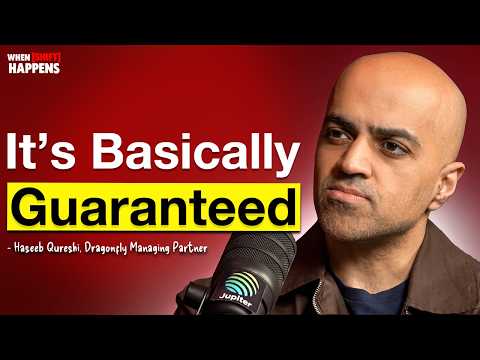
"How is that possible?" Qureshi asks. "The answer is that you just didn't do the obvious thing which is stay in the market. Just stay in the market. As long as you stay in over a long enough time horizon, you will make money. It's basically guaranteed."
The locked-up nature of venture capital, he argues, actually serves as a feature rather than a bug — it forces discipline that retail investors lack. VCs are never forced sellers, and much of the advantage in crypto comes from simply not being forced to liquidate at inopportune moments.
🎯 Understanding Market Regimes: Growth vs. Cash Flow
A critical framework for understanding crypto valuations emerged from the discussion: the distinction between growth regimes and cash flow regimes.
Cash flow regimes are straightforward: show me the money. Markets don't care about your story — only your P&L statement matters. Utility companies live here. Mature businesses live here.
Growth regimes are different. Growth regimes trade on expectations of the future, not present cash flows. Tesla's valuation doesn't rest on car sales — it rests on the belief that autonomous vehicle fleets will replace Uber and that Optimus robots will transform labor markets.
"The question is, where is Ethereum?" Qureshi poses. "Is Ethereum in the cash flow regime or is it in the growth regime? And I'm telling you demonstrably the market is treating it as though it's in the growth regime."
Ethereum's price doesn't significantly react to fee increases or burn mechanisms. It reacts to narrative shifts and growth expectations. The market is telling anyone who listens that crypto remains a bet on exponential future growth — not present fundamentals.
🏛️ The Institutional Wave Is Just Beginning
Despite the perception that "everyone is already in crypto," the data tells a dramatically different story.
Most institutional investors have zero crypto exposure. Among those who do allocate to digital assets through vehicles like Dragonfly, exposure typically represents less than 1% of portfolios.
Recently, Morgan Stanley began approving their wealth management division to recommend digital assets to high net worth clients — but only at allocation levels of "multiple percents." Until very recently, the universal advice from wealth managers was simple: don't touch this.
Perhaps most telling: Vanguard, the largest ETF provider in the United States, only approved Bitcoin ETFs in late 2024 — and that's for BlackRock's IBIT product, not their own.
"We are still in the early innings of how institutions and how the institutional asset management universe embraces crypto," Qureshi emphasizes.
🗳️ The Generational Transfer of Power
One of the most powerful predictors of crypto adoption isn't political affiliation or economic philosophy — it's age.
When the FIT 21 legislation (predecessor to the Clarity Act) passed the House, the biggest predictor of who voted in favor wasn't party alignment. It was generational cohort.
"Old people don't know what the hell is going on," Qureshi states bluntly. "They don't know what crypto is. They find it scary. They heard about it in the news and their kids are the ones who are using crypto."
For college students entering university today, Bitcoin has existed their entire conscious lives. The protocol is 18 years old. Ethereum launched when current 20-year-olds were 10 years old — long before most people develop financial literacy.
As generational handover occurs — as baby boomers age out and younger cohorts assume positions of institutional power — crypto adoption will accelerate not through conversion, but through replacement.
📱 The Cloud Computing Parallel
A useful analogy emerged from the conversation: the enterprise shift to cloud computing.
In 2015-2016, London-based enterprises were tentatively exploring cloud infrastructure. Swiss companies remained firmly opposed. The refrain was universal: "Our data won't be in our buildings. We have people taking care of our servers. We don't know where it is."
The shift didn't happen through convincing the existing generation of CTOs and CFOs. It happened when a new generation assumed C-suite roles for whom cloud infrastructure was obviously superior.
That transition took 5-10 years for a relatively niche technology question affecting enterprise IT departments. Crypto involves money — something that touches everyone, including people who don't work yet. The timeline will be longer, but the direction is set.
🪙 When Bitcoin Reaches Saturation
What does Bitcoin look like at market saturation?
"Saturation looks like Bitcoin is very boring," Qureshi explains. "It looks like young people don't talk about Bitcoin anymore. That's something their parents do. That's how you'll know it's saturated."
The signal will be cultural: when discussing Bitcoin with your children feels cringe, when it's no longer countercultural or risky but simply the default recommendation from Morgan Stanley and Vanguard — that's when the chasm has been crossed.
Only then will Bitcoin potentially begin to trade like gold used to trade: as a mature store of value asset rather than a volatile bet on future adoption.
Until that point, expecting Bitcoin to behave like gold is a category error. "Something that may in the future become like gold is still going to be very volatile on the basis of how long is it going to take for this thing to become gold," Qureshi notes.
🚀 Why the Pioneers Are Leaving (And Why That's Bullish)
Kyle Samani's departure from Multicoin Capital sparked renewed hand-wringing about talent leaving crypto. But Qureshi offers a contrarian take: this is healthy and normal.
"There's a big difference between the pioneers and the settlers," he explains. "They're always different. It's like a law of human nature. The people who push their way out west to go find California and to populate the new world are not the same people who will eventually build the towns."
For Samani specifically, the vindication arc is complete. Multicoin was one of FTX's largest investors — a position that nearly destroyed the firm when Sam Bankman-Fried's fraud was revealed. Their Solana position, once valued above $200, collapsed to $8.
They held through the darkness and were proven right. Solana recovered dramatically. For a pioneer with that kind of crowning achievement and with significant wealth already generated, moving on is natural — not an indictment.
"The best drug is not the money made. It's 'I told you so,'" Qureshi observes. "Kyle's had plenty of opportunities to feel that."
More importantly, crypto is no longer the Wild West. The industry has entered what Qureshi calls "the buildout phase" — execution over ideation, scaling over discovery.
"We are now in the buildout phase of crypto. We're in the execution phase. And if you are an ideas person and you're like, hey, I need the wild west, I need the craziness... it's not here anymore."
📊 Social Media After 2010: A Template for Crypto After 2025
By 2010, nearly every major social media platform that would come to dominate had already been created: LinkedIn, Facebook, Yelp. The only meaningful exception was TikTok.
Yet social media's explosive growth happened after 2010. The ideation phase was complete. The execution phase — the 10-30x scaling — came afterward.
"Social media was the story, but the rate of new company creation... the ideas were already all there by 2010. The rest of that was execution. The rest of that was the buildout," Qureshi explains.
This is where crypto sits today. The fundamental primitives exist. The remaining work is scaling, refining, and mainstream integration — which paradoxically may generate the largest returns, even if it feels less exciting than the pioneering days.
🧠 Silicon Valley's Secret Sauce
What makes Silicon Valley irreplicable? Three factors stand out:
1. Celebration of Failure
In Silicon Valley, you can fail upwards. In most places around the world, failure remains a career-ending stigma despite lip service to the contrary. True risk-taking requires cultural permission to fail without permanent consequences.
2. High Trust, Low Litigation
Despite America's notoriously litigious culture, Silicon Valley operates with remarkably high trust. People share ideas freely. NDAs are rare. The assumption is that rapid information exchange benefits the entire ecosystem more than protecting individual secrets.
This is why all major AI labs have essentially equivalent capabilities despite massive R&D investments — engineers meet at coffee shops, go on walks, attend house parties, and share trade secrets. Knowledge disseminates rapidly, forcing competition and preventing monopolistic capture.
3. Incestuous Talent Flows
California makes non-compete agreements illegal. In New York, Boston, and most other jurisdictions, non-competes are standard — effectively taking talent offline for years after departures.
Silicon Valley embraced the opposite philosophy: efficient information transfer across companies benefits the ecosystem more than it hurts individual firms. Short-term protection of trade secrets matters less than long-term competitive dynamism.
🌊 The AI Brain Drain Question
Should people stay in crypto when AI is attracting capital and talent?
Qureshi's answer might surprise: maybe not.
"AI is unequivocally the most important technology of the 21st century. Zero doubt in my mind about that," he states. "And if you cannot really identify the value you're bringing to crypto, then maybe it's time for you to go."
This isn't bearish — it's honest. The reallocation of capital and talent is what capitalism does. Markets signal where resources are most valuable.
But for those building in crypto, for those executing on proven primitives, for those scaling existing networks and applications — the buildout phase offers its own form of vindication and reward.
✅ The Long-Term Greedy Playbook
Goldman Sachs has a famous phrase: long-term greedy.
Short-term greed looks like greed but is actually stupidity. It's King Midas starving because everything he touches turns to gold. Long-term greed means making decisions that may not maximize immediate returns but generate vastly more wealth over extended time horizons.
For Qureshi, that means:
- Staying responsive and available to portfolio companies
- Outworking competitors who treat VC as a genteel job
- Holding crypto assets through volatility rather than trading around positions
- Committing personal capital to all Dragonfly funds
- Maintaining a simple personal finance approach: venture investments, crypto holdings, ETFs, and angel investments — mostly buy and hold
"As long as you stay in over a long enough time horizon, you will make money. It's basically guaranteed," Qureshi emphasizes. "But people don't do that."
🎭 Status Quo Bias and the Most Insidious Trap
Among cognitive biases that plague investors, Qureshi identifies status quo bias as the most insidious.
Status quo bias is the expectation that current conditions will persist because, if they weren't resilient, why would they be the status quo today?
The AI revolution has partially broken this mentality in technology broadly. There's renewed belief that fundamental change is possible — in longevity, gene editing, quantum computing, nuclear energy, autonomous systems.
But within crypto, particularly among sophisticated observers, a form of status quo bias persists: the belief that structural limitations on adoption or regulatory hostility represent permanent conditions rather than temporary states.
Breaking status quo bias requires believing in exponentials — believing that adoption curves can bend sharply, that regulatory frameworks can shift rapidly, that what seems impossible today becomes obvious tomorrow.
🔮 The Exponential Thesis
Throughout multiple crypto winters — 2018's ICO collapse, the 2022 post-FTX darkness — the correct decision was always the same: stay in the market.
In 2018, Bitcoin fell from $19,000 to $4,000. Ethereum dropped below $100. The prevailing sentiment was that the entire industry had been a collective delusion.
"You had to believe that something much bigger, much longer term was happening. Of which this is one temporary snapshot," Qureshi reflects.
After FTX, when Bitcoin traded below $20,000 and observers wondered if the U.S. government would ban crypto entirely, the same principle applied.
"In hindsight, it looks obvious, right? But it was not. It was not obvious," he emphasizes.
Poker offers an instructive parallel: you can't win every hand, even if you're the best player against the worst opponent. Success isn't about individual decisions — it's about strategies.
The strategy isn't timing perfect entries and exits. The strategy is understanding that crypto will be dramatically larger in 10 years than today, just as it's dramatically larger today than 10 years ago.
🏁 Final Thoughts: Saturation, Settlers, and the Long Game
Crypto has survived more boom-bust cycles than virtually any other technology or asset class. This resilience is extraordinarily rare.
"Usually what happens is you boom, you bust and the market realizes, 'Oh, we were collectively deluded. We're done. Great. Done. Never again. What a mistake.' Instead, crypto booms and then busts and then booms and then busts, then booms again. That doesn't happen," Qureshi notes.
The pioneers may be leaving. The Wild West may be tamed. But the buildout phase — the scaling phase — may generate the largest returns of all.
Social media achieved 10-30x growth after 2010, when all the fundamental innovations were already complete. Crypto may follow a similar trajectory: less exciting to pioneers, more profitable for settlers.
The ultimate sign of success? When Bitcoin becomes boring. When it's what your parents do. When Morgan Stanley and Vanguard unanimously recommend it.
Until then, volatility will persist. Narratives will shift. Sentiment will oscillate between euphoria and despair.
And through it all, the simple strategy remains: believe in the exponential, stay in the market, and play the long game.
Because the surest way to miss the exponential is to let short-term noise convince you the trend is over.
More from When Shift Happens

The Universal Truth About Crypto: Why Accumulation Beats Trading Every Single Ti
There's a fundamental truth about crypto that becomes clearer with every market cycle: the best performers are the ones ...

The Bitcoin Price Question Misses the Real Story: A $400 Trillion Market in Flux
When critics question whether Bitcoin at $80,000, $100,000, or even $150,000 is "too expensive," they're missing the for...
Why the Co-Founder of Ledger Put 100% of His Liquid Net Worth Into Bitcoin — And
🧭 Introduction: The Entrepreneur Who Chose Bitcoin Over EverythingEric Larchevêque is not a typical Bitcoin believer. H...

Volatility Theater vs. Generational Wealth: A Framework for Signal Over Noise
📊 The Volatility TrapMore volatility doesn't make markets easier to trade — it makes them appear easier to short-term t...

Prediction Markets as Truth Infrastructure: Building the Wisdom of Crowds Into W
🔮 The Core Thesis: Markets as Truth MechanismsAs artificial intelligence reshapes information landscapes and social med...

Why the Digital Asset Ecosystem Will Reach $50 Trillion — And Why Most Investors
📊 The Hardest Game: Making Money vs. Keeping ItThe cryptocurrency and digital asset space presents a unique paradox: it...