There's a fundamental truth about crypto that becomes clearer with every market cycle: the best performers are the ones who do nothing at all. While traders frantically chase pumps and dumps, the real wealth accumulation happens through a strategy so simple it seems almost boring — buy, hold, and never sell.
💡 The Mindset Shift: From Trading to Accumulating
A significant psychological transformation occurs when market participants shift from viewing crypto as a trading vehicle to understanding it as humanity's pension plan — an opportunity to invest directly in the infrastructure rails upon which the entire agentic economy will run. This isn't hyperbole; it's a recognition that blockchain technology represents ownership in the foundational layer of the next economic paradigm.
The challenge? This mindset becomes substantially easier to adopt when generating significant income outside of crypto holdings. For most people working traditional jobs, crypto represents dreams and hopes — the path to an exceptional life that regular income can't provide alone. This creates immense pressure to trade, to try to accelerate returns, to maximize every market movement. But this pressure is precisely what destroys returns.
📊 The Mathematical Reality: Numbers Don't Lie
Crypto follows Metcalfe's law and tracks along a predictable log regression channel over time. The path forward is mathematically clear to anyone willing to zoom out and look at the data. This creates a paradox: if the long-term trajectory is known, why would anyone ever sell?
Analysis of accumulation strategies reveals compelling evidence:
- The optimal entry strategy: Buy when price reaches between one and two standard deviations oversold on the log regression channel
- Frequency: Approximately two major buying opportunities emerge every four years — typically one mid-cycle and one end-of-cycle
- The approach: Save capital between opportunities, deploy aggressively during oversold periods, then do nothing
- The result: Compounding at rates that dwarf active trading strategies
The two standard deviation signal provides fewer entry points but delivers substantially higher quality opportunities compared to more frequent signals.
🎲 The Trading Trap: Why Even Professionals Fail
Consider the brutal mathematics of selling: How much should be sold at cycle tops? And how much gets reinvested at the bottom?
Taking 25% profit provides lifestyle chips but leaves less capital in the market to compound. Selling 50% with the intention of buying back lower sounds logical on paper, but execution proves nearly impossible in practice. As one macro veteran with 35 years in the industry noted: "I don't know anybody who can do it."
The evidence is overwhelming:
"Look at how many traders there are and look at how many of them actually made a lot of money consistently over time from trading."
The list of consistently profitable macro traders across decades is vanishingly small: Paul Tudor Jones, Louis Bacon, Stan Druckenmiller — these are five standard deviation talents who essentially don't exist in normal probability distributions. Even these legendary names generated substantial wealth through asset management fees after achieving scale, not purely from trading returns.
There's a dark joke in traditional finance that reveals this truth: the most profitable customers for every brokerage firm are the dead ones — those who literally cannot trade and therefore cannot destroy their returns through activity.
🧠 The Current Reality: Traders Losing Their Edge
An increasing number of crypto traders from the 2019-2021 era are reaching an uncomfortable conclusion: the only money they actually kept came from Bitcoin they bought and held, not from their trading activity. Despite generating significant P&L through active trading, those gains were eventually given back to the market. The passive allocation outperformed the active strategy in every meaningful timeframe.
This pattern is repeating in the current cycle. Participants who sold expecting pullbacks are now chasing price higher, unable to execute the very strategy they planned. "People can't do it. They're doing it now and they're chasing all the way up."
⚡ The Energy Efficiency Framework
When viewed through the lens of energy expenditure versus output, the superiority of passive accumulation becomes even clearer:
The passive strategy: Buy Bitcoin, do nothing. Minimal energy expenditure, maximum capital efficiency. This represents the most efficient trade possible in terms of energy-to-output ratio.
The active strategy: Constant monitoring, emotional volatility, mental energy drain, stress when prices drop, euphoria when prices rise. Vast amounts of human energy consumed, yet the system produces by definition less optimal results.
As one participant reframed it, this isn't about "doing nothing" — it's about being patient. The distinction matters. Patience is active discipline; it's the conscious choice to let the trade work, to allow capital to compound as long as possible, to resist the inefficient urge to constantly adjust positions.
⏰ The Urgency: A Closing Window
The concept of the "economic singularity" — the point at which AI, agents, and blockchain infrastructure fundamentally transform economic relationships — was initially projected to arrive in six years. That timeline has now compressed to approximately four years away.
This creates urgency: there's a four-year window to accumulate as much exposure as possible to blockchain infrastructure before entering the biggest period of economic uncertainty in modern history. While the fate of corporations through this transition remains unclear, blockchain technology is positioned to survive and thrive through the transformation.
💎 The Undeniable Examples
The wealthiest participants in crypto aren't the traders — they're the holders who did "precisely nothing" with their positions:
- Wences Casares — accumulated and held
- Dan Morehead — long-term institutional accumulation
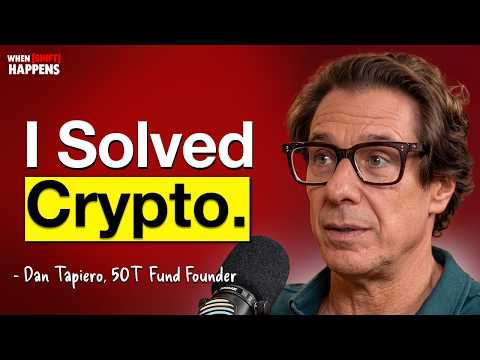
- Dan Tapiero — patient capital deployment
These aren't traders. They're patient capital allocators who understood the asymmetry early and had the discipline to let the trade work over years and cycles rather than months and quarters.
🎯 The Simple Truth
After years of complexity, sophisticated strategies, and endless market analysis, the conclusion returns to the fundamentals: never sell, and buy every month. It's the left curve and right curve converging on the same answer — the simplest strategy is also the optimal one.
The world is experiencing endless debasement of currency. Meanwhile, everything is moving on-chain. AI agents are proliferating. The infrastructure for the next economy is being built in real-time. Why would anyone sell exposure to this?
The answer increasingly is: they shouldn't. The scalpers will continue scalping. The traders will continue trading. And the holders will continue compounding wealth at rates that trading simply cannot match — not through superior intelligence, but through superior energy efficiency and patience.
In a world obsessed with activity, doing nothing has become the ultimate alpha.