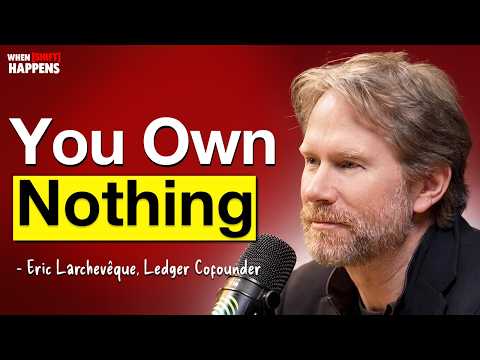
🔐 From Bank Failures to Bitcoin Maximalism: Eric Larchevêque on Resilience, Responsibility & Why He's All-In
🧭 Introduction: The Entrepreneur Who Chose Bitcoin Over Everything
Eric Larchevêque is not a typical Bitcoin believer. He's the co-founder of Ledger, one of the world's leading hardware wallet companies, and Coin House, a major gateway for digital asset access in France. But beyond the business success, Larchevêque embodies a rare conviction: he holds 100% of his liquid net worth in Bitcoin.
This isn't reckless speculation. It's the result of decades of hard-earned lessons about money, sovereignty, and the fragility of traditional systems. From losing all his money in a Latvian bank collapse to getting his gold bars trapped in Luxembourg, Larchevêque learned early that ownership is an illusion — unless you hold the keys yourself.
In this conversation, he unpacks why Bitcoin isn't just an investment thesis, but a philosophy of resilience — and why the world is heading toward a future where personal responsibility will be the ultimate currency.
💰 The Bank Collapse That Changed Everything
Larchevêque's Bitcoin journey didn't start with a whitepaper. It started with losing everything.
In 2004, long before Bitcoin existed, he was living as an expat in Eastern Europe, managing his assets through a neo-bank in Latvia. One day, while attending a consumer electronics show in Las Vegas, his card stopped working. The bank's website went offline. Within hours, he learned the bank had gone bankrupt — and all his money was gone.
"I lost all my money. It was a hundred thousand euros, which was all my net worth at the time. I was maybe 28 years old."
Eventually, liquidators offered him a deal: sign away his legal claims, and he'd get a third of his money back. He agreed — and ended up moving to Riga, Latvia, where the story took another turn.
But the lesson was clear: money in a bank is not a final asset. It's a liability you're owed.
🪙 The Gold Bars He Couldn't Access
Years later, Larchevêque made another painful discovery. He had stored gold bars in a Luxembourg bank vault — not his own safe, but the bank's vault. When he moved to Eastern Europe and began doing business there, the bank decided his profile was "too risky."
"They told me I had 30 days to close my accounts. I said, 'Okay, give me my gold.' They said, 'No. We cannot send it to you. You cannot enter the bank. You are persona non grata.'"
The bank eventually sold his gold and wired him euros — exactly what he didn't want. His plan was to own a hard, sovereign asset he could access in a crisis. Instead, he learned that custody without control is just another form of debt.
These two experiences became the foundation of his Bitcoin conviction.
🔥 Why Bitcoin? "It's the Only Asset That Will Survive Centuries"
When Larchevêque discovered Bitcoin in 2013, he didn't see it as a way to get rich. He saw it as the only way to protect the fruit of his work.
"I never saw Bitcoin as a way to enrich myself. I always saw it as a way to protect the fruit of my work and send it into the future."
Over the next 18 months, he systematically moved all his assets into Bitcoin. Not because he thought it would moon — but because he believed it was the only asset he could truly own, without third-party risk, confiscation risk, or inflation risk.
His framework is simple:
- Fiat in a bank = not yours
- Gold in a vault = not yours
- Bitcoin in self-custody = truly yours
He counts his net worth in Bitcoin, not euros. And he's at peace with volatility because his time horizon is measured in decades, not days.
📉 The COVID Crash: "I Thought I Was Wrong"
Even true believers face doubt. In March 2020, during the COVID crash, Bitcoin briefly dropped below $4,000. Larchevêque watched his entire net worth collapse in real-time.
"I remember I was in confinement, looking at the price crash. I said, 'Wow, I was wrong.' But then I told my wife, 'What do we have to watch on Netflix?' Because tomorrow is another day."
He accepted the possibility of being wrong. But he also knew that if he lost everything, he could rebuild. That's the mindset of an entrepreneur who understands money is a tool, not an identity.
Today, he still believes he could be wrong — but assigns that probability as extremely low. And he's structured his life accordingly.
⚙️ Building Ledger: What It Taught Him About Human Nature
In 2014, Larchevêque co-founded Ledger, a hardware wallet company designed to let people self-custody their Bitcoin without exposing their private keys to the internet.
The golden rule of Ledger is simple: never give anyone your 24-word seed phrase.
Yet despite endless warnings, education, and fail-safes, people still give them away — often to sophisticated social engineering scams.
"Personal responsibility is hard. Even people who are smart, who should know better, sometimes make mistakes when they're tired or stressed."
One of Larchevêque's friends — a successful entrepreneur who sold his business for $50 million — lost his entire Bitcoin wallet after falling for a fake Celsius recovery email late at night.
The lesson? Self-custody is powerful, but it requires discipline, systems, and humility.
Larchevêque's own strategy: he keeps his 24-word seed phrase in a sealed envelope with the words "Do not open under any circumstances" — and stores it outside his home. That way, even under duress, he can't access it.
🚨 The Kidnapping of His Co-Founder
In early 2025, Larchevêque's Ledger co-founder David and his wife were kidnapped by criminals. David was tortured. His finger was severed. Videos were sent to Larchevêque demanding 10 million euros in Bitcoin as ransom.
Larchevêque didn't pay. He cooperated with French special forces, who eventually arrested the criminals. The ransom was never paid, and no one has ever successfully completed such an extortion in France.
"I didn't have access to my Bitcoins myself. I made a video a few weeks before explaining that. So when they asked, I made them watch the video. They believed me — but then said, 'Call your friends. They'll give you Bitcoin because they know you're good for it.'"
The key insight: time is the most valuable commodity in a kidnapping scenario. The longer you delay, the more likely law enforcement can intervene.
Larchevêque now lives with security measures in place. His family has protection. He has weapons at home. It's not the life he imagined — but it's the reality of being publicly associated with Bitcoin in France, where 80% of global crypto-related kidnappings occur.
🧠 Time Preference, Civilization, and the Marshmallow Test
Larchevêque's Bitcoin thesis isn't just financial — it's civilizational.
He explains it through the famous Stanford marshmallow experiment: kids who could delay gratification (wait 15 minutes for a second marshmallow) tended to have better life outcomes. That's high time preference — the ability to sacrifice now for future gain.
Bitcoin, he argues, is sound money with high time preference. It can't be inflated away. It rewards patience. It encourages saving over consumption.
"A civilization with low time preference watches Netflix all day. A civilization with high time preference builds cathedrals. Money defines which one you become."
Fiat currency, by contrast, punishes saving. Inflation erodes value. Governments print money to solve short-term problems, pushing costs into the future. This creates a low time preference society — one that consumes now and ignores consequences.
Bitcoin is the remedy. It realigns incentives. It heals the relationship between present and future.
🌍 What Does a World of "Bitcoin at $1 Million" Look Like?
Larchevêque believes Bitcoin will reach $1 million — possibly within the next decade. But he's not celebrating.
"It means we're moving into a world of great suffering. A world where fiat has failed, where wars and instability are widespread. Bitcoin wins because everything else loses."
He's not rooting for collapse. He's preparing for it. And he believes anyone who ignores Bitcoin today is taking a massive opportunity cost risk.
His advice? Dollar-cost average (DCA) into Bitcoin regularly. Don't try to time the market. Don't put in money you need tomorrow. And forget about it.
"100% of the people who invested in Bitcoin and forgot about it won. 100% of the people who tried to trade it, chase altcoins, or take revenge trades lost everything."
🚀 The Bitcoin Society: Building Resilience in France
Larchevêque's latest venture is TBSO (The Bitcoin Society), a publicly listed company on Euronext built around the values of Bitcoin, resilience, and personal responsibility.
It has three pillars:
- Scale Club: A community and toolkit for entrepreneurs
- Invest Club: Education on sovereign assets (Bitcoin, gold, rare collectibles, music catalogs)
- Media & Culture: Pushing for economic liberalism, lower taxes, and entrepreneurial freedom in France
His co-founders include Nathan Benshimol (crypto industry veteran) and Tony Parker (former NBA star and investor). Parker, Larchevêque notes, has been a quiet Bitcoin holder for years — and is now "coming out of the closet."
🧘 On Happiness, Freedom, and the Power to Say No
When asked if he's happier now than when he was younger, Larchevêque doesn't say "yes" because of wealth. He says yes because of freedom.
"Money is not happiness. But money gives you freedom. And freedom is happiness. The highest achievement in life is the power to say no to anyone."
He doesn't own watches or luxury cars. He doesn't care about status symbols. What he values are experiences — and the ability to work on what he loves, every single day.
"If you wake up every morning doing what you love, that's the best thing you can have. Do everything to achieve that. Cut toxic relationships. Escape bad situations. Focus on yourself."
🔐 Final Thoughts: Why Bitcoin Matters
Eric Larchevêque's story is a masterclass in conviction, resilience, and long-term thinking.
He doesn't own Bitcoin to get rich. He owns it because:
- He learned the hard way that banks can fail
- He learned that gold in a vault isn't yours
- He learned that fiat is a liability, not an asset
- He learned that freedom requires sovereignty
And he's willing to live with the consequences — volatility, security risks, and social criticism — because he believes the alternative is worse.
"Bitcoin is the remedy. It realigns civilization. It heals the relationship between present and future. And if you don't understand the problem it solves, you won't understand why it has value — until it's too late."
For those who want to go deeper, Larchevêque has written a book on Bitcoin (in French), runs a YouTube channel on entrepreneurship and sound money, and is building The Bitcoin Society to help people take responsibility for their financial futures.
More from When Shift Happens
Volatility Theater vs. Generational Wealth: A Framework for Signal Over Noise
📊 The Volatility TrapMore volatility doesn't make markets easier to trade — it makes them appear easier to short-term t...

Prediction Markets as Truth Infrastructure: Building the Wisdom of Crowds Into W
🔮 The Core Thesis: Markets as Truth MechanismsAs artificial intelligence reshapes information landscapes and social med...
Why the Digital Asset Ecosystem Will Reach $50 Trillion — And Why Most Investors
📊 The Hardest Game: Making Money vs. Keeping ItThe cryptocurrency and digital asset space presents a unique paradox: it...
Why Gen Z Might Choose Bitcoin Over AI—And What That Means for Markets
📍 The New Occupy Movement: From Wall Street to AIA fundamental shift is emerging in how younger generations perceive fi...
Why Millennials Can't Afford Homes — And How Bitcoin Disrupts the American Dream
The intersection of housing affordability, wealth preservation, and investment philosophy is undergoing a fundamental sh...
The Preferred Stock Revolution: Inside Strategy's Tax-Deferred Bitcoin Play
📊 Bitcoin's Journey & Strategy's RoleWhen MicroStrategy first began its Bitcoin accumulation strategy, BTC was trading ...