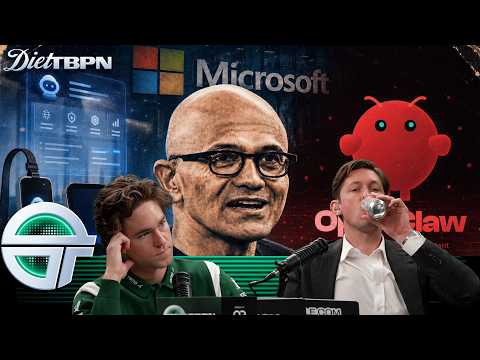
🤖 Bots Now Outnumber Humans Online + Microsoft's Agentic Future
🎯 Overview: Microsoft Goes All-In on Agents
Microsoft Build 2025 delivered a clear message: the future is agentic, and the compute lives in the cloud. From new foundation models to hardware that looks more like a security badge than a smartphone, Microsoft is betting that AI agents — not apps — will define the next computing paradigm.
The company unveiled MAI Code One Flash and MAI Thinking One, its first coding and reasoning models, emphasizing cost efficiency in an increasingly competitive race to the bottom on price-per-token. But the real story wasn't just about models — it was about infrastructure, integration, and a vision of thin clients powered by cloud-based intelligence.
🔓 Microsoft Scout: OpenClaw Comes to the Enterprise
Microsoft announced Scout, its first proactive AI agent for Copilot, which will be powered by OpenClaw — the open-source framework that has been generating buzz (and Mac Mini shortages) in recent months.
Scout connects across Teams, Outlook, OneDrive, and SharePoint, tapping into the data that powers daily workflows: chats, emails, calendars, and contacts. The catch? It's designed for those fully committed to the Microsoft ecosystem.
"You only welcome a growing open framework onto your turf when you're confident you can control the ground it stands on." — Alex Heath
Microsoft is positioning itself as a platform company rather than trying to own the entire stack. By embracing OpenClaw and contributing security guardrails back to the open-source project, Microsoft gets to ride the agent wave while maintaining control over the environment in which these agents operate.
This is a smart play. OpenClaw's rough edges — like the security issues seen with Meta AI and Instagram account theft — are mitigated when the agent operates within a walled garden where the walls are actually safe. Microsoft gets the upside of agent-driven productivity without the chaos of an ungoverned system.
As Alex Heath noted, this also positions Microsoft favorably against Apple, which is highly unlikely to create a white-glove experience for OpenClaw given its focus on privacy and control. While Apple sold out of Mac Minis during the initial OpenClaw surge, Microsoft is building the enterprise motion that could make Scout the default choice for organizations already invested in the Microsoft stack.
🎴 Project Solara: A Badge That Runs Agents
Perhaps the most unconventional announcement was Project Solara — an Android-based OS designed to run agents instead of apps, distributed across two form factors: a desk device and a portable badge-like device.
The desk device, built on MediaTek silicon, supports voice commands, handoff between devices, and direct access to agents. The portable version looks like a smart keycard or badge, featuring a lightweight form factor optimized for agent interactions.
"The usefulness happens in the cloud without the human needing to be involved because an agent is doing work." — Ben Thompson
Ben Thompson described Project Solara as vaporware at this stage — though the company did show real devices and signed chip partners including Qualcomm and MediaTek. Still, he found the concept extremely compelling, especially in enterprise scenarios where context and compute already live in the cloud.
The thesis: thin is in. When the compute is constrained to the data center, on-device compute becomes less critical. The thinnest possible client — a badge — becomes viable when its sole purpose is to interface with cloud-based agents that do the heavy lifting.
Thompson notes that this model — where the cloud is the hub and multiple devices are spokes — is clearly better for agents than the phone-centric model. Agents work best in the cloud and across apps and devices. The phone might be one of those devices, but it shouldn't be the hub because it's too locked down.
For enterprises, Project Solara could be mandated as employee badges, providing a secure on-ramp to enterprise agents running in the Microsoft Azure and 365 ecosystems. It's a vision of the future that makes sense, particularly when you're all-in on Microsoft infrastructure.
That said, the obvious question remains: Why would you want this over an app on your phone? The answer may lie in the "dumb phone" movement — users who want to delegate tasks without the distraction of endless scrolling. You're not going to watch TikTok on a badge, but you might fire off work tasks that you can review later on your desktop.
📊 Foundation Models: Cost-Efficient, But Not Frontier
Microsoft touted MAI Code One Flash and MAI Thinking One as highly efficient on a cost-per-token basis, though the company did not make a big deal of benchmarks against frontier labs. Instead, comparisons were made to older models from Anthropic and OpenAI.
The more interesting comparison is with Meta. The MAI Thinking One model is reportedly quite competitive with Meta's offerings, which is notable given that Meta has built significant hype around its MSL and TBD Labs efforts.
Microsoft emphasized several differentiators:
- Clean pre-training data: Microsoft claims to have sanitized its training data to avoid legal issues down the road (e.g., New York Times, Harry Potter books).
- No distillation: The company stated it did not distill on another lab's models, addressing accusations that have surfaced in the Elon Musk vs. OpenAI lawsuit.
- Fine-tuning options: Microsoft is offering reinforcement learning (RLE) post-training steps, similar to Amazon's mid-training approach, allowing enterprises to customize models for their specific use cases.
The pitch is clear: a model with great baseline capabilities and good price-performance, optimized for Azure, that enterprises can fine-tune and deploy with predictable costs. Microsoft's strong go-to-market and enterprise sales teams will be critical in driving adoption.
🌍 Macro Context: Bots Now Outnumber Humans Online
In a milestone that arrived faster than expected, agentic traffic has surpassed human traffic online for the first time in internet history, according to Cloudflare CEO Matthew Prince.
Bots now account for 57.5% of internet traffic. Prince had originally predicted this would happen by the end of 2027, then revised it to early 2027 — but it arrived in mid-2025.
"Every time you fire something off, it's hundreds of pages. You see it in the reasoning traces and the tool calls."
This shift underscores the rapid acceleration of agentic workflows. As agents proliferate across enterprise and consumer use cases, the internet is increasingly becoming a machine-to-machine network, with humans as orchestrators rather than primary actors.
🎬 Black Forest Labs: Cinematic Intelligence
In a separate development, Black Forest Labs released a compelling demo featuring filmmaker Martin Scorsese describing a scene using their AI storyboarding tool. The 30-second clip showcases Scorsese's cinematic vision being translated into visual concepts in real-time.
"I need a place that doesn't feel modern. A town, not a village, not a city, almost medieval. Even the streets are narrower, cobblestone. The main road through the town is twisting and turning. Put the camera higher looking down." — Martin Scorsese
The demo positions AI as a tool for cinematic intelligence — not to replace filmmakers, but to accelerate the creative process. While AI-generated content remains controversial in Hollywood, having a director of Scorsese's stature engage with the technology is a powerful signal.
Will it make the next Scorsese film? Probably not this year. But could it be useful in his workflow when thinking about what to work on next? Absolutely.
🏁 Call of Duty: Generative Level Design
In gaming news, the new Call of Duty map format introduces generative level design — not fully transformer-based, but using randomized slabs to create unique map configurations at runtime.
"We have the content to do upwards of 900 [different map configurations]."
The innovation addresses a core problem in multiplayer gaming: the sense of discovery fades after playing a map a handful of times. With Kill Block, that sense of discovery never fades, as the map is remixed every time.
This could be an existential risk for productivity — or at least for podcast schedules.
✅ Key Takeaways
- Microsoft is betting on thin clients and cloud-based agents, with Project Solara as the most radical expression of this vision.
- Scout + OpenClaw positions Microsoft as the enterprise agent platform, leveraging security and ecosystem lock-in.
- Foundation models are competitive but not frontier, with a focus on cost efficiency and clean training data.
- Bots now outnumber humans online, marking a historic shift in internet traffic composition.
- AI is entering creative workflows in gaming and film, with generative design and storyboarding tools gaining traction.
The agent era is here. Whether the badge catches on remains to be seen — but the direction is clear: agents work best in the cloud, and the device is just an interface.
More from TBPN

Alphabet Raises $80 Billion in Equity—The AI War Just Got Real
💰 Alphabet's Historic $80 Billion Equity RaiseIn a move that surprised many on Wall Street, Alphabet announced an $80 b...
The Creator Economy Goes Theatrical: How YouTube Finally Broke Through to Hollyw
🎥 The YouTuber Box Office BreakthroughAfter years of false starts, 2026 has become the year YouTube creators finally co...
New Glenn Explosion, Enterprise AI Spending Spiral, and the Return of Fossil Fev
🔥 Blue Origin's New Glenn Suffers Catastrophic Static Fire FailureBlue Origin experienced a major setback at Launch Com...
Inside Altimeter's Record Run: From Anthropic's Breakout to the Launch of Americ
Brad Gerstner returned to the pod fresh off two of the biggest months in Altimeter's 18-year history — and with a messag...
Ferrari's Electric Bet: A $640,000 Question Mark in a Shifting Market
🚗 The Luche Launch: Ferrari Goes ElectricFerrari unveiled its first-ever electric vehicle, the Luche (Italian for 'ligh...
The Mag 7 Needs a Bigger Boat: SpaceX, OpenAI, and the Great American IPO Mini-B
🔥 IPO Mania: America's Tech Boom ReturnsThe Wall Street Journal and Financial Times are calling it a "mini boom," but t...