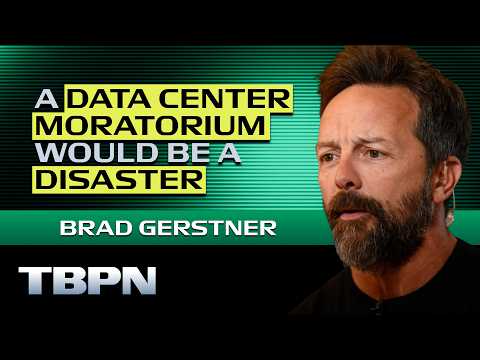
🚀 The Brad Gerstner Playbook: Trump Accounts, AI Scaling, and Why Software Multiples Aren't Low Enough
Brad Gerstner returned to the pod fresh off two of the biggest months in Altimeter's 18-year history — and with a message that cut through the noise: the AI revenue narrative is real, but fragile. While Silicon Valley obsesses over token maxing and ROI debates, Gerstner sees a different picture: a supply-constrained market where every cloud provider is token-constrained, demand is accelerating, and the next nine months could redefine the competitive landscape.
📊 The Anthropic Effect: Why One Company Saved the AI Trade
According to Gerstner, Anthropic is the fastest-growing company in the history of capitalism — and its performance this year may have single-handedly kept the market's AI narrative intact. Without Anthropic's revenue trajectory, Gerstner believes the broader market could have faced a 10-15% correction.
"Had Anthropic not delivered its revenues that it's delivered this year, I think the stock market would be down 10 or 15%. I think it's that important to the entire narrative."
While OpenAI and Google posted solid numbers, they didn't blow away expectations. Anthropic, on the other hand, delivered on both revenue scale and gross margin efficiency, with management signaling potential positive free cash flow as early as Q2. That proof point became the foundation for the market's continued belief in AI monetization.
The backdrop? A market that started the year deeply skeptical. Two months ago, major indices were down on the year. Then came the data: Dell's AI server revenues surged 750% year-over-year, growing from a $1 billion business to $16 billion. Micron rallied from the low hundreds to over $1,000. Dell climbed from roughly $80-90 to $400. These weren't incremental moves — they were seismic shifts driven by real AI infrastructure demand.
🔬 The Token Maxing Debate: Bears vs. Bulls (and the Data in Between)
The latest bear case centers on "token maxing" — the idea that enterprises are overspending on AI with little ROI, and that revenue will collapse once optimization kicks in. Gerstner's response? The truth is in the middle, and the data supports continued growth.
Altimeter conducted proprietary research across 300 enterprises to understand spending behavior:
- Enterprises actively optimizing still expect to grow AI spending by over 50% year-over-year
- Enterprises planning to optimize project 90% growth in the next 12 months
- Optimization is real — but penetration of AI use cases remains in its infancy
"Of course people optimize along the way, but we are so early in the adoption curve. They're barely using coding today... and they haven't really even started on using AI for knowledge work more generally."
The implication: even with optimization, the growth curve on enterprise penetration and use case expansion is steep enough to power through. Coding adoption is still nascent. Knowledge work is barely touched. And the vast majority of global enterprises haven't started using AI at all.
⚡ Inference Scaling: Jensen's Billion-X Vision
One of the key turning points for Gerstner's thesis came during a podcast conversation with NVIDIA CEO Jensen Huang, who made a striking prediction:
"Brad, inference isn't going to 100x. It's not going to thousand-x. It's going to 1 billion-x — because agents are going to be talking to agents."
That insight — combined with the release of Claude Opus 4.6 in early December — marked a threshold moment. The model's intelligence and utility felt fundamentally different, signaling that inference-time reasoning had unlocked a new vector of AI scaling beyond pre-training compute alone.
Gerstner pointed to the physical constraints that act as natural governors on AI adoption:
- Limited memory wafers globally
- Limited logic wafers globally
- Constrained powered shell (data center capacity)
- Result: token supply is the bottleneck
This stands in stark contrast to the dot-com era, when fiber optic cable was laid with no immediate demand — the infamous "dark fiber" problem. Today? There is not a dark GPU in the world. There is not a dark token in the world. Every unit of compute is being utilized, and every major cloud provider reported being token-constrained on recent earnings calls.
💼 The SaaS Reset: Multiples Aren't Low — They're at Market
Amid the so-called "SaaS apocalypse," Gerstner offered a contrarian take: software multiples haven't crashed — they've simply normalized.
His analysis shows that after the December correction, software companies now trade at approximately 22-23x real earnings (including stock-based compensation) — roughly in line with the broader market multiple. That's a far cry from the 40-50x multiples that prevailed during the zero-rate environment.
"Software is trading at a higher multiple than NVIDIA. NVIDIA is trading about 13x earnings for 70% growth... When I hear everybody crying that these multiples aren't fair, it looks to me like they reset from an above-market multiple to the market multiple."
The implication? There's more downside risk than upside unless a company can prove it's "in the token flow."
Winners in the new regime:
- Snowflake — up 35% in a single session, benefiting from database query growth tied to AI usage
- Databricks — positioned in the data infrastructure layer
- ServiceNow — enterprise workflows increasingly powered by AI agents
Losers (or "too hard" basket):
- Salesforce and other CRM/front-office tools that compete directly with LLM-native interfaces
- Companies with thin competitive moats that are vulnerable to model-driven disruption
Gerstner's framework is simple: if AI usage increases and your revenue decreases, expect a below-market multiple. If your business accelerates because of AI, you'll earn a premium. The rest? Too hard to call.
🏗️ Data Center Moratorium Risk: "Horrific for America"
One of the more urgent concerns Gerstner addressed was the rising activist movement calling for a data center construction moratorium — a policy idea he described as potentially catastrophic.
"All of our GDP growth is coming from the fact that we are building data centers and driving AI and driving productivity improvements in the economy. A data center moratorium would thrust us straight into a recession and high unemployment."
The risks extend beyond economics:
- National security: Ceding AI leadership to China overnight
- Economic security: Loss of the primary engine of GDP growth
- Jobs: Elimination of the fastest-growing sector in the U.S. economy
Gerstner acknowledged that local communities have legitimate concerns — particularly around water usage and electricity costs — but argued that the solution is to create tangible dividends for those communities, not to halt progress.
He's now working on an initiative (not yet public) involving cloud companies, semiconductor firms, model builders, and the White House to deliver direct, measurable benefits to communities hosting data centers. The goal: build a "socio-political bridge" over the next three years until the consumer and enterprise benefits of AI become undeniable.
"In three years, it's going to be obvious the abundance and the benefits that AI is driving. Everybody's going to have their own personal assistant in their pocket for next to nothing. But we have to give people tangible benefits now to get us over that bridge."
🌌 SpaceX, xAI, and the Elon Compute Play
The conversation pivoted to SpaceX's upcoming IPO, which Gerstner sees through the lens of compute economics rather than aerospace alone.
His thesis: Elon Musk is solving the AWS problem at planetary scale.
The "AWS problem" originated when Amazon realized it had to build data center capacity for peak demand (e.g., Black Friday), leaving infrastructure idle the rest of the year. Jeff Bezos turned that inefficiency into AWS — one of the most profitable businesses in tech history.
Now, Musk is doing the same with xAI and Elon Web Services (EWS). By building massive compute capacity for xAI's Grok and other AI workloads, Musk can rent out excess capacity during off-peak times. Nobody on Earth is better at turning electrons into tokens than Elon, Gerstner argued, pointing to recent deals with Anthropic and Cursor as proof that the model is already working.
"Expect a lot more data centers out of Elon — on Earth and eventually in space."
The Cursor deal and Anthropic partnership, in Gerstner's view, fundamentally shifted market sentiment on the SpaceX IPO from "slightly concerned" to "quite excited."
🏢 Meta's Enterprise Push and the Consumerization of B2B
Recent reporting revealed that Meta is hiring enterprise-focused FTEs — a surprising move for a company synonymous with consumer social products. Gerstner wasn't shocked.
"The second you start spending a hundred billion dollars on capex annually, you run into the AWS problem."
Meta's compute buildout for Llama and other AI initiatives creates the same dynamic: they need to monetize excess capacity. That means entering the enterprise AI market, whether through hosted inference, agents, or AI-as-a-service offerings.
Is it a natural fit? Gerstner sees it as "hard" — taking a 120% consumer-focused organization and pivoting to enterprise sales is no small feat. But he also noted that product-led growth has blurred the line between consumer and enterprise, particularly in coding tools like Cursor. Meta's relationships with hundreds of thousands of businesses through its ads platform also provide a potential wedge.
⚖️ Kirkland & Ellis and the $500M In-House AI Bet
When law firm Kirkland & Ellis announced plans to invest $500 million into proprietary AI software, the market reacted with skepticism. Gerstner shares that skepticism.
"I'm not sure that's the highest and best outcome here. Am I confident that software has gotten so easy that a law firm is all of a sudden going to write killer legal software to compete with OpenAI and Anthropic? I think that's unlikely."
Instead, he pointed to Josh Kushner's Thrive Holdings as a more probable model: private equity or holding companies acquiring professional services firms and AI-turbocharging them with top engineering talent and deep partnerships with frontier labs.
Thrive's work with accounting firms — driving massive productivity gains in partnership with OpenAI — offers a blueprint. Gerstner expects more take-privates and roll-ups where software competency is injected into legacy services businesses, rather than those businesses trying to build world-class AI in-house.
📈 Altimeter's Positioning: 100% AI, Single-Digit Multiples
Gerstner's portfolio strategy has been ruthlessly focused: for three years, Altimeter has maintained nearly 100% exposure to AI and compute in its public funds.
The results speak for themselves: Altimeter just posted two of the biggest months in its 18-year history.
Yet even after massive run-ups, Gerstner sees value:
- Hynix: Trading at a single-digit multiple
- Micron: Trading at a single-digit multiple
- NVIDIA: Trading at 13x earnings — the cheapest multiple in a decade
"NVIDIA is up 15x — better than a venture market return over three years. And their multiples have actually come down because earnings have come up."
Gerstner's prediction: if NVIDIA commits to returning 70-75% of free cash flow to shareholders (currently at 50%), the stock could attract a Warren Buffett-style investment — mirroring Buffett's legendary Apple position, which began when Apple committed to aggressive capital returns.
On the private side, Altimeter's early-stage team has been "crushing it," with investments concentrated in:
- Semiconductor and compute infrastructure (e.g., Cerebras, which IPO'd last week after a nine-year hold)
- Military modernization adjacent to AI
- Businesses "in the token flow" that benefit directly from AI scaling
Gerstner is steering clear of inflection-stage growth (Series B/C) in software, viewing it as "too hard" in the current environment. Instead, billions of dollars have been deployed into OpenAI and Anthropic — the biggest bets in Altimeter's history.
🇺🇸 Trump Accounts Launch: "The Giving Pledge 2.0"
After four years of work, the Invest America Act became law on July 4, 2024, and the Trump Accounts app launched this week — immediately shooting to #3 in the U.S. App Store, behind only ChatGPT and Claude.
The program is elegantly simple: every American child gets a stake in capitalism.
- Kids born after January 1, 2025: Receive $1,000 in the S&P 500
- Kids aged 2-10: Receive $250
- State and philanthropic add-ons: Indiana kids get an extra $250 from Gerstner; Connecticut kids get $250 from Ray Dalio; Oklahoma provides another $250 from the state
The funding is unlocked on July 4, 2025, with a ceremonial joint bell ringing at the NYSE and NASDAQ planned for July 6 from the Oval Office.
Michael and Susan Dell made the largest philanthropic gift in history: $6.25 billion, translating to $250 for 25 million kids.
"This is the giving pledge 2.0. We have trillions and trillions of dollars that are going to change hands in this country. This is the single most efficient way for somebody like me to fund the next generation. A hundred cents on the dollar goes to the kid."
Gerstner's vision: over 15 years, the program could transfer $3-4 trillion in wealth from the top to the 70% of Americans who currently own no capital. Unlike Social Security, this is private ownership — families hold title, and accounts compound for life.
Early adoption has been overwhelming:
- A school in Durham with 700 kids (75% Black and Latino, serving the rural poor) was adopted by Gerstner with $250 per child
- Teachers are using the accounts to teach financial literacy and ownership
- One mother approached Gerstner in tears: "I never thought my kids would own anything."
The compounding math is straightforward: $1,000 starting balance + $50/month = $50,000 at age 18. For millions of families starting at zero, this is the bridge from despair to possibility.
"When you're at zero, it's a despondent place to be. You don't know how to get to one. The hardest move in the world is going from zero to one."
🌉 California's Comeback: Defeating the Wealth Tax
Despite the exodus of high-profile founders and investors, Gerstner is doubling down on California.
He's backing efforts to:
- Defeat the "unconstitutional taking tax" (the proposed billionaire/wealth tax)
- Pass the Retirement and Personal Asset Protection Act as a referendum, prohibiting the seizure of retirement funds or personal assets
- Adopt Trump Accounts across Los Angeles, San Francisco, and Oakland with philanthropic backing
"As California goes, so goes the country. We cannot cede California. This is where we're going to battle for the best ideas that are consistent with the founding of the country."
Gerstner believes California is "pretty purple" and that common-sense economic initiatives will prevail in the November election. His son, Lincoln Gerstner, just published his first paper (co-authored with Stanford professor Josh Rauh) on the economic impact of tax policy in California — earning a retweet from Marc Andreessen.
🎯 Key Takeaways
- Anthropic's revenue trajectory may have saved the AI narrative — without it, the market could have corrected 10-15%
- Token maxing concerns are overblown — enterprises optimizing spend still expect 50-90% YoY growth
- Software multiples are at market levels, not depressed — and could go lower for non-AI-native companies
- Inference scaling is the new frontier — Jensen Huang predicts 1 billion-x growth as agents talk to agents
- Data center moratoriums would be catastrophic — economically, geopolitically, and for national security
- Elon's compute play (EWS) mirrors the AWS model — and could redefine SpaceX's valuation
- NVIDIA trades at its cheapest multiple in a decade (13x) despite 15x returns over three years
- Trump Accounts launched at #3 in the App Store — poised to transfer $3-4 trillion over 15 years
- California is battleground zero for economic policy and the future of American innovation
Bottom line: Gerstner sees a market still in the early innings of AI adoption, constrained by token supply, and ripe for differentiation between winners and losers. The next nine months could be pivotal — and Altimeter is positioned accordingly.
More from TBPN
Ferrari's Electric Bet: A $640,000 Question Mark in a Shifting Market
🚗 The Luche Launch: Ferrari Goes ElectricFerrari unveiled its first-ever electric vehicle, the Luche (Italian for 'ligh...
The Mag 7 Needs a Bigger Boat: SpaceX, OpenAI, and the Great American IPO Mini-B
🔥 IPO Mania: America's Tech Boom ReturnsThe Wall Street Journal and Financial Times are calling it a "mini boom," but t...
SpaceX Charts Course for Record IPO as AI Ambitions Reshape the Company
🚀 SpaceX Sets Historic IPO in MotionSpaceX officially filed its IPO prospectus this week, setting the stage for what co...
The AI Infrastructure Boom Accelerates: Nvidia Earnings, SpaceX's Historic IPO,
📊 Nvidia Delivers Another Monster QuarterJensen Huang framed Nvidia's latest earnings in characteristically bold terms:...
Google IO 2025: Why Wall Street Loves the New AI Stack (Plus: Smartphones vs. Ba
📈 Google's 140% Run: From Search Weakness to Full-Stack AI WinnerGoogle has surged 140% over the past year, reaching a ...
Big Tech Earnings, Frontier AI Risks, and the Convergence of TV & Influencer Med
📊 Google Rips Higher as IO Showcases AI DominanceGoogle is up 140% over the past year, approaching a $5 trillion market...