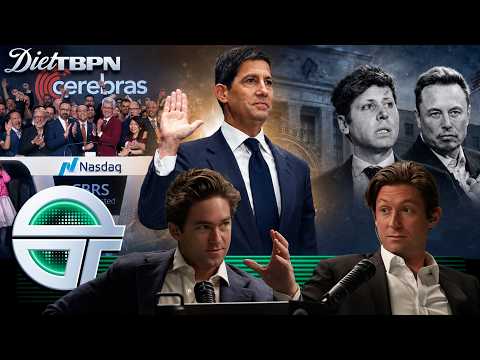
🔥 IPO Mania: America's Tech Boom Returns
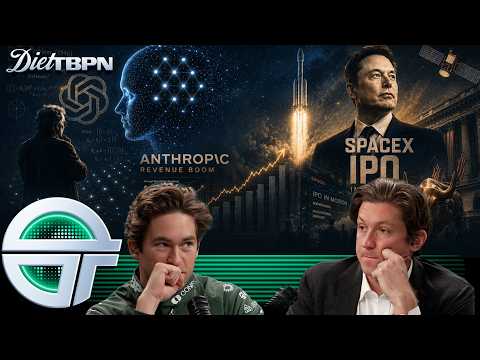
The Wall Street Journal and Financial Times are calling it a "mini boom," but there's nothing mini about it. Three of the most valuable private companies in the world—SpaceX, OpenAI, and Anthropic—are preparing to go public in what could be the most significant wave of tech listings since the dot-com era.
SpaceX is expected to debut at a market cap higher than Tesla's current $1.34 trillion valuation, cementing Elon Musk's control of two Mag 7-class companies. The term "Mag 7" itself may need an upgrade—when your newer company outvalues your legacy trillion-dollar business, the old categories break down.
"SpaceX says the company as a whole reported a $4.9 billion net loss last year, some of which stemmed from its X.com social media platform."
Despite the headline loss, SpaceX's market opportunity is staggering. The company forecasts $28.5 trillion in addressable markets—yes, trillion—including data centers in space. And how does SpaceX plan to monetize this vision? Enterprise software. Even Mars colonization starts with SaaS.
📡 Starship V3: The $15 Billion Bet on Reusability
SpaceX has invested $15 billion developing Starship, with $3 billion spent in 2025 alone. The third iteration of the vehicle—Starship V3—is 400 feet tall and features completely redesigned Raptor engines that produce more thrust while weighing less.
The company's IPO prospectus lists Starship development as the number one risk factor—a signal that SpaceX views terrestrial ventures like Starlink and data centers as lower-risk bets. The rocket's test flight was postponed due to a hydraulic pin malfunction on the launch tower, but the team worked overnight to prepare for a Friday launch.
"Every almost every part of Starship V3 is different from V2." — Elon Musk
Starship's success is critical not just for Mars ambitions, but for SpaceX's $75 billion in projected annual recurring revenue growth. The vehicle will enable the company to deploy larger satellites, scale Starlink faster, and potentially build orbital data centers—a concept that sounds like science fiction but is baked into the company's financial modeling.
🤖 AI Safety Drama: Sacks Spikes the EO
In an 11th-hour move, David Sacks successfully lobbied President Trump to cancel an executive order that would have created a voluntary program for frontier AI companies to submit models for government review 90 days before release.
Trump's reasoning? "I didn't like certain aspects of it. I think it gets in the way of—we're leading China. We're leading everybody, and I don't want to do anything that's going to get in the way of that."
The presumed text of the canceled EO was leaked shortly after, revealing the scope of the proposed oversight framework. The decision has sparked debate: should AI safety be managed by government, independent nonprofits, or the companies themselves? The "e/acc" camp celebrated the move as a win for American competitiveness, while AI safety advocates expressed concern about the lack of external review mechanisms.
💻 The YouTubification of Software is Here
Dan Shipper, founder of Every, joined the show to discuss the "after automation" era—a world where AI agents handle expert-level tasks, but still require human oversight to create truly differentiated work.
Shipper's company has grown from four to nearly 30 people since GPT-3, despite automating "everything that we can." The lesson? AI doesn't eliminate work—it eliminates bottlenecks, creating more opportunity for those who can direct it effectively.
"Even though AI can do expert human work, it actually increases the demand for human experts because what happens is you can get expert human work out of an AI... but it's all based on yesterday's competence."
Key insights from the conversation:
- Every agent needs a human. The further an agent operates from human oversight, the worse it performs
- Codex is now a daily driver for Shipper's team, with access to all computer files, emails, and documents
- The "human sandwich" model: AI collapses hours-long tasks into minutes, but humans still frame the work and evaluate the output
- SaaS isn't dead. The "SaaS apocalypse" narrative is overblown—99% of people won't vibe-code their own apps
🥑 The Appeal Sciences Story: When Big Food Fights Back
James Rogers, founder of Appeal Sciences, shared one of the most harrowing founder stories in recent memory. His company developed a plant-based coating that extends the shelf life of produce—effectively creating an edible "peel" using the same oils found naturally in citrus fruits.
By 2024, Appeal had achieved 60% market share of avocados sold in the United States. Then came the coordinated attack.
A disinformation campaign falsely linked Appeal's product to a UK cleaning agent with the same name, despite being completely separate companies. The attacks morphed to tie the company to Bill Gates (based on a $100,000 grant from 2012 for cassava research). Retail partners began receiving coordinated phone calls. One by one, Appeal lost every US customer.
"That boulder that we'd rolled up the hill for 10 years just rolled all the way back down."
Rogers had to lay off hundreds of employees. The US business went to zero. But the company survived by doubling down in Europe, South America, and Africa—regions with stricter food safety standards that actually approved the product.
Key lessons for founders:
- Attacks don't need to change minds—they just need to create suspicion
- Rebranding during an attack signals weakness; the campaign will follow you
- Map attack patterns: timestamps, coordinated accounts, and rapid reposts reveal orchestration
- The internet can be turned against you—but it can also help you fight back (Rogers is now offering bounties for digital forensics)
📊 Micron's Manufacturing Milestone
Micron announced it has begun producing 1-alpha DRAM—the most advanced memory ever manufactured in the United States—at its Manassas, Virginia facility. The move comes during an industrywide memory shortage driven by AI agents requiring longer context windows.
Micron's stock performance reflects this tailwind: the company is up almost 1,000% over the past year, with a market cap approaching $850 billion.
🏛️ World's Fairs: A Lost Art
The show also explored the history of World's Fairs—events that once served as the ultimate product launch platform. From the telephone and ketchup (Philadelphia, 1876) to the Ferris wheel and popcorn (Chicago, 1893), these exhibitions shaped American innovation.
By 1964, the New York World's Fair showcased color television and the picture phone—an early video calling system that cost $16 for a three-minute call ($121 in today's dollars).
The last officially sanctioned US World's Fair was in 1984. Why did they disappear? The function migrated to museums, television, theme parks, and tech conferences. Companies now host their own "world's fairs"—think Meta Connect or Apple's WWDC.
"The internet is the new world's fair."
🎯 What's Next
The SpaceX Starship V3 test flight is scheduled for 5:30 PM Central Time on Friday. All eyes will be on the launch, both for technical performance and market optics ahead of the IPO roadshow.
Memorial Day weekend kicks off with tech's biggest IPO wave in years, a new chapter in AI safety debates, and a reminder that even the most promising innovations face coordinated resistance from entrenched interests.
As always, the future arrives unevenly—and the battles to shape it are just beginning.