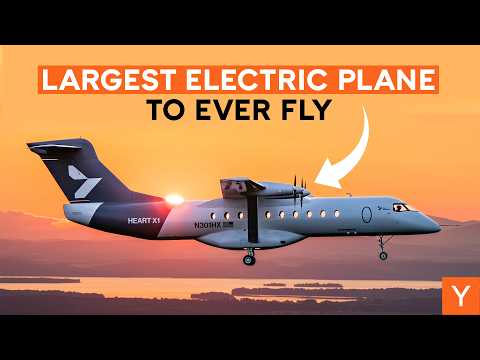
In a remote hangar in Platsburg, New York, the world's largest electric aircraft lifted off for the first time—a moment seven years in the making that began with a 3D printed model small enough to hold in one hand. What flew that day wasn't just an aircraft. It was a direct challenge to the fundamental economics of short-haul aviation, and a bet that the jet engine's 40-year reign over regional routes is coming to an end.
🔋 The Numbers That Matter
Hart Aerospace's ES19 demonstrator aircraft features a 100-foot wingspan and a takeoff weight of 25,000 pounds. But the most striking figure? The electricity required to get it airborne costs just $5.
The production successor, the ES30, will fly up to 125 miles on battery alone and up to 500 miles as a hybrid, with a recharge time of approximately 30 minutes. By Hart's calculations, the aircraft delivers 48% better operating economics compared to conventional turboprops—a figure that has expanded from 33% in just the last year as oil prices climbed.
Perhaps more remarkably, this represents the first clean-sheet airliner design to fly in the United States in 18 years, electric or otherwise.
⚙️ Why Electric Motors Change Everything
The core innovation isn't just about swapping power sources. It's about fundamentally different physics.
A conventional jet engine contains thousands of parts, burns fuel hot enough to melt metal, and wears down through constant combustion and friction. An electric motor, by contrast, has essentially one moving part. No combustion. No fluids. Virtually zero wear.
"You'd be holding a motor that weighed a few grams that you put on a drone and has one moving part, and then you look at the 400 kW ones. It's just scaled up. It's this really simple thing that has very few moving parts. You can produce them a lot cheaper. They don't break because they don't really have combustion or fluid."
The operational advantages compound on short routes. Jet engines are spectacularly inefficient during taxi, takeoff, and landing—the exact phases that dominate regional flying. On a short flight, up to 10% of fuel can be consumed just taxiing to the runway. Electric motors, meanwhile, provide constant torque at any speed and run virtually silent at low RPMs when taxiing.
🌍 The Market Opportunity: Half of All Flights
Regional aviation isn't a niche. Half of all flights globally are under two hours. Yet this segment has been poorly served by technology optimized for long-haul efficiency.
The economics of jet engines push airlines toward larger aircraft and longer routes. It costs essentially the same to build a jet engine for a 30-seater as for a 70-seater. It wears at the same rate whether flying 100 miles or 1,000 miles. This creates a structural bias against short routes—exactly where Hart sees opportunity.
"Regional connectivity is not about how far you fly. It's about how cheap you fly. This aircraft would be absolutely best if it was flying the shortest possible route. Think island hopping in Hawaii or a Norwegian fjord town that goes from being a 6-hour drive to a 20-minute flight."
The aircraft Hart is competing against are based on 40-year-old designs. There's a replacement market driven not just by cost, but by the simple fact that better technology now exists.
🔬 From MIT to the Spam Folder
Hart Aerospace's origin story begins 12 years ago at MIT, when CEO Andrew Porceland—then a PhD student working on jet engines by day and tinkering with drones at his kitchen table by night—heard Elon Musk give a talk about electric transportation.
"Elon shows up and he's talking about electric planes. He says at one point that eventually most of transportation will go electric besides rockets. He's talking about like 400 watt hours per kilogram. And it kind of felt like a call to arms."
Before founding the company, Porceland was paid by the Swedish government to conduct research—traveling around speaking with airlines, establishing relationships before attempting to build anything. When he arrived at Y Combinator seven years ago, he brought that 3D printed model and letters of intent from SAS and three Nordic airlines.
The company's first major U.S. airline customer came from an unexpected source: an inbound email sitting in the spam folder. United Airlines reached out through Hart's info@ address. After seeing a 400 kW electric motor—the size of a small jet engine—United immediately understood the potential.
🏭 Building the Pilot Plant: In-House Manufacturing
Hart Aerospace operates from a 40-person team in Los Angeles, chosen deliberately as the historic center of aviation and the emerging hub of new space companies spawned by SpaceX's ecosystem.
The company's facility functions as a pilot plant—most of the aircraft is designed and built on-site. Rather than wait a year for suppliers to deliver custom aerospace components, Hart manufactures key systems in-house, from actuators to flight control surfaces.
"This is the same basic architecture for aileron, rudder, landing gear extension, braking, even the pitch of the propellers. If you want to build something in-house, you should start with the things where you don't have to go to one supplier, but you go to eight different ones. Then it just scales with the number of technologies rather than the number of suppliers."
The entire facility is wired as one giant test bench, capable of feeding 1.6 megawatts of power to various aircraft systems. The philosophy is iterative hardware development—test fault injection scenarios, from programming errors to cutting wires, ensuring every system works even when everything goes wrong.
🔋 The Battery Lab: Approaching the Magic Number
In the battery cell lab, the team evaluates cells from Chinese, American, and Korean manufacturers to determine optimal performance across flight cycles, safety, cost, and energy density.
Twelve years ago, Musk spoke about 400 watt-hours per kilogram as the threshold for electric aviation. Today, the highest cell on Hart's test bench delivers approximately 370 watt-hours per kilogram. One manufacturer is producing cells at the 400 watt-hour level, with samples expected within the next couple of months. According to Hart's team, this "easily meets our targets for the first generation of the aircraft."
✈️ The Hybrid Solution: Solving the Reserve Problem
The hardest engineering challenge wasn't the motor or battery. It was regulatory reserves.
One in every thousand flights in the U.S. gets diverted to another airport. Regulations require aircraft to carry enough fuel for 45 minutes of loiter time plus the ability to reach an alternate airport potentially 100 miles away. For a pure battery-electric aircraft, this means two-thirds of battery capacity must be held in reserve.
Unlike jet fuel, batteries don't get lighter as they're depleted. Hart's answer: a hybrid architecture. The ES30 uses a simple turboprop engine—one of the most inexpensive available—to extend range without compromising the electric-first design. While the hybrid system adds approximately 20% to the upfront cost, it unlocks operational flexibility worth far more.
🚁 Why Not Flying Taxis? Why Not Hydrogen?
Hart's approach stands in contrast to other electric aviation startups pursuing urban air mobility or hydrogen propulsion.
"It's super cool. They're really trying to build a flying car. We're attacking not the helicopter market, but the mainline airplane market. While these companies have three or four passengers, we have 36. We're also operating from infrastructure that is already there. There's 5,000 airports in the U.S."
On hydrogen: the hybrid-electric approach delivers a negative green premium today—it's cheaper to operate while being cleaner. That's a much bigger wave to surf than waiting for hydrogen infrastructure to materialize.
And unlike conventional aircraft that depreciate, Hart's planes are designed to appreciate as battery technology improves. "The plane will actually be better in 10 years than when you buy it. It becomes like buying a house."
🔮 Looking Forward: Autonomy and Scaling Up
The 36-seat ES30 is only the beginning. The largest market by far is narrow-body aircraft—the Boeing 737 and Airbus A320 families that currently face enormous backlogs.
Hart's long-term vision includes reduced pilot requirements, with remote pilots supporting multiple aircraft similar to Waymo's remote operators, followed by autonomy in cargo operations before eventual passenger applications.
"Somebody doing what SpaceX did with rockets on airplanes just makes sense."
🎯 The Founder's Perspective
For founders attempting ambitious hardware projects, Hart's journey offers lessons in iterative progress and strategic customer development.
"Every time you need more capital, it needs to be something material. Ideally, something physical you can touch that you can show that you made. I would never start a company based on the fact that I wanted to have a company or be a founder. I would start because I really enjoy a problem."
On August 12th in Platsburg, that 3D printed model became the world's largest electric aircraft to fly—a seven-year journey from Y Combinator demo day to wheels up. The goosebumps were earned.
If Hart succeeds, regional aviation won't just be cleaner. It will be cheaper, quieter, and more accessible—with more flights to more places from neighborhood airports. The question isn't whether electric aviation is coming. It's whether the 40-year-old incumbents can respond before the new wave takes off.