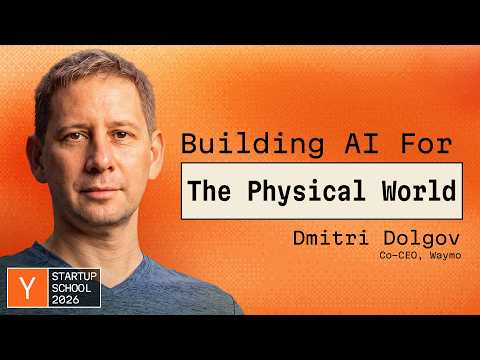
🚗 Inside Waymo's 15-Year Journey: From 90% Demo to Superhuman Safety at Scale
🔑 The Core Insight
Building AI for the physical world isn't about moving fast and breaking things—it's about moving fast and shipping safely. While Silicon Valley celebrates demos that work once, the real challenge lies in the brutal exponential ladder of reliability: every additional nine of performance requires 10 times more effort than the last.
Waymo's journey from a working prototype in 18 months to a scaled autonomous service over 15 years reveals the stark reality: a demo is at best 1% of the work. Today, the Waymo Driver serves around 500,000 trips per week, drives over 4 million fully autonomous miles weekly across 15 cities—the equivalent of 300 years of an average American driver's annual mileage every week—and has completed over 20 million fully autonomous trips totaling more than 200 million miles.
"The best AI moments in the physical world will look like nothing happened. The task just got done safely and smoothly."
⚡ The Four Gaps: Why Physical AI Is Different
Physical AI operates under fundamentally different constraints than digital AI:
- Cost of Error Gap: In digital AI, mistakes cost a retry. In physical AI, mistakes can cost human lives—there is no undo button.
- Latency Gap: Digital assistants can take seconds or minutes to respond. A car at freeway speeds travels about 100 feet in 1 second—milliseconds matter, and all inference must run on compute that fits in a trunk.
- Data Gap: Digital AI had the internet's pre-labeled human knowledge. No such digitized resource exists for the physical world.
- Validation Gap: Digital products can ship "good enough" and iterate. Physical AI demands high safety confidence before the first deployment, yet real-world experience is irreplaceable for improvement.
📊 Lesson 1: Count Your Nines Before Your Demo Views
Waymo achieved its first milestone—100,000 autonomous miles and 10 routes of 100 miles each without human intervention—in about 18 months with a team of roughly a dozen engineers. This was back in 2010, well before modern AI breakthroughs like CNNs, transformers, or VLMs.
By demo standards, autonomous driving was "solved." The system handled day and night driving, traffic, pedestrians, cyclists, traffic lights, construction zones, freeways, and surface streets. The team felt capability-complete.
Then reality hit: it took 10 more years to begin providing a service, and another 5 years to scale to half a million trips per week. The demo took 18 months; the product took 15 years.
The harsh truth: Reliability lives on an exponential ladder. Getting to 90% or 99% is easy. Every additional nine requires roughly 10 times more effort, and you can't achieve six nines by simply doing more of what got you to two nines—you must take fundamentally different approaches.
At scale, the long tail is the problem. When driving millions of miles per week, a once-in-a-million-mile event becomes daily reality.
The recurring mistake of every hype cycle: spending on the demo what should be saved for the nines.
🛰️ Lesson 2: Choose Tech That Scales to Your Product's Needs
Every technology has a performance-versus-effort curve that starts steep and flattens. The common failure mode: picking tech that gives the fastest early ramp, riding that steep curve, projecting it into the future—then hitting a plateau well before the performance your product actually requires.
Waymo's approach to sensing:
Humans can drive with just eyes, which proves approximate human performance is achievable with vision alone. But for full autonomy and superhuman performance, weak sensing flattens out too early.
Waymo uses multiple sensing modalities—cameras, lidar, and radar—that complement each other:
- Cameras: High resolution and color, but passive and degrade in darkness or glare
- Lidar: Direct 3D structure measurement, active sensing that sees equally well in pitch darkness or blinding sunsets
- Radar: Punches through fog, rain, snow; directly measures velocity via Doppler
These aren't backups—each modality has an encoder, and information fuses into a single, superior view of the world. In dust storms, at night, or when physical obstructions block sensors, this redundancy makes the difference between safe navigation and failure.
Hardware matters, but don't anchor to today's prices. Waymo is on its sixth generation of hardware. With each generation, capability improved while costs dropped dramatically. Design for the future, not today's component prices.
🌊 Lesson 3: Ride Tech Waves—Repeatedly, Without Breaking Stride
Waymo has rebuilt the Waymo Driver around every major wave of AI innovation:
- ~2013: Leveraged CNNs for computer vision and perception
- ~2017: Bet big on transformers for perception, behavior prediction, and planning (driving as a "conversation" in space via body language)
- Today: Leveraging VLMs and frontier world models
The hard part isn't prototyping new tech—it's carrying bleeding-edge research into production without regressions, in a safety-critical environment, without breaking stride on scaling.
Adding capability is straightforward. Adding capability while reducing fragmentation and complexity—that's the real muscle.
Two principles:
- When pursuing new tech, define the path to full system integration under a success scenario upfront—avoid dead ends after difficult projects succeed.
- Set launch bars that demand both breakthrough performance and radical simplification. Ask: Does this new tech reduce complexity and unify the stack, or add fragmentation?
This philosophy produced the Waymo Foundation Model.
🧠 The Waymo Foundation Model: A Multimodal World-Action-Language Model
The heart of Waymo's latest core technology is a multimodal model that:
- Processes multimodal sensor inputs: Cameras, lidar, radar
- Understands how the world works: Physics, dynamics, social and semantic aspects (world model)
- Understands action effects: How the agent's actions affect the world, distinguishing good from bad (action model)
- Aligns with language: Unlocks general world knowledge from VLMs, critical for the long tail of rare semantic situations
Architecture highlights:
- Encoder-decoder structure: Multimodal sensing compressed into efficient representations; end-to-end design allows backpropagation from task to early layers
- System 1 / System 2 (Think Fast / Think Slow):
- Think Fast: Fuses raw sensor data for split-second, safety-critical decisions (e.g., instant braking for a pedestrian darting into the road)—the "lizard brain" reacting in milliseconds
- Think Slow: Handles complex semantic and scene-level understanding (e.g., recognizing a car on fire and choosing an alternate route even if the geometric path is clear)
- Generative component (decoder): Understands and produces behavior—predicts how other actors behave and plans driving decisions
The foundation model powers multiple hardware generations (5th and 6th gen) and vehicle platforms (JLR I-PACE, Zeekr, Hyundai Ioniq 5), and will support future products like trucking and personally owned vehicles. By moving complexity upstream to a large shared foundation, specialization layers running on-vehicle remain lightweight, speeding development.
📈 Lesson 4: Structure That Channels Scale Always Wins
The Bitter Lesson (Richard Sutton, 2019): General methods leveraging massive compute and data always beat handcrafted, engineered human knowledge. This holds across every AI breakthrough wave.
But structure in models can either fight scale or channel it:
- Structure that fights scale: Loses
- Structure that channels scale: Wins
End-to-end models offer rapid early progress and allow gradient backpropagation from task to early layers. For many products, that's sufficient. But for superhuman performance in fully autonomous, safety-critical environments, vanilla end-to-end isn't enough.
Waymo's approach: Structure-Augmented End-to-End
Augment learned embeddings with materialized structured representations (laws of physics, rules of the road, object behaviors). This approach:
- Enables real-time validation at inference: A powerful correctness and safety validation layer runs in deployed vehicles—critical for physical AI
- Improves training and evaluation efficiency: Mix and match training/evaluation in the space of compact structured representations or full end-to-end
- Provides strong, verifiable feedback signals: Better metrics, loss functions, and reinforcement learning recipes
The lesson: Bet on systems that are maximally learned and minimally constrained, and leverage structure intentionally to boost performance and scaling laws.
🎮 Lesson 5: Closed-Loop Simulation Is Non-Negotiable
To safely deploy physical AI, a large-scale, realistic, high-fidelity simulator is essential. Building a good simulator is as hard as building the agent itself—it's a big AI model requiring deep understanding of physics, semantics, traffic, weather, and more.
Open-loop vs. Closed-loop:
- Open-loop: Passive observation of input-output pairs (e.g., imitation learning, "what would you do in this situation?")
- Closed-loop: Take an action, observe its effect on the world, update the view, take another action—evaluate and train on sequences of actions and world evolutions
The ability to evaluate counterfactuals—taking an action and assessing outcomes—is vital for safety-critical agents.
Waymo has built behavioral world models for years (before "world models" became popular). In the era of end-to-end models, sensing realism is also required. Waymo's sensor world model leverages Google DeepMind's Genie for controllable, highly realistic scenarios.
This enables training and evaluation not just in previously encountered situations, but in purely synthetic rare scenarios never seen in the real world—from cars stopped on freeways to planes landing on highways, elephants in intersections, snow on the Golden Gate Bridge, or dinosaurs on the loose.
The lesson: Closed-loop simulation is required for evaluation and extremely valuable for training physical AI agents.
🔄 Lesson 6: Build an Ecosystem and a Flywheel
To make this work at scale, you don't build one AI—you build three:
- The Agent: The driver that operates the car
- The Simulator: The virtual playground for the agent to learn in
- The Critic: Rigorously evaluates and judges the agent's performance, guiding improvement
All three share fundamental reasoning and generative capabilities, grounded in the same foundation world model.
The Flywheel:
- Agent deployment generates real-world data
- Data grounds the simulator, making it more realistic
- Simulator generates harder edge cases for the critic to score and the agent to learn from
- Smarter agent gets deployed, generates more data, accelerating progress
But a flywheel spins in any direction—or in place. Metrics guide it in the right direction.
📏 Lesson 7: Eval and Metrics Are Your Strategic Moat
Build your eval before you build your technology. Build your eval and metrics before you build your product.
If you can't quantitatively define "good enough," you're not building a product—you're just iterating on a demo.
Model architectures are well-known; new ideas proliferate quickly. Data is critical, but without good metrics, you're flying blind. You can't leverage data effectively or evaluate ROI on changes.
For physical AI, model-level evaluation isn't enough. Validation must span every component—from physical to behavioral layers, onboard and offboard, plus operational processes.
Waymo's Safety and Readiness Framework, refined over years, guides development, deployment, and scaling. It's one of Waymo's most important assets because in the physical world, trust is everything.
Trust isn't earned by flashy demos or clever architecture descriptions. It's earned day by day in the field, relentlessly proving the system is safe and works. Waymo openly publishes safety data and ongoing safety research for transparency and public audit.
Earned trust becomes the ultimate business advantage. Models can leak, algorithms can be replicated—but hundreds of millions of miles of fully autonomous operations backed by evidence-grade evaluation and publicly audited proof? That's much harder to replicate.
🛡️ The Results: Superhuman Safety at Scale
Based on over 220 million fully autonomous miles, the Waymo Driver is about 17 times better than human drivers when it comes to crashes causing serious injury.
Every 26 seconds, someone loses their life in a road crash somewhere in the world. At current scale, Waymo is preventing a serious injury every eight days. That means someone's loved one walks through the front door at the end of the day, safe and unharmed.
These are just the early safety benefits of AI in the physical world—and they will only grow.
🚀 The Opportunity Ahead
Physical AI is where digital AI was a few years ago. All the ingredients are in place:
- Generative world models
- Proven architectures
- Affordable compute and sensing
- Proven scaling laws
- A real product operating at scale
The last decade of AI happened in the digital world. The next decade will also happen in the physical world.
"As exciting and exhilarating as the tech is, nothing really beats the joy of making a difference in people's lives."
✅ The Seven Lessons in Summary
- Count your nines before your demo views – Understand the reliability your product demands and choose your tech path accordingly
- Pick tech that scales to your product's needs – Don't anchor to today's hardware or get stuck on a local performance maximum
- Ride tech waves repeatedly without breaking stride – Integrate innovation while reducing complexity and fragmentation
- Structure that channels scale always wins – Augment end-to-end models with structure that boosts, not fights, performance
- Closed-loop simulation is essential – Build realistic, high-fidelity simulators for training and evaluation
- Build an ecosystem and a flywheel – Agent, simulator, and critic working together accelerate progress
- Eval and metrics are your strategic moat – Define "good enough" quantitatively and earn trust through rigorous, transparent validation
None of these lessons works alone. Together, they compound into a playbook that enabled Waymo to go from a 2010 demo to a service operating at massive scale with superhuman safety—a true glimpse of AI's transformative potential in the physical world.
More from Y Combinator

The Future Belongs to the Ambitious: Meta AI's Alexander Wang on Why Vision Matt
🎯 The Conviction Game: Why Betting Against Consensus Is the Only PathIn an era where artificial intelligence has evolve...

Inside Y Combinator's Transformation: Building Billion-Dollar Companies in the A
🔮 The Economics of AI Are Shifting Faster Than You ThinkThe cost of intelligence is collapsing at a breathtaking pace —...

Why World Models, Not LLMs, Will Power the Next Wave of AI — Lessons from a €1.2
In an industry captivated by large language models, one contrarian thesis is attracting serious capital and serious ambi...

Riding the Roller Coaster: How a Former Quant Bet on AI's Physical Future
🚀 Introduction: The Bitter Lesson and the Long BetEric Landau's journey from particle physics to quantitative trading t...
How OpenCode Built a $40M Run-Rate Business in 8 Months — And Why Enterprise Dev
The coding agent wars have a new protagonist. While Claude Code and Cursor dominate headlines in Silicon Valley, OpenCod...

How Two French Founders Built Europe's Biggest YC Company by Learning to Think B
📸 From Paris to Global ScalePhotoRoom stands as a compelling case study in entrepreneurial ambition. The company provid...