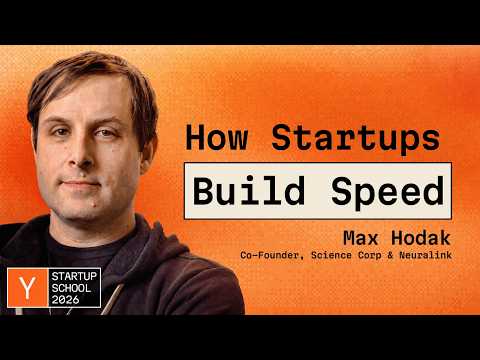
🧠 Building Deep Tech: Why Speed Beats Strategy (And How Infrastructure Makes It Possible)
Max Hodak, CEO of Science—a company developing retinal prostheses that restore vision to the blind—spent nearly 20 years working on brain-computer interfaces. His experience spans academic research at Duke to founding roles in cutting-edge neurotech, including five years at Neuralink. But his recent talk at Startup School wasn't about neural engineering or clinical trials. It was about something far less glamorous and infinitely more critical: infrastructure.
The thesis is simple but profound: speed determines success or failure in startups, and speed is determined by infrastructure. Not by technical brilliance. Not by capital. Not even by market timing. By the boring, unglamorous operational systems that most founders overlook until it's too late.
🛒 The Purchasing Problem: Why $3,000 Decisions Kill Companies
Every deep tech company—whether building rockets, drugs, or brain implants—faces a deceptively simple challenge: how does your 17th employee buy things?
Early on, founders use credit cards and wire transfers. But as the team scales, this breaks down fast. Hand out corporate cards to everyone, and burn becomes impossible to control. Approve every purchase manually, and founders drown in trivial decisions while highly paid engineers wait days for a power supply.
The real issue isn't the payment rail—it's attribution and budgeting. When materials are bought in bulk and parceled out to experiments, nobody knows what anything actually costs. Experiments feel free because "media comes from the fridge." Pricing products requires endless spreadsheets filled with opinions about rent allocation and depreciation.
Science's solution: Helix, an internal software system where nearly every company action—from purchasing to manufacturing—lives in a unified database. This isn't just about tracking spending. It's about creating real-time cost attribution so teams understand their resource constraints and make intelligent trade-offs without founder micromanagement.
As Hodak notes, this infrastructure "determines success or failure in many companies." With clear visibility into costs—like knowing that each wafer iteration costs exactly $40,000—teams can make informed decisions rather than treating capital as infinite.
🧑💼 The Hiring Machine: From Network to Algorithms
Hiring separates winners from losers more than almost any other function. The best companies emerge from scenes—moments in time that enable unique nucleation events. But those founding networks are never large enough to staff an entire company. Eventually, every startup must hire from the general public.
Science developed a four-stage process designed for both speed and signal:
- Company-wide voting: When candidates apply, the system selects 7-8 current employees with similar backgrounds and solicits votes (Known Good, Strong Yes, Yes, No, Strong No). This distributes the initial screen across the organization, preventing bottlenecks.
- Phone screen: Also drawn from a company-wide pool, focused on three core traits: judgment, horsepower, and agency. Can this person make good decisions in ambiguous situations? Do they have baseline technical competence? Can they cause the world to look like they want it to?
- Homework: Ideally "AI-resistant"—tasks with high ceilings that are naturally scorable to 2-3 metrics. The goal is to find assignments where beating the Pareto frontier is obvious, regardless of what AI tools candidates use.
- Full interview: By this stage, conversion to offer should be at least 25%, or the process wastes too much time on candidates who won't convert.
The numbers tell the story: 17% of applicants advance to phone screens. Half of those receive homework. The final interview stage maintains the 25% conversion threshold. This isn't just process—it's a finely tuned filter designed to maximize signal while distributing cognitive load across the entire organization.
📊 Eigen Reviews: Continuous Performance Feedback Without the Trauma
Traditional performance reviews—annual 360s with endless forms and HR meetings—surface problems everyone already knew about but hadn't addressed. They're disruptive, infrequent, and produce limited actionable insight.
Science built something different: Eigen Reviews, inspired by Google's original PageRank algorithm. Every few weeks, employees receive a simple prompt: "Knowing how this person turned out, would you vote again today for their hire?" The same voting scale from initial hiring applies.
The system constructs a graph over the company, weighting votes by the reviewer's own rating (similar to eigenvector centrality). It runs 1,000 iterations with dropout—randomly removing edges each time—to detect voting cliques or anomalies (visible as multiple peaks in score distributions).
The result: continuous, distributed, unbiased feedback with roughly a month lag. No annual trauma. No HR-driven kabuki theater. Just ongoing signals about who's thriving and who isn't, derived from the collective judgment of the organization.
⚡ Action Produces Information: Getting Unstuck
Startups frequently hit local minima—moments where progress stalls and paths forward seem unclear. Hodak's advice draws from physics: action produces information.
In physics, a ball following a ballistic trajectory is information-minimizing—its path is determined the moment it leaves your hand. Changing that trajectory requires action—energy injected into the system. The same applies to stuck companies: entropy must be introduced.
Sometimes this means removing high-performing people who are simply the wrong fit for the current phase. Sometimes it means making controversial technical bets. The key insight: the action space is always larger than it appears, but only motion reveals the options.
"It's uncommon that startups don't get the technology to work. It's more common that they can't organize the human organizations to accomplish their goals."
🎯 Why Iteration Speed Compounds Exponentially
If one team learns something every week and a competitor learns something every month, the competitor "will never matter." The compounding effect is that dramatic.
This is why Science obsesses over infrastructure. Faster purchasing means faster experiments. Better hiring means better judgment distributed across more decisions. Continuous performance feedback means faster course corrections.
Speed isn't about working harder—it's about removing friction. It's purchasing systems that don't bottleneck on founders. It's hiring pipelines that distribute cognitive load. It's performance systems that provide real-time signals instead of annual trauma.
🧬 The Transhumanist Mission Meets Clinical Reality
Science's flagship product—a retinal prosthesis that restores vision to patients who've lost their photoreceptors—represents the intersection of two cultures. Roughly 30% of the company embraces an overtly transhumanist mission. The other 70% are serious clinicians and scientists who think "those guys are crazy" but recognize the value of building medical devices for critical unmet needs.
The implant uses a clever workaround for power constraints: patients wear glasses with a camera and infrared laser projector. The laser projects images onto the subretinal implant, where hexagonal solar cells convert light into localized electric fields that stimulate the retina—bypassing dead rods and cones entirely.
The device has completed major clinical trials, been featured in Time and the BBC, and one patient finished a 300-page novel using it. It's approved in Europe and generating clinical trial results published in the New England Journal of Medicine.
But Hodak's point isn't just that cool technology matters—it's that execution infrastructure enabled the technology to reach patients. Without systems to manage purchasing, attribution, hiring, and performance, the science dies on the vine.
💡 Contrarian Bets: Custom Software Over Enterprise Platforms
One of Science's most contrarian decisions: building Helix instead of using commercial enterprise resource planning (ERP) systems. As Hodak puts it, "there's no company that loves their ERP system."
Historically, custom software was prohibitively expensive. Companies bought off-the-shelf tools and lived with the limitations. But AI agents and "vibe coding" changed the equation. Now, purpose-built systems tailored to a company's specific workflows are feasible—and dramatically more effective.
Examples abound: YC's internal tools, Facebook's investment in custom infrastructure, SpaceX and Tesla's "Warp Speed" manufacturing platform. When companies grow around software fit to them, they unlock capabilities that purchased platforms simply cannot provide.
🧪 Where AI Helps (And Where It Doesn't)
AI is already transforming Science's operations in three key areas:
- Coding: Hodak admits he "hasn't looked at source code much in the last six months." AI-assisted development has become that good.
- Regulatory compliance: Quality systems—historically bureaucratic nightmares—are actually well-suited to AI. Identifying applicable standards, generating evidence tables, and navigating complex requirements all benefit from language models. As Hodak notes, regulations are "written in blood and largely good ideas"—they're just hard for humans to execute efficiently.
- Agent-ready infrastructure: By consolidating everything into Helix, Science created a unified context that agents can access. This turns AI from a novelty into a genuine force multiplier.
But AI hasn't replaced humans in scientific research. Instead, it's a multiplier for existing teams, accelerating workflows without eliminating the need for judgment and hands-on experimentation.
🚀 Speed Is Built, Not Discovered
Hodak's talk offers a rare glimpse into what actually separates successful deep tech companies from failures. It's not about having the smartest scientists or the most capital. It's about the boring operational systems that enable speed.
As Picasso observed, art critics discuss form and meaning. Artists discuss where to buy cheap turpentine. Or as General Omar Bradley put it: "Amateurs talk strategy, professionals talk logistics."
For founders building anything beyond pure software—whether brain implants, rockets, or next-generation materials—the lesson is clear: invest in infrastructure early. Build purchasing systems that don't bottleneck on approvals. Design hiring pipelines that distribute judgment. Create performance feedback loops that update continuously.
Speed determines success. Infrastructure determines speed. And in the long run, infrastructure is strategy.
For founders interested in implementing Eigen Reviews or exploring Science's approach to internal tooling, Hodak invites direct outreach—though he warns he'll want to understand deployment context first. Some of this, after all, is trade craft.
More from Y Combinator

How StarCloud is Solving AI's Energy Crisis — By Building Data Centers in Space
🛰️ The Audacious Bet: Data Centers Beyond EarthIn January 2024, Philip Johnston and his co-founders at StarCloud did so...
The Seven Lessons of Building Physical AI: How Waymo Crossed the Gap Between Ato
🔑 The Core InsightBuilding AI for the physical world isn't about moving fast and breaking things—it's about moving fast...

The Future Belongs to the Ambitious: Meta AI's Alexander Wang on Why Vision Matt
🎯 The Conviction Game: Why Betting Against Consensus Is the Only PathIn an era where artificial intelligence has evolve...

Inside Y Combinator's Transformation: Building Billion-Dollar Companies in the A
🔮 The Economics of AI Are Shifting Faster Than You ThinkThe cost of intelligence is collapsing at a breathtaking pace —...

Why World Models, Not LLMs, Will Power the Next Wave of AI — Lessons from a €1.2
In an industry captivated by large language models, one contrarian thesis is attracting serious capital and serious ambi...

Riding the Roller Coaster: How a Former Quant Bet on AI's Physical Future
🚀 Introduction: The Bitter Lesson and the Long BetEric Landau's journey from particle physics to quantitative trading t...