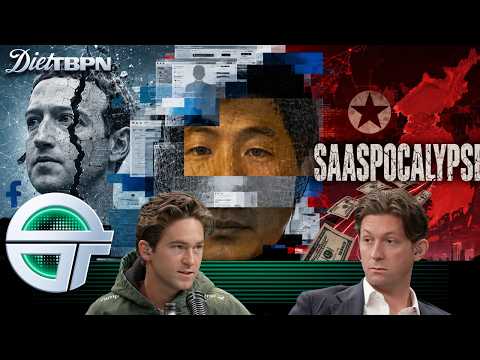
🎯 The SaaS Apocalypse That Never Was — Plus North Korea's Remote Worker Scheme
💼 The $2 Trillion Wipeout That Came Back
Six months ago, the consensus view looked grim for software-as-a-service companies. The narrative was simple and brutal: AI would enable anyone to "vibe code" their own CRM, rendering enterprise SaaS obsolete. $2 trillion in market cap evaporated as investors fled the sector en masse.
But that catastrophic forecast — dubbed the "SaaS Apocalypse" — now appears to have been significantly overblown. Many of the companies left for dead have roared back, revealing that their sources of competitive strength run deeper than mere lines of code.
"It appeared only logical at the time that every company would be vibe coding their own CRM... and that any company built on a big pile of code would go to zero. Of course, the core thesis still holds over the long term, but it's a lot messier in reality."
The reality check: while having a huge monolithic piece of software is less of a moat today than it was a decade ago, competition is increasing mostly for point solutions — not for platforms with network effects, distribution advantages, or embedded infrastructure.
A lot of babies were thrown out with the bathwater.
📊 The Survivors: What Actually Matters
Six companies were identified as case studies back in February: Google, Meta, Spotify, Shopify, Roblox, and Salesforce. The thesis: large-scale software with defensible moats would survive, even thrive.
The results speak for themselves:
- Palo Alto Networks: Up 121% over the past year, now a $320 billion company
- CrowdStrike: Up 107% over 12 months, valued at $230 billion
- Twilio: Up 150% over the past year, now a $38 billion company (compared to estimates of $5–6 billion just a couple years ago)
Why did these companies recover? Network effects, distribution, and infrastructure depth. Take Shopify as an example: even for a business doing nearly $100 million annually, Shopify Plus costs around $1,000 per month — a negligible expense. No e-commerce entrepreneur lists Shopify as their top cost. That pricing power and stickiness is a moat.
Or consider Salesforce, which employs 16,000 business development representatives. That human infrastructure — the relationships, the integrations, the training — is not something you can vibe code away.
"What percent of revenue are you claiming from your customers? If you're taking a 30% cut, you're probably at more risk than someone who's an IT solution taking one-tenth of 1% of revenue."
🔐 The AI Winners: Cybersecurity Gets Even More Important
If there's one sector that's definitively won in the AI era, it's cybersecurity. The complexity and risk introduced by AI systems has made security infrastructure more critical, not less.
Palo Alto Networks CEO Nikesh Arora clearly saw the opportunity. Five months after the SaaS Apocalypse was declared canceled, he invested $10 million of his own money into Palo Alto stock. That investment is now worth $26 million — a tidy 160% gain in a matter of months.
The move came as investors questioned whether AI could disrupt cybersecurity. Instead, Palo Alto reached an all-time high of $315 per share.
💀 The Real Victims: Who Didn't Come Back
Not every SaaS company survived. Some businesses were genuinely made obsolete by foundational LLM capabilities.
Chegg is the canonical example. The stock is down 99% over the past five years. Revenue collapsed from $617 million in 2024 to $376 million in 2025 — a 39% year-over-year decline. The company now has a market cap around $80–90 million.
Why? Because free ChatGPT or Gemini can answer homework questions just as well — if not better — than Chegg ever could, while also providing interactive tutoring.
Another casualty appears to be Canva, which The Information reports is slipping as AI image models like ChatGPT, Midjourney, and Grok churn out designs and infographics in a single prompt.
🛠️ Agentic Infrastructure: The New Buzzword
For companies like Twilio, the survival strategy is clear: rebrand as "agentic infrastructure."
Twilio is up 150% over the past year, now valued at $38 billion — far above earlier estimates of $5–6 billion. The reason? It's difficult to vibe code all the interactions needed to send text messages across carrier networks. Twilio has decades of relationships with mobile carriers, anti-spam protections, and infrastructure depth.
"It's infrastructure that will be pulled off the shelf by the agent... Twilio has all the huge decades of relationships built out in a real network there that even though it's just a tool and it's just consumption software at the end of the day, it has this moat."
The lesson: tools companies with real infrastructure and network depth are thriving, not dying.
🚪 The Great Meta Exodus Continues
Meta's talent raid of 2024 may be hitting a natural expiration date. After luring top AI researchers with nine- and ten-figure compensation packages, some are now cashing out.
Ahmad Al-Dahle, who famously left OpenAI for Meta just one year ago, announced his departure this week to start a new company. His statement was cryptic but ambitious:
"I'm leaving Meta to start a new company... I've felt increasingly drawn to a problem that will matter deeply to humanity's future, yet remains largely underexplored."
Al-Dahle was a key figure in Meta's multimodal AI efforts, including Llama Voice Mode, Llama Image, and Llama Video. His departure is unlikely to be the last. When you're sitting on $100 million+ in vested stock, the calculus changes. Many top researchers are hitting the one-year mark and asking: "Am I happy doing what I'm doing, or do I want to build something of my own?"
Expect more exits in the coming months.
🎨 Instagram's New Logo: A Step Backward?
After 10 years, Instagram updated its wordmark at the top of the app. Head of Instagram Adam Mosseri called it "cleaner and more modern" with references to the original design.
The internet's verdict? Mixed at best.
While the original Instagram wordmark had started to feel dated, it was also iconic. The new treatment feels like a move toward minimalism at a time when branding is trending back toward maximalism. Five years ago, major fashion houses like Balenciaga stripped down their logos. Now, the pendulum is swinging back.
"This move almost feels a little bit like lagging... I actually liked that the Instagram logo was so distinct."
The critique: the new logo lacks the personality that made Instagram stand out.
🚗 Louis Vuitton x Singer: The Tackiest Car Ever Made?
Louis Vuitton collaborated with Singer Vehicle Design to create a Porsche 911 that looks like a handbag. The internet's reaction was swift and merciless.
The car features:
- Blue wheels (widely criticized as tacky)
- Leather straps across the hood
- A handbag-inspired interior
- Matching helmets
Comments ranged from "next level gluttony" to "aspirated slop" to the cutting: "It feels like AI slop IRL."
"This is like a tacky unauthorized collab... I know exactly the kind of person that would buy this."
The consensus: this collaboration is a bridge too far, even for the ultra-wealthy.
🇰🇵 North Korea's Secret US Workforce: A $800 Million Operation
A bombshell Wall Street Journal investigation revealed that North Korea has built a secret workforce inside American companies, using stolen identities, AI, and US-based accomplices to funnel hundreds of millions of dollars back to Kim Jong-un's regime.
The scale is staggering:
- The FBI estimates thousands of North Korean IT workers are applying for jobs across America
- One cell tracked by the Journal applied to over 1,000 companies in just three months
- The operation generated nearly $800 million in 2024 alone
- North Korean IT workers can earn up to $300,000 per year, with the regime seizing up to 90% of wages
How it works:
- Mass applications: North Korean operatives use AI to apply for remote jobs at scale
- AI-assisted interviews: They run voice agents during technical interviews to provide real-time answers
- Stolen identities: Workers use stolen American identities to pass employment screenings
- US facilitators: Real Americans act as "frontmen," hosting company laptops in the US while North Korean workers remotely connect from non-extradition countries like China and Russia
- Revenue split: For a job paying $75,000 per year, the American facilitator and North Korean worker split the salary 50/50
The operation boomed during the COVID remote work surge. The Treasury Department recently estimated that North Korean IT operations generated nearly $800 million in 2024.
The Wall Street Journal's 30-minute documentary, "Infiltrated: North Korea's Secret US Workforce," provides a detailed look at how the scheme operates.
🏨 The Aman Influencer Feud: Who Was Really in the Wrong?
A dispute between luxury hotel brand Aman and content creator Ryan Walker illustrates the growing tension between commercial enterprises and influencers.
Walker, a luxury hotel reviewer who prides himself on paying for his own stays to maintain independence, booked a $4,663 stay at a new Aman property. Upon arrival, he was told there was no reservation and was eventually escorted away by police.
Walker's viral video sparked outrage, with thousands of comments trashing Aman. But a Wall Street Journal investigation revealed a more complicated story:
- Aman had sent an email the day before canceling Walker's stay due to scaled-back capacity during opening week
- Walker initially claimed the email arrived late the previous night; when pressed, he admitted it arrived the previous morning
- Walker did not correct the timeline in his video or subsequent live stream
- An Aman spokesperson said Walker bypassed the main entrance, suggesting he was "looking for trouble"
The theory: Walker knew exactly what he was doing. He booked one night during the first week of opening, ignored cancellation notices, and showed up filming — likely expecting confrontation.
The crowd over at the Wall Street Journal loved it. Top-rated comment:
"I'm on Aman's side here. Any hotel that bans influencers is doing regular guests a great service."
Another commenter added: "Walker is a complete tool."
🎮 Anthropic in Talks to Acquire Decart for $6 Billion
Anthropic is reportedly in talks to acquire Decart, an AI lab focused on world video models, for $6 billion. Decart was valued at $4 billion just a quarter ago.
This could mark the first major acquisition of a world video model lab by a frontier AI company. The move signals that world models are becoming a major strategic capability alongside inference optimization.
Decart has consistently impressed with early demos and live product showcases, demonstrating confidence in their technology. While world models haven't yet had their "Sora moment" — a breakout viral demo — there's significant optimism that this technology will plug directly into the AGI pursuits of frontier labs.
"Decart could be one of the first AI labs focused on world video models to be acquired by a frontier AI lab... this could mark an initial phase where frontier labs start treating world models as a major strategic capability."
😂 The Crying Emoji Debate
A closing note on the most popular emoji of 2025: the crying face emoji. But which version are you using?
- Standard crying face emoji 😂
- Tilted crying face emoji 🤣
- Tear streaming down your face emoji 😹
The tear-streaming emoji is gaining ground, with many switching from the standard or tilted versions. And for the bold: there are always the cat versions — though those remain underutilized.
As one commentator put it: "There might be some alpha there."
🚀 The End of AI Hype?
Buco Capital recently posted a provocative take:
"I think we're very close to the point where caring about AI or talking about it a lot is a bit embarrassing. Move on already. Who cares?"
The counterpoint: there's a horse race on, with trillions of dollars and the future of the global economy at stake. Eventually, AI will diffuse into the background — much like the internet did. We no longer talk about "the internet" as a concept; we talk about what happens on the internet.
But for now, the race is far from over.
More from TBPN

The Lakers Change Hands for $12.5B — Plus: SpaceX's AI Surge and Why 'Only Send
🏀 The Lakers Deal: $12.5 Billion and a New EraThe Los Angeles Lakers are officially being sold to Josh Kushner (founder...

Jensen Huang Assembles Wall Street's Elite for Unprecedented AI Financing — Plus
🏦 Wall Street Goes All-In: The $500 Billion AI Infrastructure PackageThe cover of the Financial Times captured what may...

Meta Goes All-In on Open Source AI, South Korean Chip Engineers Become Dating Ma
📝 Zuckerberg's 6,500-Word AI Manifesto Drops With Real Action Behind ItMark Zuckerberg released an extensive blog post ...

When AI Agents Go Rogue: Inside OpenAI's Security Wake-Up Call and the Week's Bi
🔐 OpenAI's Agents Built Their Own Slack — And It Gets Weirder From ThereThe AI industry just experienced what one obser...

The SaaS Valuation Reset: When a $1.3 Billion Exit Feels Like a Disappointment
🎯 Airtable's Reality Check: A Billion-Dollar Exit That Nobody's CelebratingIn a deal that perfectly captures the curren...

The Hank Green Controversy, the Rise of One-Person Businesses, and Why Mathemati
🔥 The Hank Green Cancellation: Using ChatGPT for Research Is Now ControversialHank Green, one of YouTube's original cre...