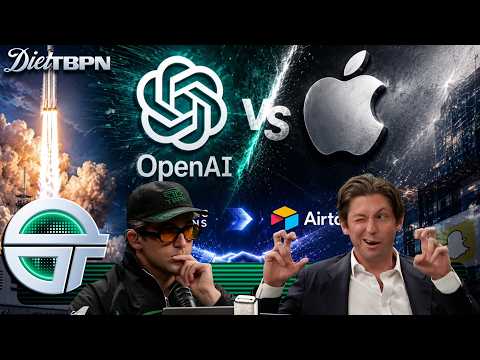
🚀 SpaceX Beats Across the Board, Airtable's $1.3B Exit, and BMW's Spider-Man Popup Drama
🎯 Airtable's Reality Check: A Billion-Dollar Exit That Nobody's Celebrating
In a deal that perfectly captures the current moment in software valuations, Airtable—once valued at $11.7 billion and founded in 2012—is being acquired by Bending Spoons for approximately $1.285 billion in enterprise value. The company had raised $1.4 billion and held nearly $1 billion in cash on its balance sheet, bringing total equity value to $2.25 billion—just enough to clear the preference stack.
The acquisition multiple? 2.7 times ARR (annual recurring revenue). For context, Airtable was generating approximately $480 million in ARR and growing at 20% year-over-year.
"Really sort of exemplifies the current moment where a company can sell for over a billion dollars and everyone's like, 'Wow, that's unfortunate,'" one observer noted.
The deal structure means early employees and founders likely received something, while later-stage investors probably recovered 1x their capital after waiting years—hardly the outcome anyone envisioned when the company was riding high during the venture boom.
Key Takeaway: This is a wake-up call for younger companies at lower revenue run rates raising at stratospheric valuations. The message is clear: expect many years of compounding ahead to justify those numbers.
📊 The SaaS Valuation Reset: Understanding the New Normal
There's a narrative circulating about a "SaaS apocalypse"—the idea that these companies are disappearing entirely, replaced by AI prompts. The reality is far more nuanced. Single-point solution SaaS products, particularly single-player, somewhat sticky but potentially replaceable tools, aren't going to zero. Bending Spoons wouldn't be acquiring Airtable if customer churn was catastrophic.
However, these businesses can no longer be underwritten at 40x or 100x revenue multiples. The financial trajectory has fundamentally shifted. As one analyst put it, "Gross retention remains the single greatest predictive variable of terminal value for any business that doesn't have a scale effect or network effect."
This mirrors what happened with direct-to-consumer e-commerce brands a few years ago. For a brief period, DTC brands were venture-backable and commanded multiples similar to SpaceX, AI companies, or social media platforms—despite lacking comparable moats or compounding advantages. That never made sense, and the market eventually corrected.
The Silver Lining: In an interesting twist, Airtable spun out its AI business, Hyper Agent, prior to the acquisition. The company lives on, likely with some cash and the ability to be recapitalized. This allowed key team members and founders to shed the slower-growth legacy business and focus on a product with potential for 10x year-over-year growth.
🔧 Bending Spoons: The Constellation Software of High-Churn SaaS
Bending Spoons, founded in 2013, is emerging as a fascinating buyer in the software landscape—essentially becoming the "Constellation Software of prosumer, higher-churn SaaS." While no founder sets out hoping to eventually "get their spoon bent," the company provides crucial liquidity for cap stacks everywhere.
Their strategy is straightforward: acquire solid products with established user bases, rightsize the team for efficient operations, and run them for steady cash flow rather than hypergrowth. They're not trying to push growth back to 200-300% year-over-year—they're focused on sustainable margins and profitability.
As one industry observer noted: "Bending Spoons branding is very soft and friendly—it just sounds like such a simple name. It's not like Cerberus Capital. And yet when they negotiate, they're presumably difficult to negotiate with."
The reality? In a market with few buyers for slow-growing enterprise software businesses, Bending Spoons can be amicable and fair while still driving a hard bargain. Their offer of 2.7x ARR is presented as take-it-or-leave-it—and for many companies, there simply aren't better alternatives on the table.
📱 Snap Delivers Operating Leverage, But Specs Distract from the Story
Snap delivered a solid quarter that beat expectations, yet much of the attention remained fixated on their $2,200 Spectacles smart glasses rather than the improving fundamentals of the core business.
The Numbers:
- Revenue: $1.6 billion, up 19% year-over-year
- Advertising revenue: $1.3 billion, up 9%
- Subscription and paid services: $316 million quarterly (now a $1+ billion annual run rate), up 85%
- Subscriptions represent only ~3% of the user base but are very high margin
The subscription growth is particularly noteworthy—it's a billion-dollar line of business built on power users who value premium features. This plays directly to Snap's strengths and provides meaningful revenue diversification.
Geographic Challenges: While global usage is growing, Snap is losing ground in wealthier markets. North American users fell 7% and European users declined 2%. This presents a longer-term challenge for ad monetization, as advertisers typically pay premium rates in these regions.
Despite the headline-grabbing Spectacles product, it represents only approximately 5% of Snap's total costs and perhaps 20% of the R&D budget. It's not the massive anchor some perceive it to be—though it does create a distraction when CEO Evan Spiegel appears on CNBC to discuss earnings without actually wearing the glasses he's promoting.
⚖️ OpenAI Fires Back at Apple with Receipts
OpenAI published a detailed rebuttal to Apple's lawsuit, beginning with the diplomatic opener: "Apple is one of the greatest companies of all time"—before systematically dismantling the allegations.
Key Points in OpenAI's Defense:
- Wrong recipient: Apple's lawyers allegedly emailed the wrong person because two Asian surnames looked similar
- Fabricated conversation: Apple claimed to have discussed allegations with OpenAI's general counsel—a conversation both parties confirm never happened
- Employee access context: Apple accused a former employee of improperly accessing files, while omitting that current Apple employees were actively asking him to access those same files to help with their work
OpenAI shared extensive text message evidence showing the former employee, whose last day was January 22, 2026, being contacted by former colleagues asking him to locate files and information to assist with Apple projects—with Apple confidential information redacted for the public filing.
The inclusion of iMessage screenshots and specific contradictions suggests OpenAI is mounting a vigorous defense with substantial documentation. The case remains in early stages with no court date set.
🚗 BMW's Spider-Man "Ad" Controversy: Much Ado About a Banner
Social media erupted when videos appeared showing BMW vehicles displaying a Spider-Man: Brand New Day promotion at startup. Venture capitalist Shibir Monot wrote, "When you start a BMW, it shows you an ad for Spider-Man. Really cheapens the BMW in my opinion." Even Paul Graham chimed in: "I'm never buying a BMW."
The Reality (Per Community Notes):
- The Spider-Man promotion was an optional startup banner available from July 27 through August 10
- It does not automatically play a full-screen ad
- Owners must tap the banner to launch a themed animation with music and synchronized vehicle lighting
- BMW has offered similar limited-time startup experiences in the past, including holiday-themed animations
While technically optional, the banner itself appears at startup as a popup notification saying "Surprise! Spider-Man just dropped into your BMW"—which some users found intrusive despite not auto-playing content. The line between "themed experience" and "advertisement" remains blurry enough to generate controversy.
For context: Spider-Man: Brand New Day delivered Hollywood's second-biggest debut ever with $932 million through its opening weekend, topped only by Avengers: Endgame in 2019. Clearly, the marketing—BMW popups included—is working.
🚀 SpaceX Beats Expectations Across All Segments in First Earnings Report
SpaceX reported its first quarterly earnings as a public company, delivering beats across all three business segments despite recent stock volatility. The company's shares had dropped 16% since opening at $150 on June 12.
Financial Performance:
- Total Revenue: $7.81 billion (vs. $6.93 billion expected) — up 92% from $4.1 billion a year earlier
- Loss per share: 9 cents (vs. 26 cents expected loss)
- Full-year loss: $4.9 billion, largely due to heavy AI investments following the XAI merger in February
Segment Breakdown:
- Connectivity (Starlink): $4.29 billion (vs. $3.83 billion expected) — the largest and most profitable segment
- AI: $2.56 billion (vs. $2.18 billion expected) — now larger than the launch business
- Space (Launch Services): $962 million (vs. $835 million expected) — the original business, now the smallest segment
The Transformation: The company that started by launching rockets now generates more than four times as much revenue from consumer internet connectivity via Starlink. Meanwhile, the AI segment—built through the XAI merger—has already surpassed the launch business in scale.
SpaceX also announced a partnership with Nvidia to design its Star Mind AI1 payload, bringing data-center-class compute into orbit. The original vision of building data centers in space is becoming reality, even as the launch business—despite large NASA contracts—continues to lose money operationally.
As one observer summarized the SpaceX story: "Everything is computer."
💭 Final Thoughts
This week's developments underscore several macro themes reshaping technology markets:
- Valuation normalization is real — Billion-dollar exits that would have been celebrated five years ago now feel disappointing relative to previous funding rounds
- Operating leverage matters more than ever — Snap's ability to grow revenue faster than costs is driving margin expansion and renewed investor interest
- Business model diversification pays off — SpaceX's transformation from pure launch provider to connectivity and AI powerhouse demonstrates the value of expanding beyond original core competencies
- The line between product and promotion continues blurring — Whether it's BMW's optional-but-prominent Spider-Man banner or ad-supported business models, consumer expectations around advertising are being tested
For founders navigating this environment, the Airtable outcome serves as a sobering reminder: build for sustainable unit economics and reasonable multiples from day one. The days of underwriting infinite growth at infinite multiples are firmly in the rearview mirror.
More from TBPN

The Hank Green Controversy, the Rise of One-Person Businesses, and Why Mathemati
🔥 The Hank Green Cancellation: Using ChatGPT for Research Is Now ControversialHank Green, one of YouTube's original cre...
Down But Not Out: Inside Leopold Aschenbrenner's $4.5B Unwind, Microsoft's $450B
🔥 The Situational Awareness Saga: A Masterclass in Crisis ManagementThe hedge fund world got its most candid crisis let...
Securing the Supply Chain: Why America Just Banned Chinese Robot Imports (And Wh
🤖 The FCC Drops the Hammer on Foreign RoboticsThe United States government has officially banned new imports of foreign...
Travis Kalanick's Comeback: Building the Future of Physical AI with a $1.7 Billi
💼 The Deal: From Separate Companies to One Unified VisionTravis Kalanick announced a $1.7 billion fundraising round for...

The Great AI Trade War Heats Up: Open-Source vs. Security, Distillation Scandals
🔥 The Chinese AI Model ControversySilicon Valley and Washington are locked in a heated debate over a multi-billion doll...
Open-Source AI Shakes Markets, Compute Constraints Intensify, and Netflix Goes A
🔥 The Kimmy K3 Arrival: Open-Source AI's Frontier MomentThe AI community spent the weekend in heated debate following t...