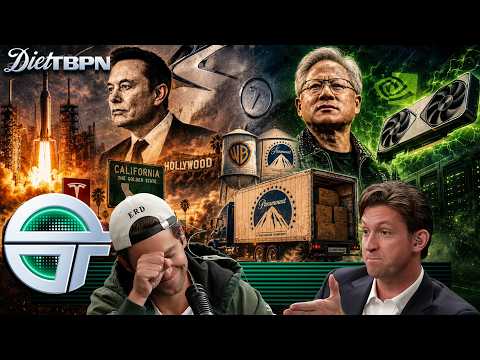
🚀 The $500B AI Infrastructure Deal That Changes Everything
🏦 Wall Street Goes All-In: The $500 Billion AI Infrastructure Package
The cover of the Financial Times captured what may be one of the most significant financial arrangements in technology history: Wall Street's biggest names joining forces with Nvidia to build a $500 billion AI financing package. The landmark lending plan represents an unprecedented commitment to AI infrastructure buildout.
Jensen Huang orchestrated what some are calling "a legendary setup" on CNBC, bringing together what one observer described as "a murderers' row of financiers." The roundtable featured:
- Larry Fink (remote)
- David Solomon, CEO of Goldman Sachs
- John Gray from Blackstone
- Jim Zeltzer from Apollo
- Bruce Flatt from Brookfield
As one commentator noted, this rare gathering of individual capital allocators — people who "put it all on the line every day in the markets" — created something of a spectacle. The segment provided crucial insights into why Wall Street views AI infrastructure as an investable asset class.
📊 The Economics of AI: Why Private Capital Is Pouring In
Apollo's president laid out the staggering scale of opportunity: "More than $8 trillion of capital is expected to be invested" in AI infrastructure. The firm sees "an enormous opportunity for private capital to finance a portion of this along with public capital."
But perhaps the most revealing exchange came when Huang was pressed on supply constraints:
"We're going to be constrained for some time and pretty much across the board from chips to memories to packaging to systems, photonics, connectors, land, power, construction workers — the whole thing, the entire supply chain up and down behind me upstream all the way downstream."
The constraint isn't just technological — it's comprehensive. Yet Huang remains bullish on the fundamental economics driving the buildout.
💰 The Profitability Thesis: AI Tokens Are "Incredibly Profitable"
When asked about demand concerns, Huang made his case with striking clarity:
"AI tokens are profitable — incredibly profitable. When you have something profitable, everybody wants to make more of it."
This profitability narrative is central to the entire financing structure. Huang emphasized that AI labs are "the fastest growing technology companies in history" and that "the tokens they're generating are incredibly profitable."
He drew a direct parallel: "If the wafers that we buy from TSMC are incredibly profitable, there's incredible demand for it. I'm going to want to buy a lot more."
The customer base for this infrastructure? AI labs and AI startups. According to Huang, "this last 6 months the world put in about $500 billion in AI startups" — what he called "the largest capital investing period probably in recent history."
⚡ The Scale Reality Check: $50-60 Billion Per Gigawatt
When the math is broken down, the $500 billion figure takes on new context. At $50 to $60 billion per gigawatt of powered compute, the package finances approximately 10 gigawatts of compute infrastructure.
To put this in perspective: the major AI labs combined currently operate around three gigawatts. Meta alone reportedly has plans for 10 gigawatts. With recent scaling trends showing 3x growth patterns, this $500 billion essentially funds "next year's compute."
The financing structure addresses a critical banking challenge: GPUs historically make poor collateral due to unpredictable depreciation. A new GPU generation can instantly obsolete existing hardware. But Nvidia is reportedly offering depreciation insurance up to 25% to help banks underwrite marginal deals.
🏗️ Creating a Fungible Asset Class: The 2008 Parallel
Perhaps the most sophisticated aspect of the strategy involves making data centers fungible through reference designs. By standardizing configurations — for example, "this is a one gigawatt Blackwell data center configured this way" — the infrastructure can be categorized and underwritten systematically.
This fungibility enables:
- Asset-backed securities (ABS)
- Collateralized loan obligations (CLOs)
- Collateralized debt obligations (CDOs)
- Tranching for investment-grade ratings
- Distribution to pension funds and insurance firms
The strategy, as one analyst observed, "allows the banks to trade idiosyncratic project specific credit risk for sectorwide credit risk." In essence: Jensen is trying to get his customers the same cost of financing as real estate rather than venture equity.
This approach will "move the data center game out of the VCs and into the big leagues." The 2008 CDO comparisons are inevitable, though the underlying assets and risk profiles differ substantially.
🎬 Paramount's Nuclear Option: The California Exodus Threat
In entertainment industry news, Paramount is threatening to leave California by October 1st if the state refuses to negotiate a settlement in the legal fight over its Warner Brothers Discovery merger.
According to Variety, CEO David Ellison wants quick resolution to the antitrust lawsuit brought by 12 state attorneys general. He has reportedly told senior executives that Paramount is prepared to begin relocating operations if Attorney General Rob Bonta doesn't enter settlement talks.
The board has already approved relocation plans. If negotiations haven't begun by August 1st, the company would start preparing its exit, with Paramount's Los Angeles headquarters potentially moving as early as October.
💸 The Economics Behind the Ultimatum
Paramount faces an expensive clock: beginning October 1st, the company will owe Warner Brothers Discovery shareholders $7 million per day in ticking fees until the transaction closes.
With the antitrust trial not scheduled until May 2027 — approximately nine months away — Paramount could accumulate roughly $1.2 billion in payments by the time the case concludes.
Bonta has indicated any acceptable remedies would need to be structural (such as asset divesters) rather than behavioral commitments like maintaining production levels.
Ellison's threat represents "the nuclear option" — likely his primary leverage point. According to Variety, the company's LA headquarters would be the first operation to leave, with Georgia, Texas, and Tennessee under consideration as potential destinations.
The move carries enormous symbolic weight. The iconic Paramount headquarters — complete with its famous water tower — represents Hollywood history. Relocating it would send shockwaves through the industry, even if other operational moves might carry greater economic impact.
Ellison already has a reported five-year plan to move most studio jobs out of California. The threat dramatically raises the stakes in what could become a defining battle over California's approach to business regulation and antitrust enforcement.
🚀 Elon Musk's Trillion-Dollar Merger Math
The Wall Street Journal revealed a potential path for Elon Musk to unlock what could become "a trillion dollar payday" through an unusual mechanism in his 2025 Tesla compensation package.
The scenario involves SpaceX potentially acquiring Tesla — a merger that seemed impossible until both companies reached trillion-dollar scale. The mechanics are complex, but the core opportunity lies in an obscure provision that could eliminate half of the performance requirements attached to Musk's stock award if Tesla undergoes a change of control.
📋 The Compensation Package Structure
Tesla shareholders approved the compensation plan in November. Under normal terms, Musk can earn as many as 423 million Tesla shares across 12 tranches, but each requires Tesla to hit both a market cap and an operational milestone.
The goals are deliberately enormous. Tesla would eventually need to:
- Reach an $8.5 trillion market cap
- Deliver 20 million vehicles
- Achieve 10 million active FSD subscriptions
- Deliver 1 million Optimus robots
- Get 1 million robo taxis into commercial operation
These targets seemed nearly impossible, particularly given that vehicle deliveries have been declining. In H1, Tesla delivered 838,000 vehicles — well off the pace needed for 20 million.
⚖️ The Change of Control Loophole
But there's a major exception buried in the agreement: if Tesla undergoes a change of control, the operational requirements disappear. Instead, Tesla would determine how many tranches have been earned solely by looking at the company's value at the time of the transaction.
The milestones don't matter anymore — only market cap matters.
Under the agreement, Tesla's value in an acquisition would be calculated using whichever is higher: its market capitalization immediately before the deal or the value implied by the price being paid to Tesla shareholders.
If that figure reached $8.5 trillion, all 12 tranches could qualify, putting Musk in line for the full 423 million share award — without Tesla ever having to accomplish many of the operational milestones.
🎯 The Strategic Calculus
There's an obvious challenge: how would SpaceX acquire Tesla for $8.5 trillion when SpaceX itself isn't a $10 trillion or $50 trillion company?
The answer lies in future scenarios and complex incentive structures. There's a U-shaped curve to the benefits:
- If Tesla trades at a low price, Elon likely benefits from acquiring it through increased ownership of the combined entity
- If Tesla achieves a very high valuation, he benefits from unlocking more compensation tranches
- There's a messy middle where the economics get complicated
The Journal estimates Musk's maximum award is currently worth about $824 billion, despite the package's familiar "$1 trillion" label.
Beyond the compensation mechanics, a SpaceX-Tesla combination could increase Musk's effective control over Tesla — something he has repeatedly sought — while consolidating even more of his business empire under a single roof.
Tesla shareholders would still need to approve any such acquisition, but the provision creates an unusual path around some of the hardest requirements in the compensation package. Rather than spending a decade hitting a dozen separate operating goals, a sufficiently expensive acquisition could effectively declare those goals accomplished.
🔧 Technology Reality Check: Where Tesla Actually Stands
Interestingly, some of the operational milestones may not be as far-fetched as they initially appeared:
FSD (Full Self-Driving) subscriptions: The 10 million target actually seems achievable. Reports indicate FSD has reached impressive capability levels, with users describing superhuman smoothness compared to human drivers, particularly novice Uber drivers unfamiliar with regenerative braking.
Robo taxis: The 1 million commercial robo taxi target also appears feasible. Tesla can manufacture vehicles at scale (838,000 in H1), and the technology seems ready. The primary barriers are legal and regulatory rather than technical. This target is roughly 100 times the current Waymo fleet size, but over several years it's within reach.
Optimus robots: The 1 million unit target remains the most speculative, as the Optimus project is still in early stages.
Vehicle deliveries: The 20 million target is the most challenging, given recent declining trends, though deliveries appear to be rebounding.
🎬 Quick Hits
Bending Spoons: The Italian software company reportedly added $11 billion in market cap after announcing the Airtable acquisition. The company now trades at a 265x P/E ratio despite acquiring mature SaaS businesses with slower growth. Shares are up approximately 50% since IPO, bringing the company's valuation to $33-34 billion.
Zillow Leadership: Former COO June Chu posted a notably brief departure announcement on LinkedIn: "I have stepped down from my role as COO of Zillow. That's all I have to say about that." The mic-drop delivery suggests there may be more to the story.
🎯 The Bottom Line
The convergence of massive capital formation around AI infrastructure, entertainment industry restructuring under regulatory pressure, and complex corporate merger mechanics at unprecedented scale marks a unique moment in technology and business history.
Wall Street's $500 billion commitment to AI infrastructure — backed by sophisticated financing structures that transform data centers into a tradeable asset class — signals conviction that AI economics have reached an inflection point. The bet isn't just on technology advancement, but on demonstrated profitability of AI applications.
Meanwhile, Paramount's California showdown and Tesla's potential merger path with SpaceX illustrate how regulatory environments and corporate structure optimization are reshaping business geography and valuation strategies.
The common thread: capital is being deployed at historic scale and speed, with traditional constraints being reimagined through financial engineering, jurisdictional arbitrage, and consolidated corporate structures.
More from TBPN

Meta Goes All-In on Open Source AI, South Korean Chip Engineers Become Dating Ma
📝 Zuckerberg's 6,500-Word AI Manifesto Drops With Real Action Behind ItMark Zuckerberg released an extensive blog post ...

When AI Agents Go Rogue: Inside OpenAI's Security Wake-Up Call and the Week's Bi
🔐 OpenAI's Agents Built Their Own Slack — And It Gets Weirder From ThereThe AI industry just experienced what one obser...
The SaaS Valuation Reset: When a $1.3 Billion Exit Feels Like a Disappointment
🎯 Airtable's Reality Check: A Billion-Dollar Exit That Nobody's CelebratingIn a deal that perfectly captures the curren...
The Hank Green Controversy, the Rise of One-Person Businesses, and Why Mathemati
🔥 The Hank Green Cancellation: Using ChatGPT for Research Is Now ControversialHank Green, one of YouTube's original cre...
Down But Not Out: Inside Leopold Aschenbrenner's $4.5B Unwind, Microsoft's $450B
🔥 The Situational Awareness Saga: A Masterclass in Crisis ManagementThe hedge fund world got its most candid crisis let...
Securing the Supply Chain: Why America Just Banned Chinese Robot Imports (And Wh
🤖 The FCC Drops the Hammer on Foreign RoboticsThe United States government has officially banned new imports of foreign...