🚀 SpaceX Surges Into the Elite Club
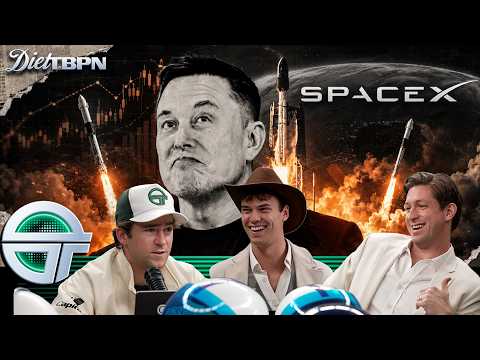
SpaceX delivered one of the most dramatic after-hours rallies in recent memory, climbing into rarified territory and cementing its position among the world's most valuable companies. The aerospace giant now sits comfortably in the top five companies globally by market capitalization, trading neck-and-neck with Microsoft at just shy of $3 trillion.
For context, the landscape at the top now looks like this: Nvidia holds the crown at $5 trillion, followed by Alphabet and Apple hovering around the $4-4.5 trillion range, with Microsoft and SpaceX battling for the next spots.
The rally was so extreme that it fundamentally altered the economics of SpaceX's recent acquisition strategy. The company's market cap increase alone — which more than quadrupled — exceeded the $60 billion in newly issued stock used to acquire Cursor, effectively making the deal economically free from a shareholder value perspective.
"With yesterday's 20% SpaceX pop, Elon made more money than Warren Buffett made in his entire career."
The sheer scale of wealth creation at these valuations produces staggering headlines. Single-day moves now exceed the entire net worth of some of history's wealthiest individuals, and the volatility cuts both ways — down days will generate equally dramatic losses.
💰 The Biggest VC-Backed M&A Deal in History
The Cursor acquisition represents uncharted territory in venture capital exits. At $60 billion, it stands as the largest VC-backed strategic sale ever — a milestone that's easy to overlook given the broader context of trillion-dollar companies, but one that fundamentally reshapes expectations for startup outcomes.
As one observer noted: "We've never had an M&A of a VC-backed company, a young startup, north of $50 billion. Like, $60 billion is so big. We sort of lose sight of it because we're talking about a trillion dollars for this company, three trillion for that company. But $60 billion is beyond a home run."
For SpaceX's retail investor base — many of whom may not have been deeply familiar with Cursor before the announcement — the deal signals an aggressive pivot into AI infrastructure and tooling. This marks a notable departure from the company's historical build-versus-buy philosophy and raises questions about whether additional acquisitions are in the pipeline.
Key Insights on Cursor's Journey:
- Cursor once accounted for 40-50% of Anthropic's revenue, highlighting how quickly AI ecosystem dynamics shift
- The landscape evolved dramatically as hyperscalers began spending hundreds of millions to over a billion dollars monthly, diluting Cursor's relative importance to model providers
- Anthropic initially characterized Claude Code as "just a research effort," a positioning that proved controversial in hindsight
- Founder Michael Truel operated without taking a salary for years during the company's early development
🤔 Corporate Finance Genius or IPO Gamesmanship?
The deal structure has sparked debate about capital allocation strategy versus market timing. Quinn Thompson framed it provocatively:
"This is brilliant corporate finance. Use your newly printed low-float retail-inflated currency to acquire real businesses ahead of the lockup expiring. Probably the most creative way to sell as much equity as possible into an IPO pump."
Others pushed back, arguing that buyers are sophisticated enough to understand the dynamics at play. Still, the question remains: are more acquisitions coming?
Historically, Tesla and SpaceX have not been acquisitive. The companies have favored internal development over external purchases. But with SpaceX's stock at current levels and the Cursor deal's smooth execution, a more aggressive M&A strategy wouldn't be unreasonable — particularly if the goal is to consolidate AI infrastructure, compute capacity, and cloud capabilities.
The strategic rationale becomes clearer when considering SpaceX's potential entry into terrestrial compute and data center operations. Near-term revenue from "boring" cloud infrastructure could provide substantial cash flow — a "Model 3 moment" that funds more ambitious long-term projects like lunar mass drivers and space-based data centers.
📊 Valuation Reality Check
As SpaceX approaches Amazon's valuation, some market observers are urging caution. Current approximate multiples paint a stark picture:
- SpaceX price-to-sales: 150x
- Amazon price-to-sales: 3.6x
- Microsoft price-to-sales: 9.2x
The low float and massive retail interest create conditions for extreme moves in both directions. As the lockup period expires and float increases, the retail cohort that bought at elevated levels may face extended periods of underperformance.
That said, bulls counter that if Amazon traded at SpaceX's multiple, it would become a $100 trillion company — suggesting that SpaceX bears may be underestimating the company's long-term revenue trajectory across launch services, Starlink, and emerging AI/compute businesses.
👓 Snap Bets Big on AR with $2,200 Spectacles
Snap unveiled its next-generation Spectacles, positioning the $2,195 all-in-one AR glasses as "the next computer." CEO Evan Spiegel framed the product as occupying a middle ground in a market split between bulky, highly capable headsets and lightweight glasses with limited functionality.
The device clocks in at 132 grams — significantly lighter than Microsoft's HoloLens 1 (580 grams) but roughly double the weight of Meta's Ray-Ban smart glasses (70 grams). Battery life is listed at up to four hours, enough for extended content consumption but potentially limiting for all-day wear.
⚖️ The Market Position Dilemma
At nearly $2,200, Snap faces a steep uphill battle. The price point approaches Apple Vision Pro territory ($3,499), but without the Apple ecosystem, brand loyalty, or wealthy fanboy base that routinely buys every new product at launch.
Meta's strategy — entering the market with affordable, familiar form factors like Ray-Ban Wayfarers at accessible price points — offers a stark contrast. Consumers are far more willing to experiment with a $300 pair of smart sunglasses than commit over $2,000 to an unproven platform.
The risk is clear: if the device collects dust after purchase, a $2,200 write-off stings far more than a $300 experiment. And unlike Apple or Meta, Snap lacks the balance sheet to subsidize hardware at scale indefinitely.
"Meta can afford to lose money on every single device effectively forever."
Snap's stock fell 7% following the announcement, suggesting investor skepticism about the company's ability to compete in premium hardware. Success will likely hinge on developer adoption and whether a breakout use case emerges from the community — perhaps a YC-backed startup building exclusively on the platform.
📱 Social Media Contrarian Takes
Two provocative ideas circulated this week:
1. Ban Social Media for Over-65s
A tongue-in-cheek proposal flipped the UK's under-16 social media ban on its head, suggesting age restrictions at the other end of the spectrum. While clearly satirical, it highlights an uncomfortable truth: the 65+ demographic holds enormous purchasing power, and platforms like Facebook and YouTube derive substantial revenue from older users. Any real restriction would face fierce resistance from the platforms themselves.
2. Don't Doubt Meta's Ad Machine
Despite ongoing criticism about bugs, model changes, and questions about Meta's AI strategy, one large advertiser planning to spend around $100 million with the platform this year offered a reality check:
"Meta is working, and no ad space comes close to their level of scale. Don't doubt the Zuck."
The reminder is timely: while SpaceX's market cap now equals roughly two Metas, the social media giant remains a cash-generating juggernaut with unmatched advertiser reach. The gap in market sentiment may reflect inspiration and narrative (rockets > social media) rather than underlying business quality.
🔮 Looking Ahead
The next few weeks will clarify several key questions:
- Will SpaceX pursue additional acquisitions, signaling a true strategic shift?
- How will retail investors react as lockup periods expire and float increases?
- Can Snap build a meaningful developer ecosystem and find product-market fit at a premium price point?
- Will Meta continue to dominate digital advertising despite platform concerns?
What's certain: the collision of AI, aerospace, and consumer hardware is producing some of the most dramatic market moves and strategic pivots in recent memory. The winners and losers are far from decided.