🚀 $70B in Fundraises, Bezos Bets on Labor Shortage, and SpaceX IPO Hype
🔥 The Physical AI Gold Rush Has Arrived
The venture markets just witnessed one of the most extraordinary 24-hour fundraising cycles in history. Jeff Bezos emerged from relative stealth with a $12 billion Series B for Prometheus, an industrial AI startup building what he calls an "artificial general engineer." The round values the company at $41 billion—bigger than Reddit, Chipotle, or AIG—just six months after raising $6.2 billion in a Series A.
This isn't traditional venture math. Series A rounds used to be $6 million, not $6 billion. But AI infrastructure is expensive, and Bezos is betting that embodied intelligence—AI that designs, manufactures, and operates in the physical world—will create more jobs than it destroys.
"Some of the pessimism about AI among young people is the opposite of reality," Bezos said. "If AI makes it cheaper, faster, and easier to invent things, employment will ultimately rise because the technology will create more than 10x as many opportunities."
Bezos argues that while AI might shrink headcount requirements by 10x, it will simultaneously unlock 10x more opportunities. He even predicts a shift to single-earner households as productivity soars—an optimistic counterpoint to widespread job loss fears.
Prometheus held talks to raise a $100 billion fund to acquire manufacturing businesses and deploy AI across operations. While that hasn't closed yet, the scale of ambition is staggering. The company has hired 150 people across San Francisco, London, and Zurich, with a focus on building robots that can design and manufacture complex physical products like jet engines.
🤖 Robotics Companies Raise Nearly $2B in a Single Day
The physical AI thesis wasn't just validated by Bezos. A parade of robotics companies announced massive rounds:
- Neuro Robotics (Germany): Raised $1.4 billion to build cognitive robots for manufacturing, with a focus on automotive supply chains
- Allen Control Systems: Raised $200 million at a $2 billion valuation for Bullfrog, an AI-powered counter-drone system achieving 100% kill rates against fast-moving targets
- TensorWave: Raised $350 million to scale AMD-powered AI infrastructure, breaking Nvidia's CUDA moat with cheaper inference costs
Neuro Robotics is building "NeuroGyms"—facilities in every major city where companies can train robots on physical tasks. The company works closely with German automotive giants like Porsche, Audi, and Mercedes, converting existing supply chains for robotics. With Europe facing a projected 7 million labor shortage by 2030, embodied AI isn't optional—it's existential.
Allen Control Systems' Bullfrog represents a breakthrough in autonomous defense. Traditional systems are either fast or accurate, but not both. By applying AI to control systems, Bullfrog can track and eliminate small drones—the hardest targets—with extreme precision. The company is scaling to 250 employees (up from 80 at the start of the year) and hiring 50 people per month.
📊 The CUDA Moat Is Cracking
TensorWave is betting big on AMD. The company raised $350 million to build AI supercomputers exclusively with AMD chips, arguing that Nvidia's dominance is less about CUDA and more about ecosystem maturity. For certain inference workloads, AMD is already more cost-effective on a token-per-dollar basis.
The company's Chief GPU Officer, Jeff Dartuk, explained that AMD's MI300X chips offer more high-bandwidth memory (HBM) than comparable Nvidia GPUs, allowing larger models to run on fewer chips. For customers frustrated by Nvidia's pricing and availability, AMD is becoming a viable alternative—especially for inference at scale.
"The frustration customers had around not wanting to be locked into one vendor forced them to look at other options. We were there every step of the way to help fill those gaps."
Switching from CUDA to ROCm (AMD's framework) was once considered impossible. But after George Hotz publicly flagged bugs and got on the phone with AMD CEO Lisa Su, the company went into "founder mode." ROCm improved rapidly, and AMD is now competitive for many AI workloads—particularly those that don't require cutting-edge training performance.
✈️ SpaceX IPO Draws $100B in Retail Demand
Speaking of founder mode, SpaceX is preparing to raise $70 billion, and retail investors are lining up. The company has drawn more than $100 billion in retail orders—far exceeding the allocation available. This isn't a case of VCs "dumping on retail." Retail demand is genuine and overwhelming.
The SpaceX alumni network now includes 152 companies that have raised $13.5 billion collectively, creating 8,280 jobs. Notable spin-offs include Relativity Space ($1.8B raised), Base Power ($1.3B), and Firefly Aerospace ($800M). The SpaceX mafia is becoming a defining force in aerospace, defense, and infrastructure.
🚚 The Four-Year Trucking Slump Is Over
After nearly four years of depressed freight rates, the trucking industry is finally recovering. Dry van spot rates surged 52% year-over-year in early June, according to the latest industry data. The turnaround comes after a brutal period where too many trucks chased too few loads, forcing hundreds of thousands of smaller carriers out of business.
The Logistics Managers Index showed transportation prices increased at the fastest rate in the report's 10-year history in May. Estes Express Lines, a $6 billion carrier, is expanding its fleet and adding drivers for the first time in years.
"It feels like a breath of air for an industry that felt like it was running out," said the company's president.
Higher freight rates will likely push up consumer prices, but a healthy trucking industry is critical for the broader economy. The recovery is supply-driven: crackdowns on immigrant drivers and persistent unprofitability pushed marginal operators out of the market, tightening supply and lifting rates.
📈 Venture Funding Explodes Across Categories
Beyond robotics, several other companies announced significant raises:
- Navan (travel management): Revenue up 40%, usage up 50% in Q1 2026 despite gas price spikes and storms
- Manurva (consumer marketing AI): Raised $20 million to optimize ad targeting with a dataset on 27 million Americans
- Fundamental (tabular AI): Raised $275 million at $1.5B valuation to build foundation models for structured data
- Base10 Partners: Raised $850 million for applied AI in logistics, transportation, and the real economy
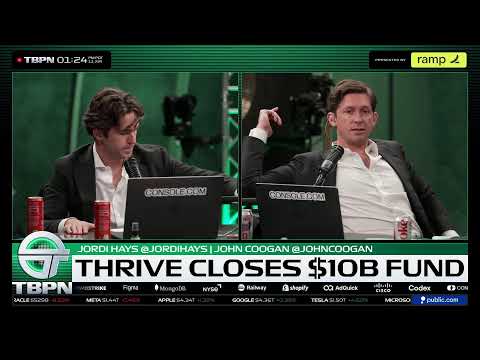
- Thrive Capital: Closed $10 billion fund, the largest ever for the firm, focused on OpenAI, Stripe, SpaceX, and Databricks
Navan's success is particularly notable. The company saved customers 15% of their travel budgets using AI-powered booking and expense reconciliation. Navan Edge, its consumer-facing product, uses AI agents to orchestrate entire trips—flights, hotels, restaurants, events—while the traveler is on the go. The company is also deploying AI bots that autonomously call hotels to confirm reservations, secure rooms, and provide virtual credit cards.
🎮 Airport Lounges Are Catering to Gamers
In lighter news, airport lounges are now installing gaming stations. The Wall Street Journal profiled Portal Lounge in Minneapolis and Gameway locations across the U.S., where travelers can play Mario Kart, Crash Bandicoot, and Apex Legends before flights.
The trend reflects a broader shift: gaming is becoming the preferred pre-flight activity, potentially outpacing gyms (which have struggled to gain traction in airports). Some travelers are even "vibe coding" on flights, using AI-powered development tools to build projects mid-air.
"Video gaming is the main attraction, but it's just one attraction. We're trying to avoid the library vibe of traditional lounges."
🌍 Texas Becomes America's New Center of Gravity
Texas continues its economic dominance. From 2020 to 2025, the state created roughly a fifth of all net new jobs in the country. At least 184 companies shifted headquarters to Austin, Dallas, or Houston during that period, including Tesla and Caterpillar.
Exxon Mobil shareholders approved a plan to reincorporate in Texas after years in New Jersey. The state is also a major beneficiary of the data center boom, thanks to its energy dominance and available land. This summer, Texas will launch the Texas Stock Exchange, joining outposts of the NYSE and Nasdaq already operating in the state.
President Trump called the NYSE's Texas branch "unbelievably bad" for New York, even though his own social media venture was the first to list on it. The irony wasn't lost on observers.
🎬 Lionsgate Takes Equity Stake in Runway
Lionsgate, the studio behind John Wick, Saw, and The Hunger Games, announced an expanded partnership with Runway, taking an equity stake and launching a joint venture to develop new IP using generative AI.
The move signals Hollywood's cautious embrace of AI tools. Lionsgate's Chief AI Officer, Kathleen Grace, is leading a multifaceted AI strategy under an internal steering committee. Whether this results in AI-generated blockbusters or just background replacement remains to be seen, but the partnership is a notable step toward AI-native filmmaking.
⚽ World Cup Predictions: AI vs. Betting Markets
Fundamental, a tabular AI startup, is benchmarking its foundation model against sports books by predicting the 2026 World Cup. The company trained its model, Nexus, on historical game data and ran more than 20,000 simulations.
For the 2022 World Cup, Nexus correctly predicted Argentina would win—long before betting markets did. Markets favored Brazil until the quarterfinals, when Brazil was eliminated. For 2026, Nexus heavily favors Spain over France and ranks Argentina as a strong runner-up, diverging significantly from market consensus.
Belgium, with a population of just 11 million, has a sub-2% chance of winning. The U.S.? Just 0.5%. The results will be tracked at soccer.fundamental.ai.
🔮 What This All Means
The physical AI wave isn't speculative anymore. Nearly $15 billion was raised in a single news cycle across robotics, AI infrastructure, and embodied intelligence. Bezos is betting labor shortages—not job losses—will define the next decade. AMD is chipping away at Nvidia's dominance. SpaceX retail demand is off the charts. And the economy is adapting faster than anyone expected.
The narrative has shifted from "AI will replace us" to "AI will empower us." Whether that optimism holds depends on execution, but the capital is flowing, the talent is mobilizing, and the infrastructure is being built.
As Bezos put it: "This is the best time to start a company."
More from TBPN

Bezos Bets $12 Billion on AI Manufacturing Revolution — Plus Trucking's Four-Yea
🤖 Bezos Goes All-In: Prometheus Raises $12 Billion at $41 Billion ValuationJeff Bezos is making a serious play in the a...

Tim Cook's Final Act: From Siri's Dawn to Its AI Renaissance — Plus North Korea'
📱 The 15-Year Arc: Siri's Full-Circle MomentTim Cook's final WWDC keynote landed with a touch of poetry: Siri, front an...

WWDC Delivers on AI Integration, Labor Market Holds Strong, and Silicon Valley's
🎯 Apple Intelligence Finally Arrives — Theme: "All Systems Glow"Apple's annual Worldwide Developers Conference kicked o...
Dead Hangs, Token Maxing, and the Nationalization Risk No One Sees Coming
🔥 The AI Hype Cycle Enters a New PhaseThe conversation around artificial intelligence has shifted dramatically in recen...
Microsoft Build 2025: The Agent Era Has Arrived (Whether We're Ready or Not)
🎯 Overview: Microsoft Goes All-In on AgentsMicrosoft Build 2025 delivered a clear message: the future is agentic, and t...

Alphabet Raises $80 Billion in Equity—The AI War Just Got Real
💰 Alphabet's Historic $80 Billion Equity RaiseIn a move that surprised many on Wall Street, Alphabet announced an $80 b...