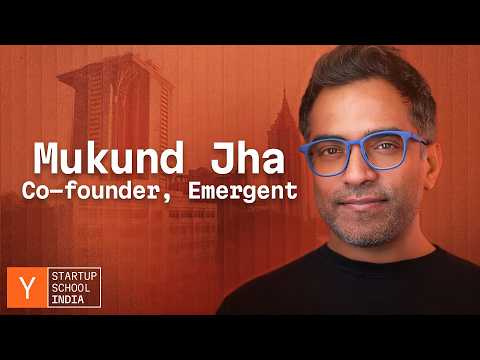
🚀 From Bangalore to $100M ARR in 9 Months: The Emergent AI Story
💡 The Democratization of Code is Here
For the past three decades, software companies have driven nearly all economic gains in global markets. Strip out software from the NASDAQ and S&P 500, and the results are striking: a flat line. This stark reality frames the mission behind Emergent, one of India's first truly AI-native companies to reach genuine scale — and arguably the fastest-growing AI startup in the world right now.
Founded by Mukund Sundararajan and his twin brother Madhav, Emergent has achieved what most startups can only dream of: crossing $100 million in annualized revenue run rate within just 9 months of launch. The platform now serves over 8.5 million users across 190 countries, with more than 10 million apps built on the system. The premise is deceptively simple but profoundly transformative: enable anyone, regardless of programming knowledge, to build and ship real, working software by chatting with an AI agent.
"There are a billion people with ideas, and so many of those ideas die because they don't have access to bring them to life. That was the mission we started with."
📊 The Scale of Ambition: Global from Day One
Emergent's growth trajectory is nothing short of remarkable. In 9 months, the company has:
- Attracted 8.5 million users globally
- Facilitated the creation of over 10 million apps
- Achieved $100 million+ in annualized revenue run rate
- Established presence in 190 countries
- Generated the majority of revenue from the US and Europe, with India accounting for approximately 10% of total revenue
This international reach was intentional. When Mukund returned to India in 2014 after working at Google in the US, he was struck by a paradox: Why is there no Google or Facebook from India? Despite the country's deep engineering talent pool — visible in the leadership ranks of Microsoft, Google, and other tech giants — no truly global, technology-first company had emerged from India at scale.
Emergent represents the realization of that ambition. The founding insight: Building a company for India versus building a global company requires exactly the same effort. Both are equally challenging, so why not think global from day one?
🔧 The Technical Foundation: Living at the Edge
What separates Emergent from the crowded field of AI coding assistants and website builders isn't just ambition — it's deep technical innovation built on a contrarian bet.
When the company started, the prevailing wisdom in venture capital and tech circles was to build copilots — AI assistants that help developers write code faster. Mukund and his team took a radically different approach: they set out to fully automate software engineering. When they pitched this vision to VCs, most rejected them outright. The models weren't there yet, investors said. It was too ambitious.
But Mukund had spent six months after leaving his previous company, Dunzo, doing something crucial: tinkering. He spent 10-12 hours a day exploring new voice models, open-source AI tools, and coding capabilities — not with any specific goal, but out of pure curiosity and joy. This period of "living at the edge" gave him a critical insight:
"AI progress is going to be exponential, and we will always build in the direction of AI. We took this view that models were going to improve rapidly, so we decided to skip problems like JSON parsing — which 20 or 30 YC companies were solving — and go straight to building autonomous agents."
Key technical innovations include:
- Multi-agent orchestration: Different specialized agents (design, testing, deployment) coordinate through a centralized memory system
- Self-learning infrastructure: Every app built on Emergent trains the system, extracting learnable patterns and storing them in memory
- Custom container technology: Emergent built deep container technology from scratch, including disk snapshotting and memory snapshotting to preserve state across multiple parallel agents
- Reinforcement learning and fine-tuning: The platform uses RL on collected data to continuously improve agent performance
- Parallel swarming agents: Multiple agents can work simultaneously on different aspects of a task, a capability Mukund believes represents the future of AI development
The team has already rewritten the entire system three times in nine months — each time a new class of model (like Anthropic's Opus) is released, they reimagine what's possible and rebuild accordingly.
🏆 Beating the Benchmark: The Founding Moment
Emergent's origin story includes a pivotal achievement that established its technical credibility: becoming world number one on SWE-bench, the premier benchmark for coding agents.
The context: Mukund and Madhav joined Y Combinator with the initial idea of building testing agents. Their YC partner suggested they think about enterprise applications rather than their ambitious vision of a consumer app-building platform. Over the three-month YC program, the team pivoted weekly — "AI Zapier" one week, something else the next. The constant changes frustrated the team.
To give them focus while he figured out the long-term direction, Mukund challenged them to tackle SWE-bench, the hardest coding benchmark available at the time. It took three months, but the four-person team achieved the top ranking globally. This wasn't just a validation metric — it became the foundation for Emergent's core technology.
"All of the innovation we have in Emergent right now — parallelized test-time compute, memory systems, agent-to-agent communication — we discovered while attacking that benchmark."
The lesson: Attaching yourself to a concrete, measurable goal provides focus and rapid feedback. It's a forcing function for innovation.
🎯 Second-Mover Advantage: Solving the Real Problem
When Emergent launched, it wasn't the first AI website builder on the market. There were already several established players and countless smaller competitors. This echoed Mukund's experience with Dunzo, which launched into a market with 87 similar companies offering on-demand delivery via WhatsApp.
What gave Emergent the confidence to launch anyway? A fundamental insight about what users actually need.
Most existing platforms focused on front-end prototyping and demos. They were excellent at getting started — impressive at first glance — but terrible at finishing. Users couldn't get real, working software. There were no proper backends, no real databases, no genuine deployment infrastructure.
Emergent approached the problem differently: If you were to automate all of software engineering — not just prototyping — how would you build it? They built everything from the ground up with that question in mind. The platform handles not just code generation, but hosting, deployment, and maintenance. Users can actually ship production applications, monetize them, and serve real customers.
"Consumers are actually going to want real software that is working, not just prototypes and demos. Nobody in the market was solving that problem all the way to the finish line."
Once the product was ready, growth became a math problem: calculate how many social views are needed, how many impressions, how many clicks, how many conversions. The team identified influencer marketing as the optimal channel and executed aggressively. The product-market fit was so strong that the main challenge was simply getting in front of as many users as possible.
🚲 Lessons from Dunzo: Operational Excellence and Focus
Before Emergent, Mukund built Dunzo, one of India's most recognized consumer brands and a pioneer in quick commerce. At its peak, Dunzo was processing 10 million monthly orders, managing almost a million riders, and working with 5,000 stores. The company raised approximately half a billion dollars and became so ubiquitous in Bangalore that "Dunzo it" became a verb.
Key lessons from the Dunzo experience:
1. Solve the Hard Problem
Of the 87 companies doing on-demand delivery via WhatsApp, Dunzo distinguished itself by tackling last-mile logistics head-on. In the early days, Mukund himself would jump on a bike at night to deliver orders, learning the operational challenges firsthand. This obsessive focus on the difficult parts — actually getting products to customers in the right condition — created genuine competitive advantage.
2. Obsess Over the Customer
Before AI, all customer chat had to be manual. During evening traffic spikes, every single engineer would drop their work and get on chat to help customers. The team once put a rider on a plane to deliver a package to another city. This extreme customer focus built authentic brand love.
3. Focus is Crucial
Dunzo's eventual challenges taught a critical lesson: when something works, double down. The dark store model was performing well, but the company was simultaneously pursuing 10 other initiatives — a marketplace model, pick-up and drop services, and more. This lack of focus diluted execution. At Emergent, this lesson translated into ruthless prioritization and clarity of mission.
4. Do Things That Don't Scale
In the early days, understanding customer pain points by doing the work yourself — physically making deliveries, manually handling chats — provides irreplaceable insights. This YC principle proved invaluable.
When Mukund left Dunzo in September 2023, he was "pretty depressed" and spent six months reflecting. But that period became transformative. With no pressure and no clear objective, he returned to pure tinkering — the joy of building for its own sake. That's where Emergent was born.
🌏 Building a Global AI-Native Company from India
Emergent's team is 95% based in Bangalore, with only a small office recently opened in San Francisco. This is deliberate. The company represents a new model: a truly global, AI-native product company built primarily out of India.
The hiring philosophy reflects the technical ambition. Emergent looks for people with steep learning slopes — those genuinely excited about solving complex AI problems. The team has found that the sheer complexity and possibility space of building at the frontier of AI creates intrinsic motivation. Engineers aren't just excited about growth metrics; they're energized by the daily problem-solving with cutting-edge AI systems.
The broader insight for founders: Technology is a great leveler. Internet access is universal. The same AI models available to a startup in San Francisco are available in Bangalore. There's no structural reason a world-class AI company can't be built from India and serve global customers from day one. The effort required is identical — so aim for the bigger market.
💭 Advice for Founders: Think Bigger, Trust Your Intuition
Mukund's advice to aspiring founders, drawn from building two very different companies:
1. Think Global from Day One
Building a company for the Indian market versus building a global company requires exactly the same effort. Both are equally challenging. Given that reality, why not target the larger opportunity? The reach, access, and technology are available to everyone now.
2. Follow Your Intuition
Founders receive endless advice, often contradictory. When Emergent pitched the idea of fully automating software engineering, 10-12 VCs rejected them because they thought AI wasn't ready. But Mukund and Madhav could see the trajectory of model improvement. Personal conviction beats consensus wisdom when you're building at the edge of what's possible.
"You'll get a lot of advice, but following your intuition as a founder is much better because you probably have a better sense of what your customer wants and needs."
3. Solve a Personal Problem
Both Dunzo and Emergent emerged from personal pain points. Dunzo started because Mukund needed an easier way to handle errands after moving to Bangalore. Emergent came from him and Madhav having "thousands of ideas all the time" and wanting a way to bring them to life without waiting for technical resources. When you're solving your own problem, the feedback loop is stronger and the customer understanding is deeper.
4. Attack the Ceiling, Not the Floor
With AI, everything is changing rapidly. This is not the time to think incrementally. Whatever ambition you're holding, 10x it. 100x it. Starting with a harder, more ambitious idea is actually easier — it inspires more talented people to join, it motivates you through difficult periods, and it increases the probability of breakthrough success.
5. Live at the Edge
The best startup ideas often emerge from seeing what's not quite possible yet but projecting where technology will be in six months. When Emergent started, models couldn't reliably produce clean JSON output. Instead of building tooling to fix that limitation (like 20-30 YC companies did), they skipped it entirely and built for where models would be soon. Those companies solving JSON parsing are likely obsolete now.
🔮 The Future: Rewriting Systems for Each Model Generation
Perhaps the most striking aspect of Emergent's operation is the pace of foundational change. The team has rewritten the entire system three times in nine months. Each time a new class of model is released, they don't just integrate it — they reimagine the architecture based on new capabilities.
This approach reflects a core insight: every new model generation requires deleting what you've learned and rebuilding from first principles. What worked with GPT-4 may be suboptimal for Claude Opus. The temptation is to incrementally improve existing systems, but breakthrough performance requires periodically starting fresh.
For Emergent, this means constantly asking: What will be possible in six months? It's an exhausting but necessary discipline for staying at the frontier.
✨ Closing Thoughts: The Democratization Thesis
Emergent's mission is fundamentally about economic access. For 30 years, the value creation in global markets has been captured almost entirely by software companies and those who can build software. If you remove software from major indices, economic progress nearly flatlines.
What happens when that capability is democratized? When a billion people with ideas — entrepreneurs without technical teams, professionals in non-tech industries, students with side projects — can actually build, ship, and monetize real software?
The first nine months of Emergent's existence provide a glimpse: 8.5 million people across 190 countries building 10 million applications. The latent demand was always there. The barrier was access to technical capability.
For India specifically, Emergent represents something more: proof that a truly global, technology-first company can be built from Bangalore and compete at the highest level worldwide. Not a company serving the Indian market, but one that serves the world.
The next wave of Indian startups won't be defined by solving local problems with local solutions. They'll be defined by solving global problems with frontier technology — and keeping 95% of their team in India while doing it.
"Whatever you're thinking right now, just 10x that. 100x that. With AI, it's not a time to attack the floor. It's time to attack the ceiling and think really big. The bigger you think, the higher the probability you'll get to success."
More from Y Combinator

Inside Y Combinator's Transformation: Building Billion-Dollar Companies in the A
🔮 The Economics of AI Are Shifting Faster Than You ThinkThe cost of intelligence is collapsing at a breathtaking pace —...

Why World Models, Not LLMs, Will Power the Next Wave of AI — Lessons from a €1.2
In an industry captivated by large language models, one contrarian thesis is attracting serious capital and serious ambi...

Riding the Roller Coaster: How a Former Quant Bet on AI's Physical Future
🚀 Introduction: The Bitter Lesson and the Long BetEric Landau's journey from particle physics to quantitative trading t...

How OpenCode Built a $40M Run-Rate Business in 8 Months — And Why Enterprise Dev
The coding agent wars have a new protagonist. While Claude Code and Cursor dominate headlines in Silicon Valley, OpenCod...

How Two French Founders Built Europe's Biggest YC Company by Learning to Think B
📸 From Paris to Global ScalePhotoRoom stands as a compelling case study in entrepreneurial ambition. The company provid...
From Zero to Decacorn: The Superbase Story and the Rise of Agent-First Developme
💡 The Bootstrap Philosophy: Why Money Won't Save Your StartupIn an era where venture capital headlines dominate tech di...