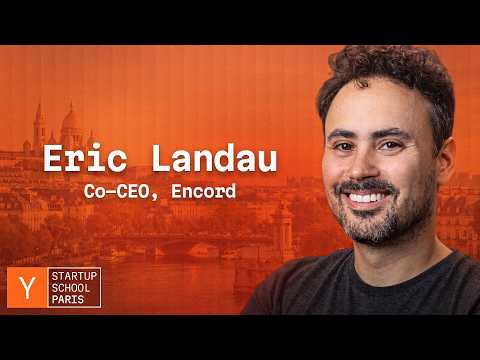
🎢 From Quant Trading to Physical AI: The Encord Journey — Building Through the Roller Coaster
🚀 Introduction: The Bitter Lesson and the Long Bet
Eric Landau's journey from particle physics to quantitative trading to founding Encord reflects a broader story about the evolution of artificial intelligence itself. His career trajectory mirrors what AI researchers call "the bitter lesson" — the realization that building AI systems is less about careful feature engineering and domain expertise, and more about scaling data and compute.
In physics, Landau filtered data based on particle momentum and movement patterns. In high-frequency trading, he crafted market factors into machine learning models. Today, at Encord, the approach is fundamentally different: "Now it's just throwing data into a big pile of machine learning and then seeing it inside."
"AI used to require careful thinking and feature engineering. Now it's better to just scale the system — add more data, more compute."
What makes Landau's story particularly compelling isn't just the technological shift he witnessed, but the personal sacrifice required to build in the space. He left a lucrative quant trading career during COVID — specifically in the month when oil traded negative and his former desk made more money than the previous three years combined. While his colleagues profited from historic market volatility, Landau sat on his couch "fighting Python dependencies" and questioning his decision.
Yet four years later, Encord has become a critical infrastructure player in the emerging Physical AI ecosystem — managing more data than was reportedly used to train GPT-4, serving hundreds of customers, and operating at the multiple-petabyte scale.
🌵 The Desert Years: Building Before the Market Arrived
Encord's early years were marked by a challenging reality: the market wasn't ready. Landau and his co-founder believed deeply in AI's transformative potential, but convincing others proved difficult. "We were in the desert for a couple years," he recalls.
The turning point came with the release of ChatGPT, which fundamentally changed the tenor of conversations around AI. It wasn't that Encord's product suddenly became better overnight — rather, the market began moving toward them faster than before.
Product-market fit at Encord didn't arrive as a single eureka moment. Instead, it was a gradual compounding process — the product improving incrementally while the market slowly caught up. Landau's co-founder identified one memorable signal: "When we saw a sale close in the Gong channel, and we didn't know what the company did. That was very satisfying because we were doing all the sales ourselves."
This happened approximately two months ago, but only in retrospect did they recognize it as confirmation of product-market fit. The lesson: for infrastructure companies in nascent markets, validation often comes quietly, not with fanfare.
"Product-market fit is both product and market. Sometimes the market comes to the product — the world changes and suddenly people care about what they didn't before."
💼 The Painful Education: Building a Sales Organization
For a former physicist and quant, building a sales organization required trial and error — lots of it. Encord went through three sales teams before finding the right fit. One particularly expensive lesson: keeping a misaligned hire for nine months despite knowing early on it wasn't working.
Key lessons on hiring:
- YC advice is "almost always right" — but founders still make the mistakes anyway
- There's rarely a clear, objective reason to let someone go early — often it's just gut instinct
- The skill isn't avoiding bad hires; it's recognizing them faster and acting decisively
- Following your gut and making decisions quickly improves with experience
Landau shared a telling anecdote: after making a hire that violated specific YC guidance, he realized immediately they'd made "exactly what you said not to hire." They brought the person on anyway, hoping it would work out. It didn't — and the lesson cost them nine months.
The evolution from making that mistake to today reflects a broader founder maturity: trusting intuition and acting on it rather than waiting for incontrovertible evidence.
🤖 The Pivot to Physical AI: Betting Ahead of the Curve
Encord started focused on vision AI, deliberately choosing the hardest modality to tackle first. The thesis: AI systems would naturally become multimodal because humans are multimodal — we make better decisions by processing multiple sensory inputs simultaneously.
But the company's focus has shifted dramatically toward Physical AI — robotics, autonomous vehicles, logistics, and manufacturing. This wasn't a traditional pivot born of desperation, but rather a strategic repositioning as the market evolved.
Why Physical AI matters:
- 80% of economic activity involves manipulating or moving things in the physical world
- Robotics experts predict that within 5 to 10 years, there will be more robots than people
- The biggest application of multimodal AI is now in Physical AI systems
- Autonomous driving is furthest along the maturity curve, approaching mass-scale production
- Robotics (humanoids, consumer robotics, manufacturing) represents the biggest growth area
Encord's approach to identifying this shift wasn't insular strategic planning — it was constant dialogue. Landau emphasizes talking to as many smart people as possible: prospects, customers, industry leaders, fellow YC founders. The goal is to "absorb what's going on, what problems they're thinking about, and synthesize those things into the next bet."
"With AI, you can never be comfortable. You always have to think about the next thing. The best way to do that is just to talk to people — as many people as you can."
Despite the narrative shift, Encord still serves a diverse customer base across healthcare, agriculture (including facial recognition for cows — algorithms outperform humans at distinguishing bovine faces), and numerous other verticals. The lesson: infrastructure companies can evolve their positioning without abandoning existing customers.
📊 Operating at Scale: The Encord Infrastructure
Encord's value proposition centers on scalability — specifically, operating at the multiple-petabyte level, which most companies struggle to achieve. The platform handles several core functions:
1. Data Collection
- Operates a physical facility in the Bay Area with robot systems and operators
- Functions like film sets where robots perform tasks in specific environments
- Primarily serves earlier-stage companies building pre-training datasets
- Ingests production data from customers (video streams, sensor data, audio, language)
2. Data Management and Curation
- Described as "finding a million needles in a billion haystacks"
- Companies have vast amounts of data but need to select the right subsets
- Annotation and enrichment of multimodal data
- Evaluation systems for model performance
3. Scale
- Serves hundreds of customers
- Manages multiple petabytes of multimodal data
- Handles more data than was reportedly used to train GPT-4
The geographic split reflects strategic priorities: Landau's co-founder moved to San Francisco, where they built the data collection facility, because most customers are in the US, with the vast majority concentrated in the Bay Area. Meanwhile, the London office leverages Europe's comparative advantage in AI and engineering talent.
The decision framework is clear: "You should be where the important people for your company are. For us, it's customers, then talent, then investors — in that order."
🥊 Competition and Market Positioning
When Encord launched, the overwhelming feedback was that the space was "way too competitive" with too many companies. Over time, many competitors pivoted, consolidated, or ran out of money. For a period, competition actually decreased.
Now the market is heating up again, with players like Scale AI and others competing for dominance in the data infrastructure layer. Landau's perspective on competition is refreshingly positive: "We want it to be competitive. We prefer to have really good competitors because they push you, they make you better as a company."
Encord's differentiation:
- Deep focus on Physical AI applications specifically
- Proven ability to operate at multiple-petabyte scale
- Years spent building foundational infrastructure for massive data operations
For early-stage founders considering whether to use Encord or competitors, Landau offers honest guidance: the inflection point is when internal tools and POCs need to scale. When models are moving from proof-of-concept to production, or when there's a major influx of data, that's when purpose-built infrastructure becomes essential. Before that, open-source tools may suffice.
🎢 The Roller Coaster Philosophy: Embracing the Chaos
Perhaps the most valuable insight from Landau's journey isn't technical or strategic — it's psychological.
Building a company, he explains, is inherently a roller coaster with extreme highs and lows. The natural instinct is to try to mitigate the swings, to smooth out the ride. His advice: don't.
"My view is that you should just ride the roller coaster. Whenever you're at the low, you know that a high is coming. Whenever you're at a high, you know a low is coming. Just accept that you're on a roller coaster."
This philosophy didn't come naturally or early. Only "relatively recently" did Landau develop this mindset, after experiencing enough cycles to recognize the pattern. The key insight: you have more control over your mental state than you realize. You can choose how to react to reality.
The evolution goes further: from merely accepting the volatility to actively enjoying it. As Landau puts it simply: "Roller coasters are fun."
For founders in the early stages, this framing offers a valuable reframe. Rather than viewing challenges as threats to be eliminated, they can be seen as inherent features of the journey — and potentially exciting ones. The founder who can "hack their brain" to run toward fires rather than away from them will find the experience dramatically more sustainable.
🎯 Key Takeaways for Founders
On Market Timing:
- Product-market fit can arrive gradually through compounding improvements rather than a single breakthrough
- Sometimes the market moves toward your product as much as you move toward the market
- Infrastructure companies in nascent markets may need to build for years before seeing validation
On Building the Team:
- Trial and error is inevitable — expect multiple iterations before finding the right sales approach
- Develop the skill of recognizing misalignment early and acting on it quickly
- YC advice is worth following, but you'll probably make the mistakes anyway
On Strategic Positioning:
- Stay close to where your customers are, especially in deep tech where relationships matter
- Constantly synthesize information from customers, prospects, and peers to identify the next bet
- You can evolve your narrative and focus without abandoning existing customers
On Competition:
- Welcome strong competitors — they validate the market and push you to improve
- Focus on building foundational advantages (like scale) that take years to replicate
- Markets that seem overcrowded often thin out as companies pivot or fail
On Founder Psychology:
- Accept that building a company is inherently volatile — don't fight the roller coaster
- You have more control over your reaction to events than the events themselves
- The experience becomes more sustainable when you learn to enjoy the challenges
🔮 Looking Ahead: The Physical AI Wave
Encord's bet on Physical AI appears increasingly prescient. While consumer-facing robotics may not yet be ubiquitous, the infrastructure layer is already seeing significant traction. The company manages multiple petabytes of multimodal data, serves hundreds of customers, and continues to expand its Bay Area operations.
The broader thesis — that 80% of economic activity involves physical manipulation — suggests enormous room for growth. If robotics experts are correct that robots will outnumber people within the decade, the data infrastructure enabling those systems will be critically important.
For founders building in AI, Encord's journey offers a roadmap: start with the hardest technical problems, build infrastructure that scales, position yourself ahead of market curves, and embrace the roller coaster ride.
As Landau discovered sitting on his couch during COVID, fighting Python dependencies while his former colleagues made historic profits, the existential question isn't whether you're maximizing short-term compensation. It's whether you're building something that provides real value and participating in the technological paradigm shift of your generation.
Sometimes the answer is worth leaving millions on the table.
More from Y Combinator
How OpenCode Built a $40M Run-Rate Business in 8 Months — And Why Enterprise Dev
The coding agent wars have a new protagonist. While Claude Code and Cursor dominate headlines in Silicon Valley, OpenCod...

How Two French Founders Built Europe's Biggest YC Company by Learning to Think B
📸 From Paris to Global ScalePhotoRoom stands as a compelling case study in entrepreneurial ambition. The company provid...
From Zero to Decacorn: The Superbase Story and the Rise of Agent-First Developme
💡 The Bootstrap Philosophy: Why Money Won't Save Your StartupIn an era where venture capital headlines dominate tech di...
The New Design Paradigm: Building Interactive Products with Voice, AI Agents, an
The design process has fundamentally changed. What once required months of manual coding, painstaking iteration in Figma...
Why Aggregate Metrics Hide the Truth — And How Dot Plots Reveal What Users Actua
Most founders obsess over the wrong numbers. Daily active users, monthly active users, aggregate retention rates — these...

The Dawn of India's Global AI Era: Insights from Y Combinator's Delhi Event
Y Combinator recently convened hundreds of builders, founders, and aspiring entrepreneurs in Delhi for an electrifying d...