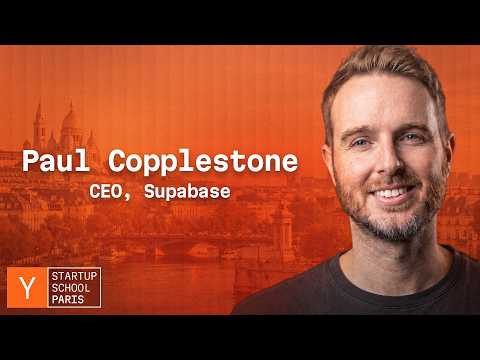
🚀 How Superbase Scaled to 10M Developers in the Age of AI Agents
💡 The Bootstrap Philosophy: Why Money Won't Save Your Startup
In an era where venture capital headlines dominate tech discourse, one insight stands out from Superbase CEO Paul Coppestone: money will not solve fundamental business problems. Despite recently raising $500 million at a valuation exceeding $10 billion, Coppestone maintains that capital serves the mission — not the other way around.
"The founders have to really know that money won't make you succeed," Coppestone explained. "If you want to build a generational company, you have to do a bunch of things correctly." This philosophy has enabled Superbase to compete against AWS despite having significantly less capital at their disposal.
The company's approach reflects a fundamental truth about startup competition: resource constraints can be advantages. By this logic, early-stage founders competing against Superbase shouldn't feel disadvantaged by their smaller war chests — they can compete on vectors beyond pure capital deployment.
📊 The Numbers: Explosive Growth in the AI Era
Superbase's trajectory exemplifies the compounding effects of platform adoption in the developer tools space:
- Year 1 (2021): Approximately $1 million in ARR
- Year 2 (2022): $7.5 million in ARR
- Developer Base: Grew from 6.5 million to 10 million developers in recent months
- YC Penetration: Over 60% of every Y Combinator batch now uses Superbase
- Agent-Generated Usage: An estimated 60-90% of databases are now launched by AI agents
What makes this growth particularly remarkable is that all key metrics improved simultaneously — user acquisition accelerated while conversion and activation rates increased, defying the typical pattern where increased marketing spend dilutes intent signals.
🎯 The Open Source Gambit
Superbase's commitment to open source wasn't strategic calculation — it was philosophical conviction. Both Coppestone and his co-founder simply preferred building in the open, embracing community-driven development from day one.
The company operates under a fully open-source model with one critical exception: the infrastructure code managing millions of concurrent databases remains proprietary, primarily because it's "lumped in with billing logic" and would create security vulnerabilities if released.
This approach created natural advantages when large language models began training on public code repositories. Years of GitHub comments, Reddit discussions, and community documentation became embedded in AI training data, making Superbase a default choice for agent-generated applications — without spending a dollar on traditional marketing.
"If I could give a free database, I'd rather give that to developers than spending on marketing."
⚡ Why Postgres? The 40-Year Bet
Choosing Postgres as the foundation wasn't arbitrary. Coppestone identified several compounding advantages in the 40-year-old database technology:
Game Theory Dynamics: No single entity owns Postgres, which means everyone contributes. This creates a flywheel where hyperscalers must offer best-in-class Postgres support because it's the most popular choice, which in turn strengthens Postgres dominance.
Built-in Credibility: Database companies require immense trust. Postgres's four-decade reputation provided instant legitimacy that would take years to build from scratch.
Market Momentum: Through careful monitoring of Hacker News ("I'd read it three times a day"), Coppestone identified Postgres as trending upward despite not being the most popular database at the time. That directional bet has since proven prescient — Postgres is now the dominant database technology.
🤖 The AI Inflection Point: When Agents Became Your Primary Users
The transition happened almost overnight. In December 2024, Superbase's engineering team thought they were experiencing a DDoS attack. The traffic surge came from Bolt and Lovable — AI coding platforms generating thousands of applications, each requiring database infrastructure.
Initially, there was internal debate about whether these use cases mattered. The applications being generated seemed small and unlikely to scale into meaningful revenue. That assessment proved spectacularly wrong.
By early 2025, the pattern became undeniable. When Cursor, Claude Code, and CodeX joined the ecosystem, agent-generated databases reached the millions monthly. The infrastructure that Superbase had built to serve human developers became perfectly positioned for the agent economy.
🏗️ Superbase for Platforms: The Product Nobody Knew They Needed
The AI explosion revealed a latent market: platforms that need to provision millions of database instances. Superbase formalized this capability into "Superbase for Platforms" — enabling companies to launch and manage massive fleets of databases.
The product serves two distinct markets that converged on the same technical requirements:
1. AI Coding Platforms: Companies like Lovable need to spin up databases at unprecedented scale and speed.
2. Enterprise Innovation Labs: Large organizations want controlled environments where teams can rapidly prototype, with centralized visibility, security controls, and resource management.
The convergence created roadmap alignment — features built for one segment naturally benefit the other. Over 50 companies now build on this platform infrastructure.
📐 Developer Experience in the Agent Era
Superbase's obsession with developer experience began with a simple metric: time to value. Coppestone personally timed the process of launching an RDS instance on AWS, connecting tools, and inserting a row — it took 8.5 minutes.
The goal: get that under one minute. Today, Superbase achieves this in 5 seconds. AWS? Still roughly 8.5 minutes.
But the optimization target has evolved. In the agent era, time becomes less relevant than "shots to completion" — how many prompts are required to achieve the desired outcome? When an agent walks away from your product to seek clarification, that represents a failure of the abstraction layer.
This thinking drove three phases of product evolution:
- Phase 1: Dashboard with click-through interfaces for discovery
- Phase 2: Stripped-down dashboard focused on SQL editor and chat interface
- Phase 3: CLI and MCP (Model Context Protocol) interfaces that agents can programmatically control
The north star: infrastructure as code with full git integration and branch-level database environments. Every database configuration should live in declarative schemas that agents can read, modify, and version control.
🌍 The Remote-First Advantage Nobody Expected
Superbase operates with 360 people distributed across 60+ countries with zero offices. This wasn't a pandemic compromise — it was an intentional design choice from founding.
The unexpected benefit emerged with AI tooling: six years of institutional knowledge exists in searchable, written form. Every decision, every debate, every architecture choice was documented in Slack and Notion.
"Most people have agents who know everything from the last 6 months. We have agents that know everything from the last six years."
This creates asymmetric advantages in AI-assisted operations. When leadership wants to understand fundamental operating principles or historical decision rationale, they can query comprehensive context that hybrid or office-centric companies simply don't have in structured form.
Coppestone's advice: "You can't halfass it" — the hybrid model with some distributed and some office-based teams fails to capture these benefits while maintaining coordination costs.
💰 The Fundraising Reality Check
Despite raising $500 million at a $10+ billion valuation, Superbase maintains operational discipline that seems paradoxical for a company of its scale.
The company's first institutional investor was Coatue, a hedge fund managing approximately $70 billion that participated in the seed round. This created an unusual dynamic: early investors who became more interested as success accumulated, rather than less.
"At the start they're like 'here's $6 million, we don't care about you,'" Coppestone noted. "As we started getting more successful and it looks like we might go to the public markets, suddenly they're very interested."
The inversion of typical seed dynamics — where early investors become less relevant as later-stage investors drive toward liquidity events — shaped how Superbase thinks about investor relationships and pressure.
🔮 The Next Frontier: Self-Driving Databases
Looking forward, Coppestone identifies autonomous database operations as the critical unsolved problem. While AI agents excel at the "build stage" — generating applications from prompts — they struggle with the "operate stage" — maintaining, securing, and optimizing systems over time.
"How can I continue to operate this once it's built?" represents a defensible moat in an era where building applications becomes increasingly commoditized. Self-driving databases that handle patches, security updates, performance optimization, and incident response without human intervention would dramatically expand what individual developers and small teams can manage.
This focus on hard, operational problems reflects broader strategic thinking: easy-to-replicate startups built purely in the "build stage" lack durability. The companies that will matter in five years are solving problems in the operate stage — where complexity creates genuine barriers to entry.
📝 Lessons for Founders Building in the Agent Era
On Competing When Agents Choose Defaults: If there's a world where agents only select three database providers by default, competing on being one of those three requires "a lot of luck" — not a viable strategy. Instead, focus on the fundamentals: word of mouth, exceptional experience, and vectors of competition beyond default selection.
On Open Source as Moat: Years of public documentation, community discussion, and code repositories create training data advantages that compound over time. This isn't marketing spend — it's architectural DNA that becomes embedded in how agents understand and use your product.
On Resource Constraints: AWS shouldn't have allowed Superbase to exist based on pure resource comparison. But startups win by doing specific things exceptionally well, not by having the largest balance sheet. Capital should fund these capabilities, not replace them.
On Remote Operations: The "written by default" culture of remote-first companies creates machine-readable institutional knowledge that becomes increasingly valuable as AI systems integrate into operations. This is a durable advantage that office-centric competitors will struggle to replicate.
✨ The Vibes Economy
In a future where technical capabilities converge and AWS potentially matches Superbase's developer experience, what remains? "Maybe people will choose Superbase because they just like our vibes," Coppestone mused.
It's a strangely profound observation: as technical differentiation compresses, community, values, and identity become the ultimate moats. Developers choosing databases based on "vibes" isn't irrational — it's a sophisticated evaluation of alignment, trust, and cultural fit that can't be easily automated or replicated.
That insight might be the most important takeaway for founders navigating the agent era: build something humans genuinely want to be associated with, and the agents will follow.
More from Y Combinator

The New Design Paradigm: Building Interactive Products with Voice, AI Agents, an
The design process has fundamentally changed. What once required months of manual coding, painstaking iteration in Figma...
Why Aggregate Metrics Hide the Truth — And How Dot Plots Reveal What Users Actua
Most founders obsess over the wrong numbers. Daily active users, monthly active users, aggregate retention rates — these...

The Dawn of India's Global AI Era: Insights from Y Combinator's Delhi Event
Y Combinator recently convened hundreds of builders, founders, and aspiring entrepreneurs in Delhi for an electrifying d...

Ploy, Webflow, and the New Economics of Entrepreneurship
🎯 The Shift: From Technical Gatekeeping to Taste & ExpertiseA profound transformation is underway in how products get b...
Stop Overthinking: The Ruthless Focus Required to Validate a Startup Idea
📊 The Decision Paralysis ProblemA common pattern has emerged among early-stage founders: an abundance of ideas paired w...
Building Consumer Fintech at Scale: Lessons from Grow's Journey to IPO
📊 From Zero Revenue to Public MarketsGrow's journey represents one of the most compelling case studies in consumer fint...