TL;DR
- Elon Inc. bundles the vision across Tesla, SpaceX, and xAI: chip manufacturing (Terafab), space data centers, and a lunar electromagnetic mass driver to scale AI and space infrastructure.
- Compute is the core bottleneck: the plan leans on being “chip constrained by a 1000x” and aspiring to “reach a pedawatt.” Specific chip-use cases remain loosely defined.
- Lunar mass driver thesis: move bulk materials (rock, water, metals) and eventually satellite components from the Moon’s low gravity well into orbit; bold timelines range from 15–20 years to 2100.
- Reception split: admiration for ambition vs. claims of a “sci‑fi pump” into an IPO era. Memorable line: “turning science fiction into science fact.”
What Changed: A Consolidated Elon Platform
The keynote stitched together Tesla, SpaceX, and xAI into a single narrative. The backdrop: a sprawling roadmap that spans sports cars and Cybertrucks, reusable rockets, Starlink, Neuralink, tunnels, X/Twitter, and now Terafab, next‑gen training compute, and space data centers. The presentation cadence drew mixed reviews, but the scope was unmistakable.
“Never bet against Elon.”
Notably, the logos and ambitions aligned onstage, fueling speculation of an integrated strategy—potentially even “gearing up for the Elon Mega‑org.”
Compute Is the Constraint ⚙️
- Demand: multiple references to being “chip constrained by a 1000x” en route to “a pedawatt.”
- Supply: no definitive path for where all that compute would be deployed—self‑driving, humanoids, xAI cloud, or internal workloads remain open questions.
- xAI cloud: the path to offering cloud services to other companies was floated as logical over time.
Policy context resurfaced. The CHIPS Act moment in 2022 featured talk of “like 60 billion” up for grabs, while Elon was raising “around 60 billion” (and “40 something billion”) for Twitter; Intel’s market cap was cited as $220 billion now vs. “maybe 150 billion” then. The broader point: U.S. IP and export controls (ASML/TSMC/NVIDIA links) are levers in the geopolitical chip race.
Space Data Centers: Bold, Costly, and Contentious ☁️🛰️
Space data centers remain a polarizing idea. Costs cited in recent discourse included:
- “50 billion” for a 1 GW space data center (pegged by Andrew McCallip)
- “16 billion” target by StarCloud
- At $200/kg, about “101 billion dollars per gigawatt”
- “SpaceX is trying to do it for 10.”
Whether these economics converge is unresolved. Even supporters conceded: “It is not clocking for me… on space data centers.”
Moonshot: The Lunar Mass Driver 🌕
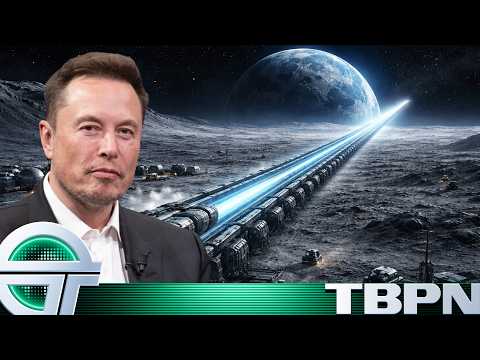
The mass driver is the keystone of the ultra‑long‑term plan: an electromagnetic launcher fixed to the lunar surface, turning solar power into kinetic energy to accelerate payloads to escape velocity—bypassing propellant heavy lifts from Earth.
“Turning science fiction into science fact.”
Physics and use‑cases:
- Quoted escape velocities: “5,000 m an hour” for the Moon vs. “25,000 m hour” for Earth.
- Initial payloads: rocks, metals, oxygen, water for radiation shielding, life support, and propellant (via electrolysis).
- Longer term: satellites built on the Moon—or at least heavier housings assembled there—with chips delivered from Earth and mass‑launched to orbital destinations.
What counts as ‘working’—a proposed four‑part operational bar:
- Permanently installed electromagnetic launcher on the lunar surface.
- Throughput: at least 300 metric tons over 12 months.
- Reliability: about 95% mission success with at least 200 launches per year.
- Utility: launched mass must be put to use (e.g., delivered for shielding, fuel, or manufacturing), not just demonstrations.
Build sequence and rough phasing (as discussed):
- Access: reliable heavy lunar launch capacity—“3 to 5 years away, like minimum.”
- Power: deploy a 100 kilowatt solar array first, then scale to a multi‑megawatt plant with burst capacity.
- Thermals & construction: autonomous rovers to lay precision electromagnetic track; survive swings from “negative 280” to “positive 260 Fahrenheit”.
- Logistics: build major components on Earth; ship hundreds of tons of superconducting coils via dozens of dedicated cargo flights.
- Assembly & integration: human/robotic crews; extended testing; avoid catastrophic failures that damage the power stack.
- Scale: track length estimates around “one kilometer” mentioned; once operational, the Moon’s lack of atmosphere and lower gravity are major advantages.
Timelines, Benchmarks, and Bench Racing ⏱️
Unlike prior Elon programs with tight (and often controversial) timelines, the mass driver came without a date—only “I hope to see it in my lifetime.” The debate quickly turned to scenarios and over/unders:
- Over/under: “15 to 20 years” (aggressive case); counter: “over 20”.
- Median calls: “70 years”; “50 years”; “30” also floated.
- MVP take: “10 years to an MVP” was raised and then challenged against the stricter 300‑ton/95%/200‑launches bar.
- Century line: “2100” as a working over/under; “75 years” cited as plausible.
For context on high‑speed benchmarks: the fastest aircraft speed on record was Mach 9.6 by an unmanned NASA X‑43 scramjet on November 16th, 2004—“nearly 7,000 miles hour.”
Markets, Policy, and the ‘Midcurve’ Framing 📊
- Midcurve case: a “sci‑fi pump” to energize a cycle across semis, space, and AI—“the final pump… to get to the $2 trillion valuation.”
- Left curve: “Elon good businessman. Elon do hard thing.”
- Right curve: “insane AI acceleration” enables timelines that look impossible with today’s cost stacks.
One critic put it starkly:
“Terafab is a blatant pump… There will never be leading edge chips from them. There will never be data centers in space… an effort to IPO SpaceX… and then merge with Tesla.”
Yet the counterweight remains the track record—Starlink was late to some early estimates but ultimately worked and scaled into a real business.
AGI Timelines vs. Industrial Timelines
Last year saw a surprising consonance among prominent technologists: “8 10 years”, “a few thousand days”, and targeting 2032 for superintelligence—generally in a 7 to 10 year range. Translating those software‑centric horizons into hard‑tech supply chains, lunar logistics, and megaproject commissioning remains the core tension.
Watchlist and Near‑Term Catalysts ✅
- Chip manufacturing (Terafab): expectation that Tesla/xAI/SpaceX lean into in‑house chip progress; viewed as “good for America” and global competitiveness.
- xAI cloud services: credible pathway once compute is stood up beyond internal needs.
- Export controls & IP: ASML/TSMC/NVIDIA licensing dynamics and enforcement remain pivotal to the U.S.–China chip race.
- Optimus odds: a related market bet—“Will the Tesla Optimus be released this year?”—sat at 25.4%, having moved from 19% up to “almost 30%” and back to 25% alongside recent headlines.
Final Take
The keynote lacked granular roadmaps but delivered an unmistakable statement of intent. The near‑term reality is all about chips and power; the medium term is about scaling compute and services; the far term is about lifting mass from the Moon. As one line put it, the ambition is about “turning science fiction into science fact.” Whether this becomes a durable industrial strategy or a speculative pump will show up not in renders, but in fabs, power plants, payloads, and unit economics.