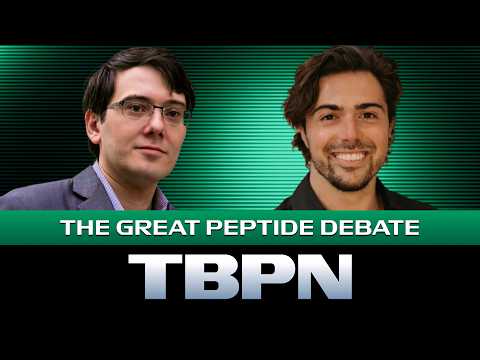
🧬 Peptides at a Crossroads: DIY Hype vs FDA Evidence
TBPN•
March 23, 2026

🧬 Peptides at a Crossroads: DIY Hype vs FDA Evidence

Key takeaways

  • Two competing frameworks: evidence-based approval via the FDA versus a harm-reduction push to legalize popular gray-market peptides for compounding and physician oversight.
  • IP and enforcement risk: claims of piracy around next‑gen GLP‑1s and other candidates underscore the role of U.S. biopharma R&D, exclusivities, and interstate commerce rules (BLA/NDA/505(b)(2)).
  • BPC‑157 is the flashpoint: one camp calls it ā€œthe biggest scam,ā€ the other cites 10–20 years of clinical use, ā€œthousands of doctors,ā€ and ā€œmillions of patientsā€ as real‑world evidence worth legalizing and studying.
  • Policy watch: discussion around moving ~14 peptides from Category 2 (cannot be compounded) to Category 1 (can be compounded) frames a pivotal regulatory shift.

What ā€˜peptides’ means today 🧪

  • Peptides sit between small molecules and large biologics. As one voice put it: ā€œPeptides are sort of the worst of both worlds.ā€ Another countered that injections are now normalized, wellness/optimization is mainstream, and AI‑driven discovery could expand the peptide toolkit.
  • GLP‑1 receptor agonists were cited as the breakthrough proof point: ā€œWe’ve seen one category of peptides, GLP‑1s, already change the world.ā€
  • The spectrum runs from physician‑prescribed, FDA‑approved GLP‑1s to the so‑called ā€œWolverine stackā€ favored by a gym‑going teen—highlighting vastly different risk profiles under one broad label.

IP, gray markets, and the ā€˜retatrutide’ moment āš–ļø

On overseas copycats and next‑gen GLP‑1s, the industry view was blunt:

ā€œWhy do you have a right to pirate somebody’s intellectual property? … This is the property of [a major pharma]. They discovered it. They spent billions of dollars on it. You want to steal it? … That’s not good for America. That’s not good for the drug industry.ā€

The argument: if DIY channels scale, innovation could suffer similarly to music piracy’s early impact—especially when compounds originate in U.S. R&D labs. The counter: people are taking these compounds anyway; the safer path is to bring them under legal compounding, GMP standards, and medical oversight.

BPC‑157: placebo, panacea, or trial‑worthy?

No peptide sparked more heat than BPC‑157.

  • The skeptic:
    ā€œBPC‑157 is the biggest scam I’ve ever seen. It does absolutely nothing.ā€

    Cited points included: a single origin story (a Croatian lab), lack of independent publications, a 15‑amino‑acid sequence with a half‑life measured in minutes, and a failed attempt at human trials by a Balkan company. The conclusion: no plausible pharmacology; any benefits are placebo.

  • The believer:
    ā€œThousands of doctors [have used it] … for 10 to 20 years. … Millions of patients have taken this.ā€

    This camp doesn’t claim RCTs exist, but argues the accumulated clinical experience cannot be dismissed. Anecdotes cited included: someone who ā€œlost three organsā€ and came off biologics; a back‑pain case reporting relief after 3 days and no painkillers for the first time in 4 months.

The methodological line remained stark:

ā€œScience is controlled experiments … Why are we going backwards?ā€
ā€œWe can’t ignore real‑world evidence.ā€

One side insisted only rigorous RCTs count and even added: ā€œI would bet anything no trial of BPC would work.ā€ The other pledged to fund a study, arguing the path to safety runs through legalization and formal trials rather than underground channels.

Legal pathways, exclusivities, and compounding

  • FDA frameworks: trafficking medicines in interstate commerce requires a BLA, NDA, or 505(b)(2). Data exclusivities exist beyond patents: 7 years for orphan drugs and 5 years for NCEs—cited as meaningful incentives to innovate even without a composition‑of‑matter patent.
  • Compounding debate: a push is underway to move ~14 peptides from Category 2 (cannot be compounded) back to Category 1 (can be compounded). Proponents frame this as harm reduction: bring popular compounds into GMP settings with physician oversight. Opponents argue this creates a shadow FDA for products that ā€œcouldn’t quite get on the school bus.ā€
  • Cost to re‑engineer: altering molecules to secure new IP and run trials can, by one estimate, cost $300 million to $3 billion.

Beyond GLP‑1s: thymosin alpha‑1 and short half‑lives

Another peptide, thymosin alpha‑1, surfaced as a proof point from the pro‑peptide side:

ā€œApproved in 35 countries … Every time I get a sore throat I take [it] … and the sore throat disappears.ā€

Paired with the argument that some short‑half‑life peptides can still be clinically effective, it challenged the contention that peptides are inherently weak agents without heavy modification.

The macro frame: incentives, enforcement, and where this goes next šŸ”­

  • Incentives vs. access: IP protection and exclusivities are designed to fuel U.S. R&D; gray‑market compounding erodes that incentive. The counterclaim: real‑world demand won’t vanish—so legalization reduces harm while evidence catches up.
  • Regulatory risk: peptides framed as gray‑market copies of major pipelines (e.g., next‑gen GLP‑1 combinations) invite stepped‑up enforcement. One view: ā€œWe can arrest the genie.ā€ The other: attempts to ban will simply push use further underground.
  • Clinical bar: the RCT‑only camp sees uncontrolled anecdotes as noise; the legalization‑first camp wants GMP compounding and physician oversight now, while funding trials to harden the signal.

Notable quotes šŸ’¬

ā€œPeptides are sort of the worst of both worlds.ā€
ā€œFormer peptide skeptic turned peptide believer.ā€
ā€œGLP‑1 receptor agonists … have already changed the world.ā€
ā€œBPC‑157 is the biggest scam I’ve ever seen.ā€
ā€œThousands of doctors … millions of patients … over 10 to 20 years.ā€
ā€œYou need a BLA or an NDA or 505(b)(2) to traffic a drug across interstate commerce.ā€
ā€œSeven years orphan exclusivity, 5 years of NCE exclusivity.ā€
ā€œApproved in 35 countries.ā€
ā€œSpend $300 million to $3 billion.ā€

What to watch next

  • Policy shifts: any FDA movement on reclassifying the ~14 peptides between Categories 1 and 2 will materially reshape compounding, supply chains, and liability.
  • Trial read‑outs: attempts to run proper studies on BPC‑157 and other peptides will test the anecdotal narrative against RCT evidence.
  • Enforcement: expect scrutiny on gray‑market suppliers, especially around IP‑sensitive GLP‑1 combinations and imports.

Bottom line

Peptides sit at the intersection of blockbuster precedent (GLP‑1s), surging consumer demand, and a regulatory regime built for high‑bar evidence. The debate isn’t simply pro‑ or anti‑peptide—it’s about how to balance innovation incentives, patient safety, and real‑world behavior when the genie is out of the bottle.

More from TBPN