Perico3 min read
Trader claims $280,000 profit in 2026 with a 43% win-rate $100-start system
Craig Percoco lays out a crypto day-trading framework he says scales from $25 risk to his current $2,000-per-trade sizing.
AI summary of “How To Start Day Trading With $100 In 2026 (Full Course)”
Key takeaways
- Craig Percoco says he has made $280,000 in profit so far in 2026 while winning only 43% of trades.
- He favors crypto over stocks, futures and forex for small accounts because leverage cuts capital requirements drastically.
- His strategy relies on spotting a "change of character," a fair value gap, and entering at the gap's 50% midpoint.
- He recommends testing a strategy over roughly 100 simulated trades before risking real money.
- Percoco suggests scaling risk by a fixed percentage of account size (e.g. 2%) rather than jumping to larger dollar risk.
Percoco's track record and starting premise
Craig Percoco opens by stating that trading about two hours a day has produced $280,000 in profit so far this year, achieved while "losing more than half" of his trades. He says nine years ago he started with around $25 of risk per trade and has scaled that to risking $2,000 per trade today, with winning days ranging from $10 to $20,000. He frames the video as the process he would follow if starting over with $100.
He stresses that profitability, not being "right," is what matters:
"The only thing that matters is whether or not the strategy and your execution is profitable over time."He says his year-to-date results came with a 43% win rate, and that early on he struggled with losing streaks and closing winning trades too early.
Choosing a market: why he prefers crypto
Percoco compares stocks, futures, forex and crypto. Stocks are liquid and regulated but require large capital and limited leverage; futures offer better leverage and hours but aren't suited to long-term holding; forex trades nearly anytime but he finds its price action "very inconsistent and volatile." Crypto, he argues, is a 24/7 market with a low capital threshold thanks to leverage.
Using worked examples, he shows that risking $150 on a stock trade might require around $32,000 notional ($16,000 with 2x margin), while the same trade in futures needs about $1,000, and in crypto with 100x leverage needs only around $300. He notes a personal trade with a $950,000 notional position that only cost about $39,000 in actual capital, aiming for "$6 to $7,000" in profit.
Getting access to capital: prop firms vs. leverage
He outlines two routes to trading with limited funds. Prop firms give traders simulated capital (e.g. $100,000) for a fee of "between $80 and $150," with drawdown rules (e.g. can't lose $3,000 before earning $6,000) before payouts are credited. He says one of his private team's traders got funded "3 weeks in." The alternative is using personal leverage, e.g. $200 at 50x for $10,000 notional exposure, with no consistency rules but more liquidation risk — he notes 2x leverage needs a 50% drawdown to wipe an account, while higher leverage needs far less.
The trading framework: change of character and fair value gaps
Percoco's repeatable setup looks for a "change of character" — price breaking above a prior lower high after a downtrend — followed by a "fair value gap," a three-candle imbalance where price tends to retrace before continuing. He enters at the gap's 50% midpoint, places a stop below the recent swing low, moves to break-even once price confirms a new swing high, and targets 1:3 to 1:4 risk-reward as a baseline, though he says some trades run to "seven times 10 times 12 times" the risk. He also uses higher timeframe (e.g. 15-minute) fair value gaps as "high conviction" confluence signals, citing a trade where a team member achieved "5R, 6R, $18R."
Scaling from $100: the four pillars and percentage risk
He proposes four stages: learning the strategy, testing it in simulation over roughly 100 trades to reach "statistical significance," performing it in a simulated environment, and only then trading live with $10–$20 risk per trade. He uses a Notion journal to track win rate, average R, and consecutive losses before committing real money.
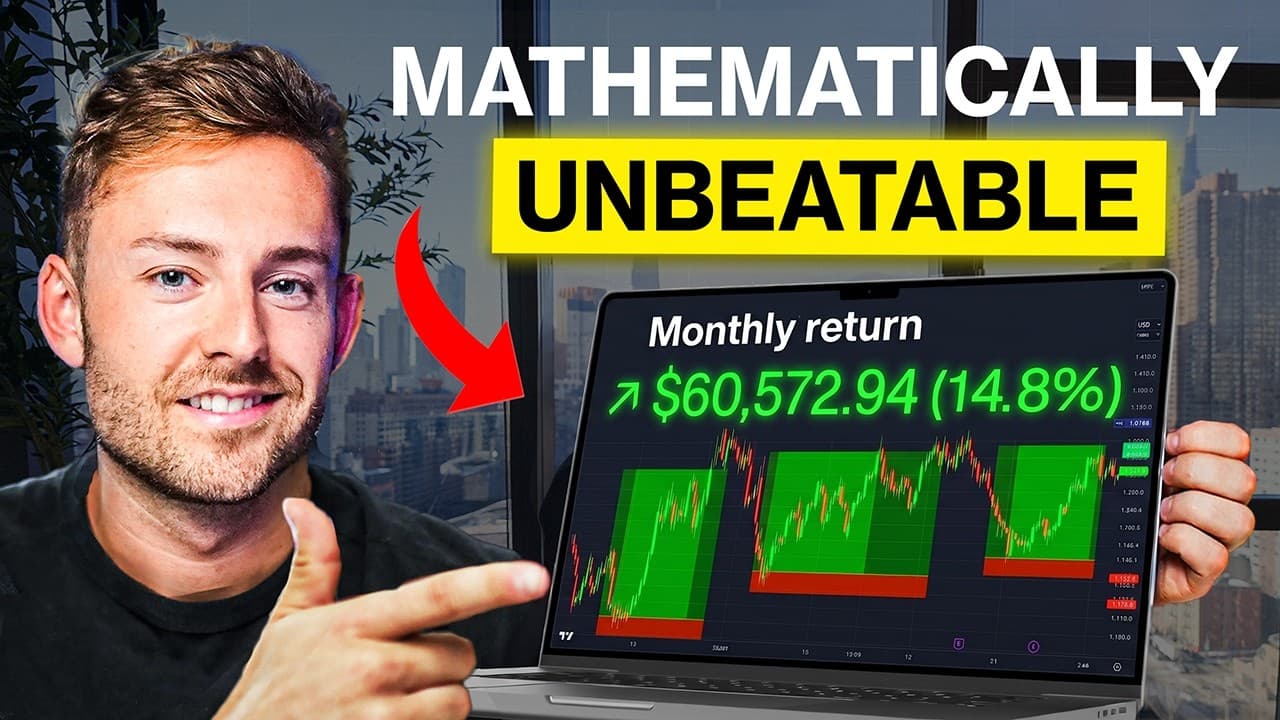
For scaling, he recommends risking a fixed percentage of the account (e.g. 2%) rather than fixed dollar amounts, saying he personally had to retreat from $100 back to $25 risk after finding it emotionally difficult. He gives examples: a $500 account risking 2% ($10/trade) making 4R weekly nets $71; this scales to $400/week on a $5,000 account. He cites a prior week where $2,000-per-trade risk produced $8.2K, and says the same performance at $150 risk would equal roughly $1,200 a month, or $4,500 at $2,000 risk based on September's "a little over $60,000" result.
Written by AI from the video's transcript. It can compress, misattribute or miss context — the original video is the source. Not investment advice.