Perico3 min read
Trader claims over $60,000 month using fair-value-gap and Fibonacci entry model
A day-trading YouTuber outlines the chart model he says produced a 42% win-rate month of over $60,000 in profit.
AI summary of “The ONLY Strategy I Used To Make $60,572/Month Day Trading”
Key takeaways
- Craig Percoco says he made over $60,000 in 30 days risking $2,000 per trade with a 42% win rate.
- The model combines 1-minute change of character, fair value gaps, and the 61.8% Fibonacci retracement for entries.
- He targets a 1:4 risk-reward minimum, aiming for roughly 5R per week across 20 to 25 trades.
- He adds a 15-minute "liquidity inflection level" confluence and a proprietary buy/sell signal not shared publicly.
- He frames the same approach at $150 risk per trade as a hypothetical $4,500 month.
Percoco says a single repeatable model drove his best month
Craig Percoco states he made "a little over $60,000 in profit over the last 30 days," much of it traded live in front of his team and journaled in detail, risking $2,000 per trade. He says the same approach scaled down to $150 of risk per trade "would have resulted in a $4,500 month." He describes his overall activity as trading about 3 days per week, taking 20 to 25 trades, and aiming for roughly 5R (five times his risk unit) per week, which he says gets him to "that $10,000 a week average."
He frames the month's result as coming from a 42% win rate, stressing that trading "has very little to do with being right... and everything to do with whether or not you're actually generating profit over a set period of time."
The setup starts with simplified charts and the New York open
Percoco sets up TradingView with a 1-minute and 15-minute chart side by side, using what he calls the "IT Foundation indicator" to mark the New York stock market open, which he says brings increased market participation and volatility. He waits for the 9:30 a.m. New York open before looking for trades.
From there he looks for a 1-minute trend via "break of structure" (higher highs/higher lows or the reverse) and a "change of character," where price closes beyond the last swing high or low against the prevailing trend, as the first signal of a potential new direction.
Entries combine fair value gaps, Fibonacci levels and a higher-timeframe filter
Once a change of character appears, Percoco looks for a "fair value gap" — a three-candle imbalance — and waits for price to retrace into the gap's midpoint, ideally between the 50% and 61.8% Fibonacci retracement levels, to build an entry. Stops are placed "slightly outside the bottom of the fair value gap producing candle or at an important technical level."
He layers in a 15-minute timeframe check, looking for price to respond off 15-minute fair value gaps ("points of interest") before confirming the 1-minute entry, plus a "liquidity inflection level" where price has previously bounced and later tests the opposite side of that level as added confluence. He also references a "proprietary buy/sell signal" used with his private team that is not shared on YouTube but is "not necessarily required for this model to work."
"This isn't us being wrong about our idea... it's just the fact that the markets are effectively random." — Craig Percoco
Risk management and position sizing are presented as central to results
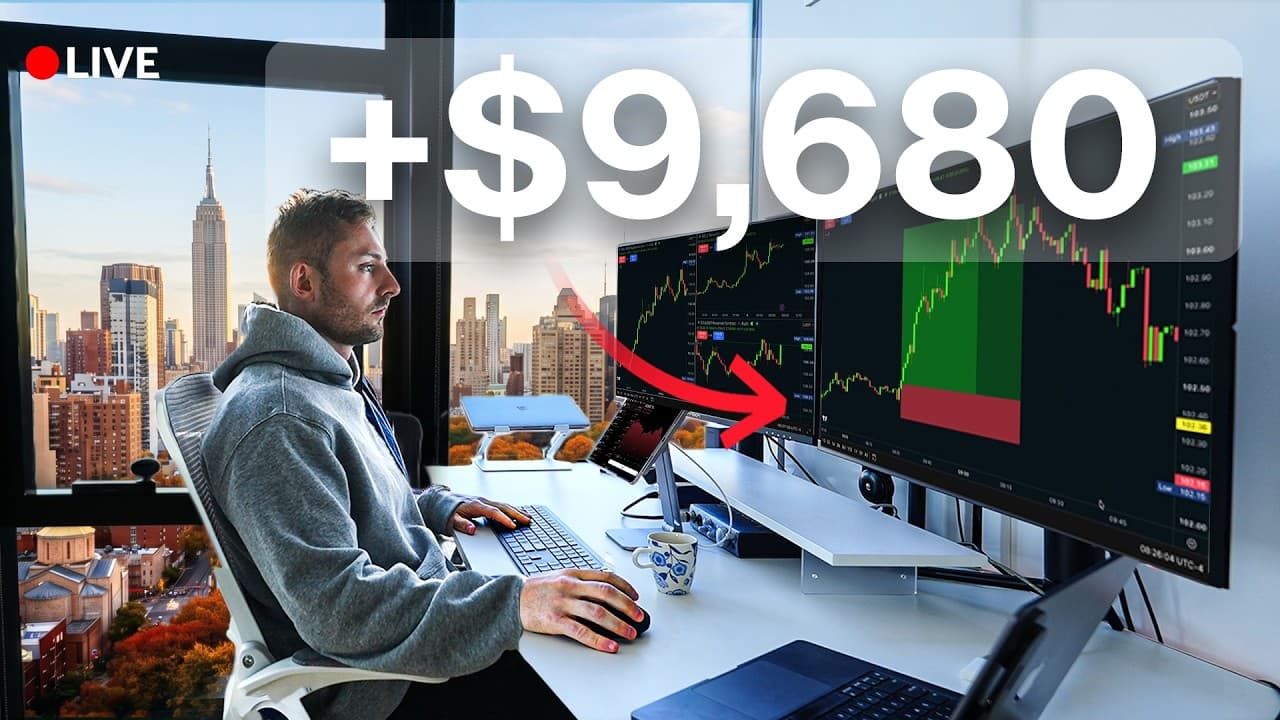
Percoco sets a minimum 1:4 risk-reward ratio on entries, moving his stop to breakeven once price closes beyond a defined structural level, which he says removes risk and lets winners run toward higher targets drawn from the 15-minute chart, potentially "14, 15, 20 times what you're risking." He gives examples of team members logging trades like "eight R no partials" and "JT seven R, 5.6 R with partials included, $1,700," and describes one live example where he let a trade run to roughly $7,000–$8,000 of open profit before taking partial profit, netting "almost 10k."
He acknowledges the figures in the video are a "hypothetical illustration" of the power of risk management and a repeatable system, and says further detail on confluences and position management is reserved for his private team, which he does not disclose on YouTube.
Written by AI from the video's transcript. It can compress, misattribute or miss context — the original video is the source. Not investment advice.