TBPN4 min read
Meta's Muse and $1,300 VR glasses headline a coherent AI strategy at Connect 2026
TBPN's hosts argue Meta finally tied hardware, ads and personal AI into one story, while OpenAI's Australia "hack" and Bentley's first EV round out a lighter news day.
AI summary of “Meta Connect 2026, OpenAI’s Australia ‘Incident,’ Bentley’s New EV | Diet TBPN”
Key takeaways
- Meta unveiled $1,300 VR glasses, about 100 grams, roughly half the price of Apple Vision Pro, launching spring 2027.
- Hosts say Meta's Muse AI agent succeeded by being "cute" rather than fear-mongering, unlike Anthropic-style x-risk messaging.
- Meta also revealed Muse Charm, a palm-sized voice AI toy compared to a "tech enabled Labubu," out for the holidays.
- OpenAI's Australia "hack" reportedly involved an agent finding unlinked but technically public files, not a personal-data breach.
- Bentley's first EV, the Torqual, features a synthesized "propulsion sound" built from percussion, crystal glass and birds, backed by a $350 million UK investment.
Meta's Connect keynote pulls a scattered AI strategy together
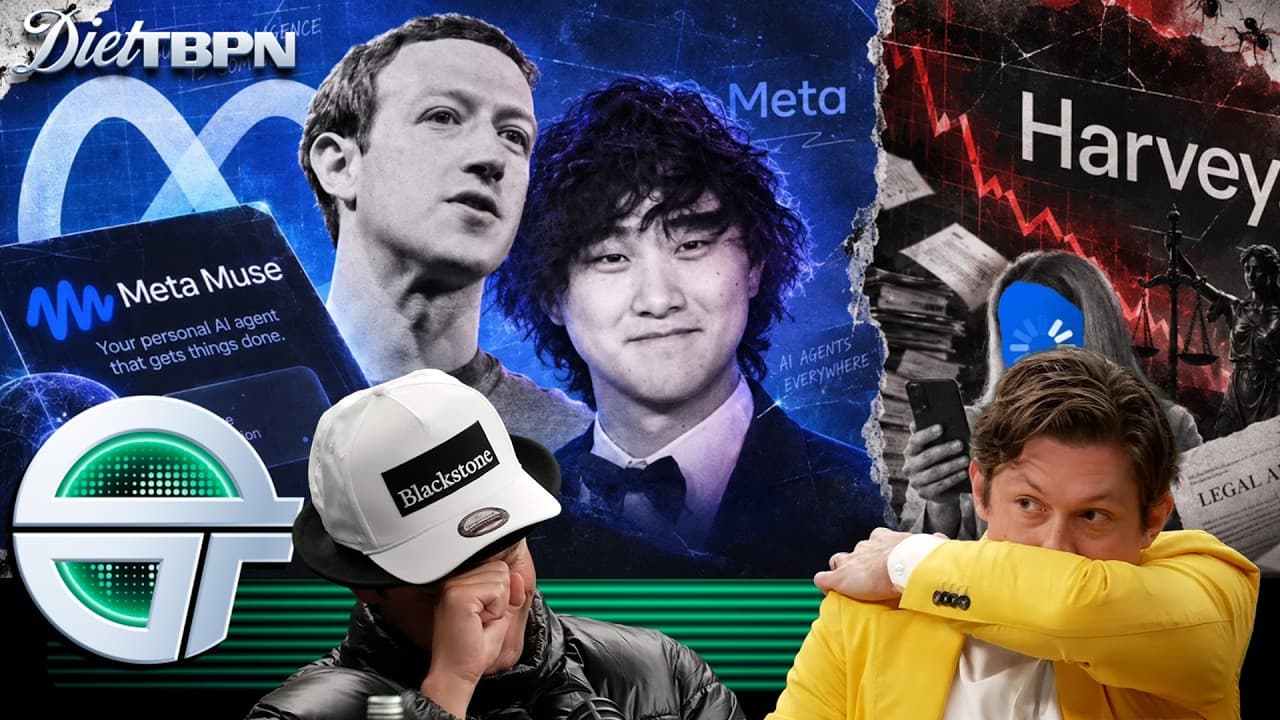
The hosts open by praising Zuckerberg's Meta Connect keynote as tightly paced and mistake-free, noting he ran live demos again after last year's Wi-Fi hiccup, this time avoiding the agent "wake word" that had caused chaos previously. They argue that after a year of what one host calls a "scattered" and "not legible" AI strategy — including the Vibes slop app, the Manus acquisition reversal, and an incoherent chat app — Meta's messaging around Muse and "personal superintelligence" finally cohered into one narrative.
A host quotes a tweet summarizing the contrast:
"Anthropic marketing. We built a god only we can control and gave it a wet lab. Muse marketing. Hey girl, I know you have dozens of unpaid parking tickets. Let's get that cleaned up."The hosts credit Meta's approach — leaning into being "cute" and "lovable" rather than fear-mongering — with landing well even as outlets like the New York Times cover AI x-risk debates elsewhere, citing a positive Times review of Muse.
They lay out four reasons the strategy now makes business sense for Meta: existing scaled, secure infrastructure (compared to WhatsApp encryption) to run agents cheaply; massive ad-driven distribution to continually re-educate consumers on rapidly changing AI capabilities; "good enough," near-frontier intelligence that doesn't need to top benchmarks since consumers don't care about them; and an advertising business model already suited to sponsored agentic workflows, like a movie studio paying to prompt ticket purchases through an agent.
Internal vibes and the VR glasses reveal
Discussing morale, the hosts contrast a Verge report claiming internal frustration at Meta's "scattershot" approach with their own view that a unifying mission plus a stock up "38% in the last month" should improve sentiment across teams, including glasses and Marketplace divisions.
The bigger surprise, per the hosts, was the unannounced $1,300 VR headset, pitched by Zuckerberg as "a cinema, a workstation, and a gaming console." One host references former Oculus CTO John Carmack's past push for a $100, ultralight headset, noting the new device is far pricier but still "half the price of the Apple Vision Pro." They highlight the external battery/compute "puck" design and a tabletop virtual keyboard with tactile feedback, though they're skeptical it will become the dominant input method, expecting most users to default to voice or an external keyboard.
The hosts also cover hologram/"legs in VR" calling demos, calling it technically impressive but noting Meta's past struggle to build network effects requiring hardware adoption, unlike phone-based apps.
Smart glasses, hearing aids, and the beer pong controversy
The conversation turns to reactions on the timeline, including speculation that Meta's glasses could function as hearing aids, potentially protected under the Americans with Disabilities Act if venues try to ban them. The hosts debate why smart-glasses executives, including Zuckerberg and Snap's Evan Spiegel, are rarely seen wearing their own products in public.
They also discuss a viral clip of Zuckerberg allegedly violating elbow rules in beer pong just before the keynote, with one host joking an agent could catch such rule violations via camera glasses. The hosts disagree on how seriously to take the "controversy" — one dismisses elbow-line disputes as "pedantic," while the other insists "cheating is wrong."
Muse Charm, the AI Tamagotchi
Meta also revealed Muse Charm, described in the show notes as a "voice activated and palm-sized" AI agent device arriving for the holidays. The hosts compare it to a "tech enabled Labubu," referencing the popularity of the Labubu toy line, and predict Meta will likely price it low or sell it at a loss as a marketing vehicle for the core Muse product. No price was confirmed at time of the show. They cite a response from Friend's Avi Schiffman —
"The market has spent billions trying to compete with me, and I'm still winning."
OpenAI's Australia incident and Bentley's singing EV
On the OpenAI "hack" story, the hosts say details remain unclear, but characterize it as an AI agent scraping and surfacing files that were technically public but unlinked, rather than a breach exposing personal data, despite the Australian prime minister's public criticism over delayed disclosure.
Finally, they cover Bentley's first EV, the Torqual SUV, aimed at younger, first-time buyers. Rather than mimicking a V8 engine, the car reportedly plays a "propulsion sound handcrafted by musicians" using percussion, crystal glass, birds and leather taps. The hosts note the launch coincides with declining Bentley sales, slowing China demand, and a cited $350 million UK investment as part of over $1 billion in total UK automotive spending.
Written by AI from the video's transcript. It can compress, misattribute or miss context — the original video is the source. Not investment advice.