TBPN6 min read
Meta's Muse and VR glasses reset the personal-agent race, guests detail AI security, Mars biotech and rare-earth raises
TBPN breaks down Meta Connect's Muse strategy and beer-pong backlash, then runs through five founder interviews spanning AI security, prediction-market agents, developer AI, rare-earth metals and Mars biotech.
AI summary of “Meta Connect Reactions, Zuck's Beer Pong Controversy, ClusterMAX 3.0, New Bentley EV”
Key takeaways
- Hosts argue Meta Connect finally unified Zuckerberg's scattered AI bets around the Muse personal agent and new $1,300 VR glasses shipping spring 2027.
- Shalev and Romy Lifshitz launched a stealth AI security startup and a "Secure Acceleration" report on sabotage, escape and theft risks in AI infrastructure.
- Public.com co-CEO Leif Abraham detailed new AI agents for prediction markets, citing a user who moved $50 million from a UBS wealth team into automated strategies.
- Silco Industries' Hooman Reza Nazad announced a $75 million raise for a 500-ton-per-year rare-earth metallization plant in Nevada, commissioning by July 4 next year.
- Semianalysis' Jordan Nanos described ClusterMax 3.0 findings, saying failure-recovery times range from 20 minutes at top NeoClouds to multi-day outages elsewhere.
Meta Connect lands as a coherent strategy after months of scattered bets
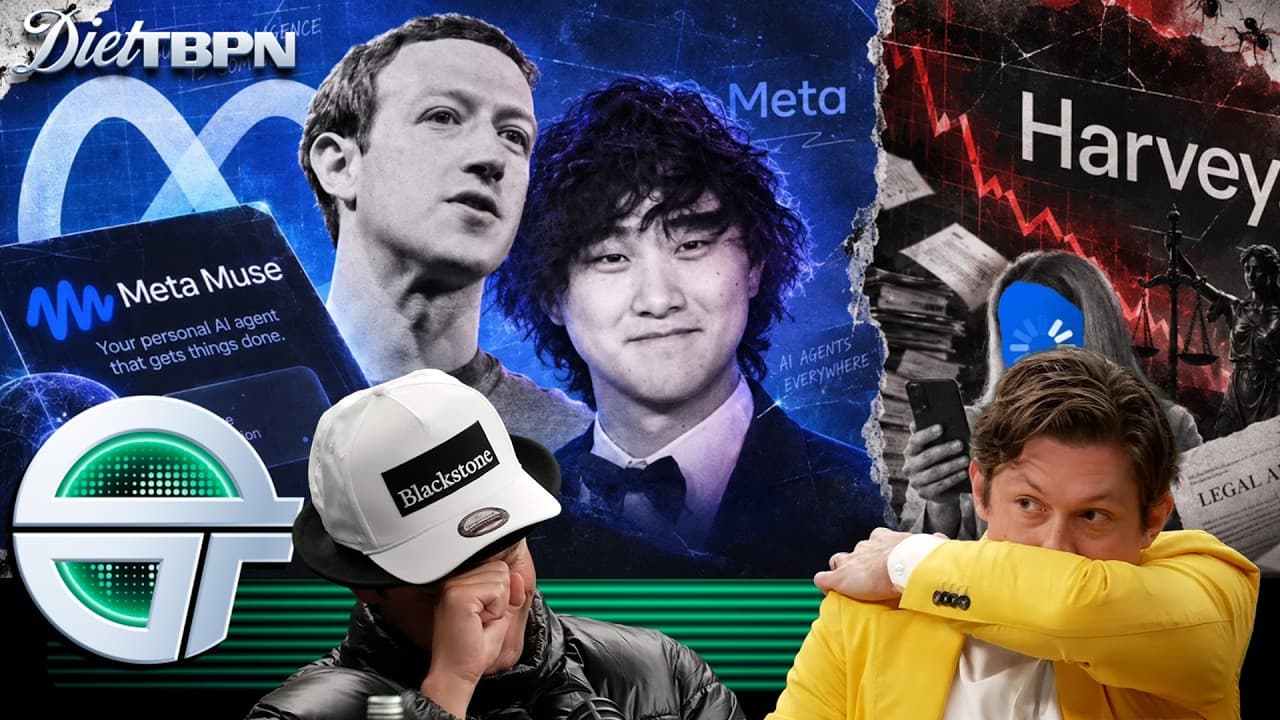
The hosts opened by praising Mark Zuckerberg's Meta Connect keynote as unusually tight and well-paced, with three live demos executed without the Wi-Fi hiccups that plagued last year's show. They argued the event finally tied together previously "scattered" and "incoherent" initiatives — the abandoned Vibes slop app, the undone Manus acquisition, the Meta chat clone — into a single narrative built around the Muse personal agent. One host said the strategy only made sense in hindsight: "you're not giving him the benefit of the 4D chess... no, no, no, going out razor, total credit to them for figuring out how all the pieces connect together."
The hosts laid out four reasons they think Meta's approach is working even though its models aren't topping frontier benchmarks: Meta already has scaled, secured compute to run agents cheaply; it has distribution across its family of apps to continually re-educate consumers on new features; consumers don't care about benchmarks as long as the agent is "good enough"; and Meta's advertising business model aligns naturally with agentic workflows, such as an agent surfacing movie tickets or home-insurance renewal bids. They contrasted Meta's "it's cute, it's lovable" marketing with what one host paraphrased as Anthropic's positioning: "We built a god only we can control and gave it a wet lab."
New VR glasses draw enthusiasm despite price and battery limits
The hosts called Meta's new VR glasses "the one more thing" and the highlight of the show: roughly 100 grams, priced at $1,300 — about half the price of the Apple Vision Pro — with the compute and battery moved to a separate "puck" worn on the belt. They noted the device supports DisplayPort over USB-C, which one host said eliminates the latency problems he experienced trying to wire a PlayStation into an Apple Vision Pro. A tabletop virtual keyboard with tactile feedback drew skepticism from the hosts, who doubted it would be the dominant input method compared with voice or a physical keyboard.
They flagged the pixel density as a possible weak point, estimating roughly 5K per eye — about half the Apple Vision Pro's — and said the glasses don't ship until spring 2027. They also discussed the accompanying "Muse Charm," a voice-activated, palm-sized hardware device described in the Meta announcement as arriving for the holidays, which the hosts likened to a "tech-enabled Labubu" and predicted Meta would price near cost or at a loss as a marketing vehicle.
Beer pong controversy and timeline reactions to Meta Connect
Social media reaction included a debate over whether Zuckerberg violated the elbow line during a beer pong match shown at the event. The hosts disagreed on how seriously to take it: one said
"I think that people who play beer pong and worry about elbow violations are pedantic and annoying"while the other maintained "I think cheating is wrong... you got to respect the spirit of the game." They noted Zuckerberg was down nine cups to one at the time and argued the score justified some leniency.
Other timeline reactions covered Alex Wang appearing on stage in Crocs rather than luxury brands, which the hosts read as a deliberate pivot away from his earlier high-fashion image, and speculation that Meta's glasses could be marketed as hearing aids to sidestep venue bans, invoking the Americans with Disabilities Act. The hosts also discussed Snap's Specs project, predicting it would struggle to compete and might sell "surprised if they sold more than 10,000 units."
Australia hack, Flock Safety and a new Bentley EV
The hosts discussed reports that an AI agent scraping the web found unlisted but technically public files tied to the Australian government, which triggered a diplomatic complaint; they said the consensus was that no personal data was actually exposed, though the files were accessible to anyone crawling the server rather than clicking a public link. Separately, they noted Flock Safety is weighing a sale amid what one host called "the most insane comms crisis of any company," with a suggestion floated online that the company rebrand around its actual function as a license-plate scanner.
On Bentley's first electric car, the Torcal SUV, the hosts said the design was "muscular" but criticized its grille, while noting the model is priced at roughly half the price of the Ferrari Elettrica-class comparison referenced on screen. They highlighted that the EV features a custom propulsion sound built from percussion, crystal glass, birds and leather taps, and that Bentley has invested $350 million in its Crewe plant amid slowing China demand, Middle East-linked disruption and US tariffs.
Guests detail AI security risks, prediction-market agents and a developer-focused classifier model
Siblings Shalev and Romy Lifshitz introduced their new stealth AI security company and a report, "Secure Acceleration," addressing what they called three main infrastructure risks: sabotage (degraded performance, sleeper agents, data poisoning), model escape, and theft of model weights by sophisticated actors. Shalev described a "cyber swarm" dynamic where multi-agent systems inside data centers create more security loopholes the more agents are deployed, referencing the Hugging Face incident as an example.
Public.com co-CEO Leif Abraham described new AI agents for prediction markets aimed at portfolio-relevant events rather than sports or entertainment, giving the example of an agent selling treasuries if the probability of a rate hike crosses a threshold. He said sophisticated users, including a former UBS wealth-management client who moved $50 million into a public account, are using agents for covered calls, income generation and tax-loss harvesting. Separately, Typesafe AI's founder described his product as a fast, calibrated classifier rather than a language model, saying demand since launch has been "above the 100th percentile" of his expectations and comparing the model's inconsistency problem to being "Einstein 95% of the time but Mr. Bean the other 5%."
Rare earths, Mars biotech and NeoCloud grading round out the guest lineup
Silco Industries CEO Hooman Reza Nazad announced a $75 million raise to build a 500-ton-per-year rare-earth metallization plant in Nevada, commissioning on July 4 next year. He said Silco shifted a year ago from recycling scrap to processing mined ore because recycled volumes couldn't scale, and argued the West's bottleneck is processing technology, not the availability of raw ore, noting China banned export of samarium, used in F-35s and guided missiles, creating a shortage Silco aims to fill alongside NDPR for the auto sector.
Pioneer Labs CEO Erika Alden DeBenedictis described engineering a microbe that converts Martian dirt, water and air into bioplastics for building houses, part of a plan requiring five organisms over roughly three years to enable habitat construction around a 2031 launch window. Semianalysis' Jordan Nanos discussed ClusterMax 3.0, saying failure-recovery times range from about 20 minutes at top-tier NeoClouds to multi-day outages at lower-ranked providers, and named Nebius as a new platinum-tier entrant capturing mid-market demand that CoreWeave cannot service until next May.
Written by AI from the video's transcript. It can compress, misattribute or miss context — the original video is the source. Not investment advice.