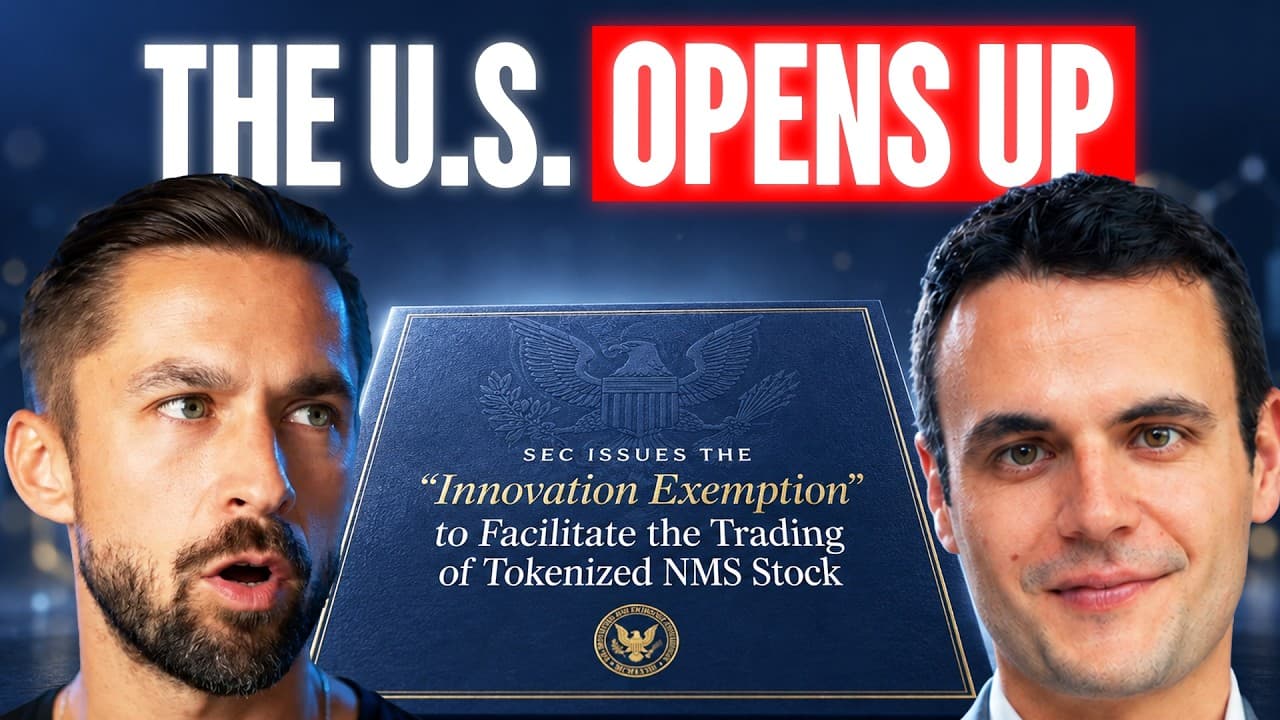
🚀 Robinhood Chain: Two Months, $2.1B in Tokenized Assets, and the New Innovation Exemption
📊 A Landmark Moment for Tokenization
The SEC's Innovation Exemption has just landed, marking a significant turning point for the tokenization movement in the United States. This development comes directly after the Clarity Act failed to advance, underscoring the ongoing regulatory uncertainty in the crypto space. Despite the legislative setback, the Innovation Exemption signals that tokenization is no longer something reserved for overseas markets—it's ready for domestic deployment.
According to Johan from Robinhood, the exemption represents a green light for bringing products that have been developed offshore on-shore. While federal-level regulation remains a critical need to provide long-term confidence for institutions, the Innovation Exemption is a major step forward. The text, though still requiring deeper analysis, appears fairly open to creating the tokenization ecosystem the industry has been anticipating for years.
"It really means that tokenization is also ready for the US—not just something that we should keep doing overseas."
⚖️ How the Innovation Exemption Impacts Robinhood's Strategy
The Innovation Exemption introduces a pathway for actual tokenized securities with high-fidelity relationships to underlying assets. This includes permissioning and KYC requirements for trading, which differs from Robinhood's current tokenized stock product—a debt security rather than a direct equity representation.
Robinhood's existing stock tokens maintain a one-to-one relationship with underlying equities: every token minted corresponds to a stock purchase. However, the Innovation Exemption may require Robinhood to develop a new set of products that fully comply with the framework. The company is evaluating how to adapt its compliance infrastructure—leveraging its proprietary chain, tokens, and wallet—to meet varying regional requirements.
Johan emphasized that Robinhood's approach has always been to adapt to the regulatory landscape of each jurisdiction, and the Innovation Exemption is no different. The company is exploring how to integrate this framework while continuing to offer the right tokens in the right markets.
📈 Robinhood Chain by the Numbers
Nearly two months since launch, Robinhood Chain has posted impressive metrics:
- $2.1 billion in tokenized assets, including over $1 billion in stablecoins
- $165 million in tokenized real-world assets
- $1.5 billion in value deposited into applications:
- $500 million into Morpho
- $330 million into Aethir
- $300 million into Uniswap
- 750 million cumulative transactions
- 14 million unique wallets
- $1.2 billion in stock token volume on a single day
- Over $500 million in stock token volume on multiple days
- 70% of trading volume occurs outside traditional exchange hours—on weekends or after-hours
- Approaching $50 million in gross fee revenue and $44 million in profit
Perhaps most surprising to Robinhood: the chain has become one of the top three platforms for active development, with numerous teams building on the infrastructure.
"What's most exciting is to think about all the new stuff that is yet to be built or that are built but we haven't seen them yet."
🌍 24/7 Trading and the Weekend Effect
One of the most compelling use cases for tokenized stocks is 24/7 trading. The fact that 70% of Robinhood Chain trading volume occurs outside traditional exchange hours demonstrates real demand for round-the-clock market access.
However, this introduces mechanical challenges. Price dislocations can occur over weekends when crypto markets remain active but traditional exchanges are closed. Robinhood addresses this through market makers and liquidity pools, which help prices converge when markets reopen. The company has been actively onboarding market makers and expanding liquidity on platforms like Uniswap to minimize divergence.
Johan noted that similar pricing dynamics exist in traditional markets—such as between Alternative Trading Systems (ATS) and exchanges—and that the solution lies in bootstrapping sufficient liquidity and arbitrage opportunities.
During a recent three-day weekend, Robinhood successfully maintained pricing stability by ensuring adequate liquidity, and the team continues to refine this process.
🤝 CEO Reactions: Drama and Opportunity
The launch of tokenized stocks has attracted attention from traditional finance CEOs—some positive, some less so. The AMC CEO publicly criticized the product, calling it contemptible and vile. In contrast, the HIMS CEO expressed enthusiasm for the innovation.
Behind the scenes, however, the response has been overwhelmingly constructive. Johan revealed that Robinhood has received numerous emails from CEOs of publicly traded companies asking to have their stocks tokenized. The public Twitter drama, he suggested, was more about attracting attention than expressing genuine concern.
Robinhood maintains that its tokenized stocks are fully backed by actual shares—similar to how stablecoins are backed by treasuries and equivalents rather than literal dollar bills. The company is focused on demonstrating the value proposition: global access, instant settlement, and 24/7 trading.
🗳️ Upgrading the Tokens: Voting Rights and In-Kind Redemption
In response to feedback, Robinhood CEO Vlad Tenev announced upcoming upgrades to stock tokens, including voting rights and in-kind redemption. Johan clarified that these features have always been on the roadmap—not reactive measures.
In-kind redemption was announced at Robinhood's London event and is being rolled out first for market makers, enabling smoother transitions between traditional finance and DeFi. Extending this feature to retail customers is more complex due to varying brokerage account structures globally.
Voting rights are also planned but were deprioritized in the early stages. With $175 million in stock tokens issued, the voting impact remains minimal. The immediate focus has been on unlocking DeFi use cases—such as using stock tokens as collateral—and ensuring tight pricing around the clock.
Robinhood already operates Say by Robinhood, a platform that facilitates shareholder engagement and voting, so the infrastructure is in place. It's simply a matter of timing and adoption scale.
🪙 The Memecoin Phenomenon and Composability
One unexpected development has been the emergence of paired memecoins pegged to stock tokens—a testament to the composability of Robinhood's infrastructure. Projects like Minkcoin have built on top of stock tokens, generating viral attention and creative memes featuring Vlad and other figures.
This type of innovation—enabled by open, composable design—illustrates the broader potential of tokenized assets. It's not just about replicating traditional markets on-chain; it's about unlocking entirely new financial primitives.
🔮 The Future: Commodities, Real Estate, and Beyond
Robinhood's tokenization ambitions extend far beyond stocks. The roadmap includes:
- Private equities
- Real estate
- Art
- Additional commodities (gold is already live; silver and copper are under consideration)
The company is also exploring perpetuals for commodities and other assets. Robinhood already offers a licensed perpetuals platform in the EU, featuring crypto, commodities, and ETFs. The question is how to bring this capability to the U.S. in a compliant manner.
Johan emphasized that if the right regulatory structure emerges, perpetuals will appear in the core Robinhood app. EU customers can already trade crypto stock tokens and access perpetuals in the same interface, with features like take-profit and stop-loss sliders for simplified user experience.
🤖 AI Meets Crypto: Agentic Trading
Robinhood is integrating AI and crypto through agentic trading, allowing users to connect AI agents to Robinhood's Model Context Protocol (MCP) to execute strategies autonomously. The system includes safeguards such as separate fund pools and configurable checks to ensure agents act according to user intent.
This capability is particularly relevant in the context of Robinhood Chain and tokenization, where arbitrage opportunities and complex trading pairs are emerging—strategies that may not be intuitive to human traders but can be identified and executed by AI.
"I think that's going to be more and more interesting, especially in the world of the chain and tokenization—you will see more of these arbitrage opportunities and pairs of things that we haven't thought about doing before in traditional markets."
⛓️ Ethereum Alignment and the Role of ETH
Robinhood Chain is an Ethereum Layer 2, using ETH as gas. This design choice reflects a strategic commitment to Ethereum's decentralization and security. Johan explained that one of the primary reasons for building an L2 was to leverage Ethereum's robust infrastructure, especially as emerging threats like AI-driven vulnerabilities and quantum computing loom on the horizon.
The team regularly meets with the Ethereum Foundation and groups like HIS Lab to coordinate and contribute to the ecosystem. While Robinhood has no current plans to add ETH to its balance sheet, the company does hold ETH generated from chain fees, managing it based on financial considerations.
Robinhood views itself as a growing part of the Ethereum ecosystem and is committed to contributing meaningfully as its usage expands.
🚀 What's Next for Robinhood Wallet and Cross-Chain UX
Robinhood is investing heavily in Robinhood Wallet to improve user experience, including:
- Gasless transactions for customers
- Automatic cross-chain bridging
- Enhanced asset discoverability
These features aim to abstract away the complexity of blockchain interactions, making crypto more accessible to mainstream users.
🎯 The Big Picture: Convergence of TradFi and DeFi
Johan envisions a future where the distinction between traditional markets and crypto markets disappears entirely. In a few years, he predicts, there will be one market based on blockchain. Traditional exchanges are already adopting blockchain technology to compete with the advantages of 24/7 uptime, instant settlement, and high-frequency trading.
The current system—with market shutdowns, maintenance windows, and regional restrictions—cannot compete with blockchain infrastructure designed for continuous operation. Robinhood is positioning itself at the intersection of these worlds, building the rails for this convergence.
"I think in a few years we are not even going to talk about this new market versus traditional markets. I think it's just going to be one market and it's going to be based on blockchain."
📝 Final Thoughts
The Innovation Exemption is a watershed moment for tokenization in the U.S., and Robinhood is uniquely positioned to capitalize on it. With $2.1 billion in tokenized assets, 14 million wallets, and 70% of trading volume occurring off-hours, the data speaks to real demand for blockchain-based financial infrastructure.
As regulatory clarity continues to improve and Robinhood expands its product suite—from stock tokens to commodities, perpetuals, and AI-driven trading—the line between traditional and decentralized finance will continue to blur. The future of markets is being built today, and it's happening on-chain.
More from Bankless

When Bad News Doesn't Matter: Inside the Week That Proved Crypto's Bull Market H
📈 The Bull Market Test: Bad News Doesn't MatterThe third week of September delivered a decisive verdict on the state of...
Circle Unveils Arc Mainnet: Building the Infrastructure Layer for Agentic Commer
After 18 months of development, Circle has officially launched Arc mainnet—positioning it not merely as another Layer 1 ...

The Awakening: How October 10th Changed Everything for Crypto Options
📊 The Great Divide: Options vs. Perpetuals For years, crypto traders have gravitated toward perpetual futures while op...

The Bessent Put Triples Down as Treasury Yields Hit 2007 Highs — Plus: Are We in
📊 Markets: Is This an Altcoin Season?Bitcoin and Ether remained flat this week, trading largely sideways in a range. Bi...

The Intersection of Growth and Value: How One Fund Manager is Navigating Crypto'
The crypto market is evolving. What worked in 2017, 2021, or even 2024 won't necessarily continue to work. But according...

Fake World Assets: Building the Universal AMM for NFTs
🎲 The Core Mechanism: NFT Liquidity Meets Casino Dynamics The NFT market has faced a critical challenge: liquidity dis...