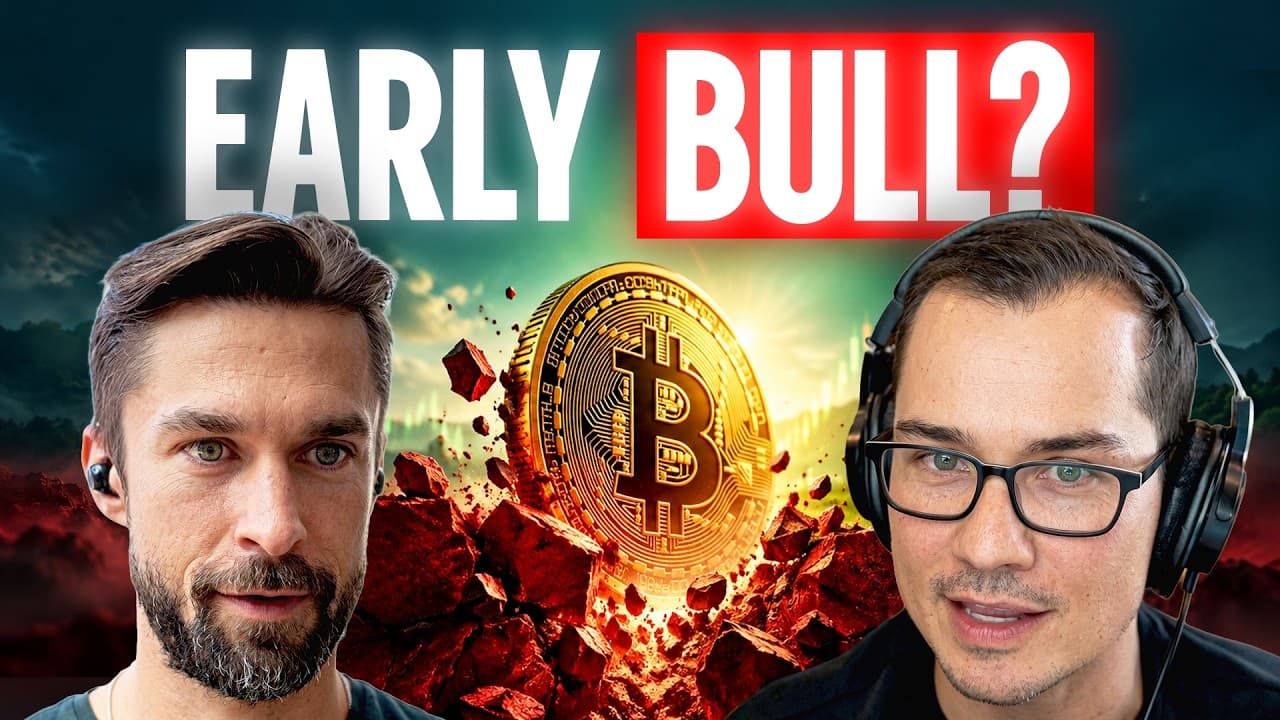
🚀 Clarity Lost, Crypto Won: The Bull Market Confirmation Week
📈 The Bull Market Test: Bad News Doesn't Matter
The third week of September delivered a decisive verdict on the state of crypto markets: good news is making prices go up, and bad news is not mattering. This asymmetric response represents perhaps the clearest confirmation yet that crypto has entered the early stages of a bull market.
Despite what should have been a double dose of bearish developments—the Clarity Act failing in the Senate and the Federal Reserve hiking rates for the first time since 2023—crypto prices moved higher or remained resilient. Bitcoin climbed from $77K to $79K, ETH jumped from $2,400 to $2,500, and multiple altcoins posted significant gains.
"This is just a telltale sign of the bull market—the market is sensitive to good news and insensitive to bad news. That is just even further confirmation that we are in the earliest innings of a bull market."
Crypto investor Eric Connor captured the sentiment succinctly: "Kind of nice to flush the double bad news of no clarity and rate hike in the same day to be honest."
🎯 The Price Band That Matters
Market analyst Michael Nato has identified a critical trading range for Bitcoin that could confirm the early bull market thesis. According to his analysis, Bitcoin needs to maintain support above $69.9K (the 200-day moving average) while working toward breaking through $80.4K (the 50-week moving average).
If Bitcoin stays within this band without breaking down, the probability increases that the June 30th low represents the cycle bottom, with no lower lows ahead. A decisive break above $80.4K sustained over multiple weeks would represent technical confirmation of the bull market's arrival.
⚡ The Middle Market Recovery
Perhaps most encouraging for the long-term health of the ecosystem is evidence of a middle market recovery—a reversal of the "barbell effect" that dominated the bear market, where only blue chips and memecoins showed vitality.
Zcash hit all-time highs above $1,500, up from $1,200 the previous week. The privacy-focused asset has demonstrated unusual strength, outperforming Bitcoin during both the bear market and the current recovery phase—behavior that deviates from typical cycle patterns where Bitcoin leads and altcoins follow.
Meanwhile, Near Protocol reached $3—its highest level in considerable time—powered by real adoption metrics: $30 billion in confidential cross-chain transactions and $70 million in TVL. Hyperliquid also achieved all-time highs as its decentralized perpetuals platform continues gaining market share.
The recovery of fundamental-driven tokens with real products and usage represents a healthy divergence from the speculative excesses of previous cycles.
📊 TradFi Optimism: Tom Lee's Bold Call
The bullish sentiment isn't confined to crypto. Veteran market analyst Tom Lee made waves with his prediction that Q4 could deliver "one of the biggest rallies of our lifetime," with the S&P potentially reaching 8,200 by year-end—up from current levels around 7,585.
Lee's thesis centers on the resurgence of technology stocks, particularly the "Magnificent Seven" and AI-exposed software names. His calm, measured delivery—devoid of hype—lent credibility to what would otherwise sound like an aggressive forecast.
The macro backdrop supporting this optimism includes continued AI infrastructure investment, resilient GDP growth, and what appears to be a genuine economic expansion rather than merely monetary stimulus-driven asset inflation.
💸 The Bond Market Battle Continues
While risk assets rallied, the 10-year Treasury yield broke through 5% for the first time since 2007—a development that threatens to undermine Treasury Secretary Scott Bessent's ongoing "war on bonds."
Despite Bessent deploying $6 billion in targeted Treasury purchases on the long end, yields continue their upward march. This raises a fundamental question for markets: Are rising yields a signal of debasement concerns, or simply the natural cost of capital in a genuinely hot economy?
The answer has profound implications for crypto's narrative. If yields rise due to debasement fears, that strengthens Bitcoin's value proposition as a hedge. But if they rise due to strong economic growth and capital demand for productive investment in AI, infrastructure, and domestic manufacturing, the dynamics are more complex.
The debate remains unresolved, but evidence increasingly points toward a combination of both factors rather than a single explanation.
🏦 The Fed Hikes: Walsh Plays It Straight
In a move that surprised market participants expecting dovish accommodation, Fed Chair Kevin Walsh raised the federal funds rate to a target range of 3.75% to 4%—the first hike since 2023. The FOMC vote was unanimous at 12-0, signaling institutional consensus despite political pressure.
Walsh characterized the decision as "sober, serious, and responsible," citing the plain fact that "inflation is too high and has been for too long."
Most remarkably, President Trump—who had appointed Walsh expecting a dovish "Cuddle McCutface"—did not attack the decision. Instead, Trump appeared to accept Walsh's framing that the broader FOMC board drove the outcome, preserving Walsh's political cover while maintaining Fed independence.
Trump on Truth Social: "You might as well vote with the board because it's not going to matter. The board is very hostile. But interest rates in the US should be 1% or less because we are the best credit in the world by far."
Whether this represents genuine Fed independence, behind-the-scenes coordination between Walsh and the Treasury, or simply Trump's strategic patience remains an open question. However, the decision to raise rates without political interference lends credibility to the "hot economy" thesis over the pure debasement narrative.
❌ Clarity Act: The Death and the Aftermath
The Clarity Act's failure in the Senate represented the headline "bad news" of the week. Despite last-minute compromises from the Trump administration on ethics provisions, all Democrats voted no on the procedural vote, leaving the measure 11 votes short of the supermajority needed to proceed.
The Democratic calculation appears straightforward: with confidence in winning the midterm elections, there's no incentive to hand Republicans a legislative victory on crypto. The Clarity Act failing means no standardized framework for token classification, no clear safe harbor for DeFi protocols, and continued regulatory uncertainty at the legislative level.
However, the market response validated the bull market thesis: prices absorbed the news without significant downside. Within 21 hours of Clarity's demise, regulatory agencies delivered an unexpected counterpunch.
🎁 The SEC's Innovation Exemption: Tokenized Stocks Go Live
On September 17th, SEC Chairman Paul Atkins unveiled the "Innovation Exemption"—a regulatory framework allowing tokenized stocks to trade on AMMs and decentralized exchanges on public, permissionless blockchains, effective immediately.
This represents a genuine breakthrough for onshore tokenization, though with important limitations:
- KYC and whitelisting requirements for all participants
- Full shareholder rights including governance voting
- Trading venues (TSVs) like Uniswap and Aerodrome exempt from broker-dealer registration
- Smart contracts must be auditable, public, and deployed on genuinely permissionless blockchains
- Volume caps: no more than 0.25% of daily traditional market volume
The exemption appears heavily influenced by SEC Commissioner Hester Peirce's long-advocated "innovation sandbox" concept, representing years of groundwork finally bearing fruit.
Paul Atkins: "I have been unequivocal—with or without legislation, we will act decisively within the SEC's statutory authority to deliver certainty for American investors. Stay tuned."
Securitize, the leading tokenized securities platform, saw its stock price jump 30% on the news, as the company is best positioned to capitalize on compliant, onshore tokenization with full shareholder rights.
⚖️ The Onshore vs. Offshore Split
The Innovation Exemption creates a clear bifurcation in the tokenized equity market:
Offshore products (like those on Robinhood Chain or Ondo) remain available to non-US participants, offering economic exposure without governance rights or KYC requirements. These products trade with higher volume caps and fewer restrictions but lack regulatory blessing for US investors.
Onshore products under the Innovation Exemption offer full shareholder rights including voting, regulatory compliance, and legitimacy—at the cost of KYC requirements, whitelisting, and volume restrictions.
For retail crypto participants, the offshore versions may remain more attractive due to permissionless access. For institutions and RIAs seeking compliant exposure to tokenized equities, the Innovation Exemption provides the first viable onshore path.
The 0.25% daily volume cap ensures these markets remain in "sandbox" mode, unable to absorb institutional-scale order flow. However, as adoption proves the model, these caps could be relaxed over time.
🎲 Options: The Next DeFi Frontier?
Perpetual futures have been DeFi's breakout derivative success, with platforms like Hyperliquid achieving product-market fit. But options markets have remained elusive—until now.
Multiple platforms are converging on options as the next major DeFi primitive:
- Derive (already live with options, particularly on Hyperliquid)
- Hyperliquid (recently enabled options trading)
- Lighter (building options infrastructure)
Derive's native token is up 150% in the last month and 50% in the last two weeks, signaling market conviction in the options thesis.
Why haven't options worked in crypto until now? The answer lies in market structure maturity. Options require a diverse set of sophisticated market participants with varied directional views to create liquidity through natural two-sided markets. Crypto historically lacked this diversity, dominated instead by concentrated retail and crypto-native funds with correlated views.
Additionally, the October 10th crash demonstrated to perps traders the hidden risks of leveraged perpetual positions—namely, liquidation risk even when directionally correct due to intraday volatility. Options eliminate this risk: once purchased, an option cannot be liquidated before expiry, regardless of interim price action or platform stability.
"1010 showed a lot of perp traders how much extra risk encumbrance a perpetual position has that an option does not. With an option, you pick your asset, your strike price, your expiry date—and that's it. You don't get liquidated along the way."
As market participants mature and seek more sophisticated risk management tools, options may represent the "second act" for DeFi derivatives—complementing rather than competing with perpetuals.
🇺🇸 Kraken Brings Perps Onshore
In a significant development for US market access, Kraken announced it will offer Hyperliquid perpetuals to US customers through a compliant, KYC-enabled front-end with CFTC licensing.
This marks a potential template for how decentralized perps platforms can achieve onshore distribution in the United States: the protocol remains permissionless and decentralized, while regulated entities provide compliant access layers.
The model differs from Lighter's integration with Robinhood Wallet (which was limited to EU users). Kraken's approach brings perps directly to US customers through the main Kraken exchange interface—significantly broader distribution than previous attempts.
If successful, this could establish the playbook for other DeFi protocols seeking US market access without compromising their decentralized architecture.
📈 Venice AI: The Token Consumption Surge
One of the more bullish under-the-radar developments involves Venice AI's token consumption rates, which are doubling approximately every two months.
Six months ago, the platform consumed 50 billion tokens per day. As of this week, consumption has reached 250 billion tokens per day—a 5x increase driven by genuine usage rather than speculation.
Venice's VVV token captures this usage through direct value accrual mechanisms, taking 25% of platform fees to buy the token. If consumption growth continues on this trajectory, VVV represents precisely the kind of fundamental-driven token that could help rehabilitate the "crypto tokens are uninvestable" narrative that has dominated bear market discourse.
"We need to make tokens investable again. What that requires is tokens like VVV, tokens like Hype, tokens like Lighter—value accrual tokens—to be successful. We need successes, huge successes, not just one or two but more than a handful, a dozen or two dozen successes. Then you got the market back and you have the asset class back."
🏦 Arc Chain's Identity Crisis
Circle's Arc Chain launched with approximately 100 memecoin launch pads on day one—an incongruous start for what was positioned as enterprise-grade blockchain infrastructure optimized for USDC and tokenized assets.
The launch raises questions about Arc's strategy: Is it attempting to compete as an alternative Layer 1 in the crowded smart contract platform market, or focusing on its natural advantage as backend financial infrastructure?
Arc's core competency—USDC as backend banking and settlement infrastructure—suggests a focus on payments, tokenized assets, and enterprise workflows rather than competing for retail DeFi and memecoin activity.
However, the memecoin launch pad proliferation may represent a pragmatic path to bootstrapping liquidity and infrastructure, allowing the "speculation vapor" to boil off while building the plumbing for more serious use cases later.
Nevertheless, the contrast between USDC's brand (regulatory compliance, institutional trust, stability) and the memecoin casino aesthetic creates an identity tension that Arc will need to resolve as it matures.
🔐 S&P Acquires OpenZeppelin
In a move that would have seemed like science fiction in 2021, S&P Global acquired OpenZeppelin, one of crypto's most respected smart contract security firms. Deal terms were not disclosed.
OpenZeppelin has audited and secured over $37 trillion in value transferred across thousands of protocols, representing arguably the gold standard for smart contract security.
The acquisition represents a milestone in crypto's institutional integration—traditional financial infrastructure giants are no longer just experimenting with blockchain; they're acquiring the native builders and security primitives that make the ecosystem function.
"A headline like this would have blown my mind in 2021. If you told me Bankless would be reporting that S&P acquired OpenZeppelin, I'd assume ETH was at $10K. We kind of made it—not 'made it made it,' but we kind of made it. And we made it in a way that kind of hurts because it took longer. But that doesn't mean we can't make it more."
🎯 The Bull Market Checklist
As September closes and Q4 approaches, the evidence for an early bull market continues accumulating:
- ✅ Bad news doesn't move prices down
- ✅ Good news drives significant upside
- ✅ Middle market tokens with real usage are recovering
- ✅ Regulatory clarity emerging through agency action despite legislative failure
- ✅ Infrastructure maturing (options, onshore perps, tokenized stocks)
- ✅ Institutional integration accelerating (S&P/OpenZeppelin, Kraken/Hyperliquid)
- ✅ Privacy and fundamentals-driven narratives gaining traction
The question now is not whether the bull market has begun, but whether Bitcoin can decisively break through $80.4K and sustain momentum into year-end.
If Tom Lee's prediction holds and equities rally into the strongest Q4 in years, crypto may finally sync with broader risk-on sentiment after two years of regulatory suppression. Combined with improving clarity, maturing infrastructure, and genuine usage growth, the pieces are falling into place.
Crypto lost the Clarity Act. But somehow, we're still winning.
More from Bankless
Circle Unveils Arc Mainnet: Building the Infrastructure Layer for Agentic Commer
After 18 months of development, Circle has officially launched Arc mainnet—positioning it not merely as another Layer 1 ...

The Awakening: How October 10th Changed Everything for Crypto Options
📊 The Great Divide: Options vs. Perpetuals For years, crypto traders have gravitated toward perpetual futures while op...

The Bessent Put Triples Down as Treasury Yields Hit 2007 Highs — Plus: Are We in
📊 Markets: Is This an Altcoin Season?Bitcoin and Ether remained flat this week, trading largely sideways in a range. Bi...

The Intersection of Growth and Value: How One Fund Manager is Navigating Crypto'
The crypto market is evolving. What worked in 2017, 2021, or even 2024 won't necessarily continue to work. But according...

Fake World Assets: Building the Universal AMM for NFTs
🎲 The Core Mechanism: NFT Liquidity Meets Casino Dynamics The NFT market has faced a critical challenge: liquidity dis...

Privacy-First Infrastructure: How Ethereum Is Building the Bridge to Institution
🏦 The Institutional Privacy ChallengeEthereum faces a fundamental paradox: it offers deep liquidity, programmable infra...