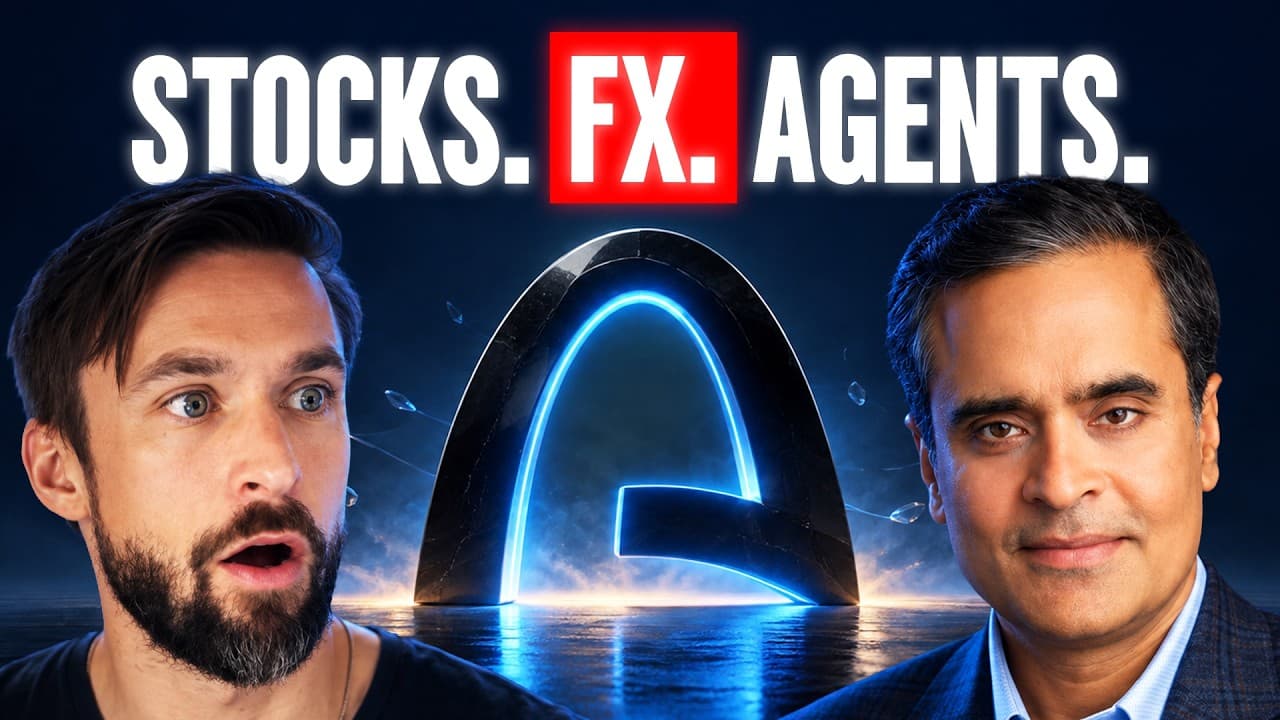
🏦 Circle Launches Arc: A Full-Stack Economic Operating System for the Next Billion Blockchain Transactions
After 18 months of development, Circle has officially launched Arc mainnet—positioning it not merely as another Layer 1 blockchain, but as what they're calling an "economic operating system" designed to bridge traditional financial infrastructure with the bleeding edge of crypto innovation.
Nikil Viswanathan, Circle's Chief Product and Technology Officer, describes Arc as the natural evolution of Circle's core mission: building regulated financial infrastructure that serves both legacy institutions and crypto-native developers. Where USDC brought stable, compliant digital dollars to the blockchain ecosystem, Arc aims to provide the rails, tooling, and compliance framework to support the next generation of economic activity—from agentic commerce to tokenized real-world assets.
⚡ Core Technical Properties: Speed, Finality, and Stable Gas
Arc differentiates itself with several key technical features tailored for financial applications:
- Subsecond finality: Transactions settle in half a second with true payment finality, eliminating settlement risk—a critical feature for institutions managing treasury operations or executing high-value RWA trades.
- Gas payments in stablecoins: Users pay fees directly in USDC, removing the friction of holding volatile native tokens. For institutions and enterprises, this solves a significant accounting problem—no need to manage inventory or book volatile crypto assets just to transact on-chain.
- Permissioned validator set: While contract deployment remains fully permissionless, Arc's validator set is curated. This design choice reflects the platform's focus on attracting institutional capital that requires transparency around network operators.
- Post-quantum signatures: Arc is launching support for post-quantum cryptographic signatures in beta, future-proofing security as quantum computing advances.
Under the hood, Arc utilizes the Malikite consensus layer, acquired specifically to enable the platform's performance characteristics. The team emphasizes that Arc is not competing with Ethereum for DeFi market share—it's targeting net new activity that hasn't yet migrated on-chain.
🔒 Privacy via Trusted Execution Environments
Arc introduces a privacy sector that allows users to toggle transactions between public and private modes seamlessly. The trust model relies on Trusted Execution Environments (TEEs)—hardware-based secure enclaves where even validators and Circle itself cannot inspect transaction contents.
As Viswanathan explains: "Validators are not going to be able to look at your transactions. That is not a thing that we want. Circle cannot look inside those transactions. When I say privacy, it is true privacy."
While some in the crypto community might prefer purely cryptographic privacy solutions (like zero-knowledge proofs), Arc's approach prioritizes performance and known validator guarantees. The team acknowledges that users can still engage in cryptographic privacy techniques on top of Arc's base layer, including through the upcoming post-quantum signature support.
Beyond financial transactions, Viswanathan envisions privacy enabling entirely new use cases—such as confidential medical AI consultations where users can query language models with sensitive health data, encrypted and stored on-chain, without exposing information to third parties.
🛡️ Immutability and the Lazarus Question
Arc maintains the immutability standards expected of serious blockchain infrastructure. There are no backdoors for recovering lost funds, no special admin keys for rolling back transactions. As Viswanathan put it: "It is an immutable chain. It is public infrastructure. There are 20 plus validators. We're running public financial infrastructure and we want to do that in good faith."
When pressed on how Arc would handle a major exploit—such as a Lazarus Group attack draining protocol funds—the response was clear: security is paramount, and the team is running continuous audits across the stack. However, the chain itself will not be rolled back except under the most extraordinary circumstances. Breaking immutability, in Circle's view, would fracture trust irreparably.
🤖 The Agentic Commerce Thesis: Agents as Economic Actors
If there's one theme that defines Arc's near-term roadmap, it's agentic commerce—the idea that AI agents will become independent economic participants, transacting on behalf of users or autonomously pursuing objectives.
Circle is betting that agents will evolve from simple task executors into full economic actors with wallets, credit histories, and verifiable work records. Viswanathan draws a parallel to the early internet: just as websites moved from insecure HTTP to verified HTTPS with certificates, agents will need cryptographic proofs of identity, reputation, and transaction history.
"What agents do in the next 3 or 4 years will be no different than what websites did 25 years ago. Websites were not secure. You wouldn't even know if you were talking to the website you thought you were talking to. Agents will have a higher bar—it's not just that you're talking to the agent you think you are, but that the agent has the work history and economic output they claim."
Arc is building the infrastructure to support this:
- Agent marketplace: A protocol-level venue where agents can list services and prove their capabilities
- Reputation systems: On-chain records of agent performance and transaction history
- Nanopayments: Infrastructure for agents to transact in fractions of a cent, enabling micro-services markets
- Agent credit markets: Agents with proven track records can access leverage to scale operations
Viswanathan himself has already made his first agentic purchase—he tasked an AI agent with ordering flea medicine for his cat from Chewy after getting a prescription from the vet. It worked seamlessly.
While goods commerce (buying physical items) is imminent, services commerce—where agents perform specialized tasks like translation, data analysis, or portfolio management—is where the real opportunity lies. Tasks too small or niche for human labor markets could become viable as agents specialize and compete.
💱 FX Markets and the Stablecoin Ecosystem
Arc is launching with 16 stablecoins, not just USDC. Circle recognizes that a truly global economic OS must support local currencies, and the platform's Stable FX protocol enables efficient swaps between stablecoins without relying solely on AMMs.
Circle has provisioned over $900 billion in on- and off-ramps over USDC's lifetime, making it the best-in-class bridge between traditional banking and crypto rails. Arc extends this with:
- Request-for-Quote (RFQ) liquidity pools for institutional-grade execution
- Private liquidity pools connecting to global FX markets
- Circle Mint integration for seamless on-ramps
Circle won't issue stablecoins in every jurisdiction—there are nearly 190 countries, after all. Instead, the strategy is to partner with local issuers who understand regional regulations and user needs, while Arc provides the infrastructure, liquidity, and compliance framework to connect those assets globally.
With the MiCA framework taking effect in the EU and similar regulations emerging worldwide, Circle expects a wave of compliant local stablecoins to launch. Arc is positioning itself as the settlement layer for this new multi-currency reality.
🏗️ Full-Stack Developer Experience
Arc isn't just a blockchain—it's a full-stack platform designed to minimize friction for developers and enterprises:
- Arc Studio: An AI-powered interface for deploying custom smart contracts via natural language
- Arc Kits: Pre-built app templates and primitives for common use cases
- Agent SDK: Tools for building, deploying, and managing AI agents with on-chain identities
The goal is to make building financial applications on Arc as straightforward as deploying a web app—abstractions at every layer, from the network up to the application.
🚀 What's Launching Day One?
Arc is going live with a surprisingly mature ecosystem:
- DeFi Primitives: AMMs, lending protocols, and the usual DeFi suspects
- Major Exchanges: Centralized exchanges integrating Arc for deposits and withdrawals
- RWA Issuers: Institutional asset managers bringing tokenized securities on-chain
- Stable FX Protocol: Live with liquidity providers and market makers
- Privacy Sector: Functional, with TEE-based confidential transactions
- Post-Quantum Signatures: Entering beta shortly after launch
And yes, there will be memecoins. Viswanathan acknowledges the reality: "Culture begins on the internet now. We welcome all kinds of activity. The internet doesn't split traffic into 'this part is for banking, this part is for games.' We want everything to be possible."
📍 Where Arc Fits in the L1 Landscape
Circle is explicit about not competing with Ethereum for existing DeFi volume. Ethereum remains the "granddaddy" and the largest home for USDC. Moving liquidity from Ethereum to Arc would be zero-sum—it wouldn't grow the market.
Instead, Arc is targeting:
- Institutional capital that hasn't yet moved on-chain due to compliance, gas, or finality concerns
- Agentic activity that requires subsecond settlement and micropayments
- New economic primitives like agent credit markets and reputation systems
- Global stablecoin liquidity across currencies and jurisdictions
If Arc succeeds, it will do so by unlocking net new demand—bringing billions of transactions that wouldn't have happened on existing chains.
🔮 The Road Ahead
Over the next three months, Circle's focus includes:
- Expanding the validator set as the network matures
- Launching additional privacy features and agent primitives
- Preparing for a proof-of-stake transition
- Onboarding institutional RWA issuers and liquidity providers
The long-term vision is audacious: an economic OS where humans, companies, and AI agents transact seamlessly across borders and asset classes—all settled on-chain, in real-time, with full regulatory clarity.
It's day one of a very long journey. But if Circle's track record with USDC is any indication, Arc has the partnerships, capital, and technical chops to become a cornerstone of the next phase of crypto's institutional adoption.
And if you're wondering: yes, someone should probably find out the name of Jeremy Allaire's pet. That memecoin isn't going to launch itself. 🐾
More from Bankless

The Awakening: How October 10th Changed Everything for Crypto Options
📊 The Great Divide: Options vs. Perpetuals For years, crypto traders have gravitated toward perpetual futures while op...

The Bessent Put Triples Down as Treasury Yields Hit 2007 Highs — Plus: Are We in
📊 Markets: Is This an Altcoin Season?Bitcoin and Ether remained flat this week, trading largely sideways in a range. Bi...

The Intersection of Growth and Value: How One Fund Manager is Navigating Crypto'
The crypto market is evolving. What worked in 2017, 2021, or even 2024 won't necessarily continue to work. But according...
Fake World Assets: Building the Universal AMM for NFTs
🎲 The Core Mechanism: NFT Liquidity Meets Casino Dynamics The NFT market has faced a critical challenge: liquidity dis...

Privacy-First Infrastructure: How Ethereum Is Building the Bridge to Institution
🏦 The Institutional Privacy ChallengeEthereum faces a fundamental paradox: it offers deep liquidity, programmable infra...

Treasury QE + White House Crypto Push = Biggest Bitcoin Candle Since 2020
📊 A Legendary Day in Crypto MarketsWednesday, May 19th, 2025 will be remembered as one of the most explosive days in cr...