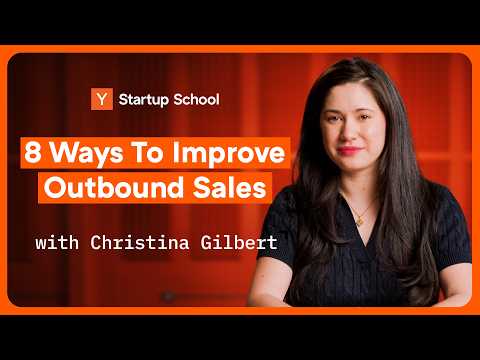
🎯 Eight Proven Tactics to Transform Your Outbound Sales From Zero to Revenue
For early-stage founders staring at reply rates hovering near zero, the outbound sales challenge can feel insurmountable. Yet the path from cold outreach to closed revenue doesn't require expensive tools or elaborate automation—it demands a methodical, founder-led approach that treats each interaction as a learning opportunity.
Drawing from experience generating millions in revenue through founder sales and coaching hundreds of Y Combinator companies, a clear framework emerges for transforming ineffective outbound into a reliable revenue engine. The following eight tactical areas represent the difference between founders who break through and those who burn out on outbound.
🔧 Manual Execution Before Automation
The most common failure pattern in early-stage outbound begins with premature automation. Founders load prospect lists into email tools, blast thousands of messages, and receive zero replies—learning nothing in the process.
"The biggest issue with this is if you get zero replies from a campaign that you didn't give any thought to in the first place, then at the end when you have zero replies, you've learned nothing."
The problem could lie in messaging, company targeting, prospect selection, deliverability, or subject lines—but without manual execution, these variables remain impossible to isolate. The recommended baseline: complete at least 100 outreaches by hand before considering automation.
This means genuinely researching individual prospects—visiting LinkedIn profiles, understanding specific company challenges, and crafting messages that reflect actual knowledge of their business context. This homework phase is where the highest-converting outbound ideas originate.
🎯 Targeting Trumps Perfect Messaging
Founders routinely spend hours refining email copy while giving minimal thought to recipient selection. This represents a fundamental misunderstanding of outbound economics. Outbound prospecting resembles searching for a needle in a haystack—without a person experiencing the exact pain point a product solves, even perfectly crafted messages fail to land.
A concrete example: One YC company selling infrastructure products was targeting DevOps managers, GTM managers, and even customer success managers—when their product should have been sold exclusively to senior engineering leaders. Hundreds of messages yielded minimal results simply because the wrong job titles would never convert, regardless of message quality.
How to identify the right job titles:
- Examine existing customers and identify who actually signed contracts and processed payments
- Review who has replied to previous outbound efforts
- Ask which organizational role has the most to gain from purchasing the solution
For example, software monitoring employee devices for security purposes would resonate with a Chief Security Officer who faces termination risk from data breaches—but an engineering manager would prefer to avoid monitoring entirely, making them a poor target.
Company selection matters equally. Sales Navigator searches for "tech companies" often return IT implementation consultancies rather than the intended target profile. Each company should be individually verified as a genuine fit before inclusion in outreach lists.
📊 Intent Signals: Reading Market Readiness
As outbound volume increases, patterns emerge revealing which companies need a product now. These are called intent signals, and job postings represent one of the richest sources.
Company growth stage serves as another powerful indicator. For compensation planning software, companies below 100 employees likely haven't introduced formal levels, while companies above 500 probably already have compensation bands established. The crossing point—somewhere in the 100-employee range—represents prime buying window.
Every product has analogous signals. The founder's job is discovering them through systematic observation.
For initial customers, warm network outreach produces dramatically higher conversion rates than cold prospecting. Friends, family, investors, college connections, and even casual acquaintances should be exhaustively contacted before moving to purely cold outreach.
✍️ Crafting Messages Worth Reading
The single most critical element in outbound messaging: a crisp explanation of how the product helps the recipient. This requires understanding the top three concerns keeping buyers awake at night—what would trigger their termination, what would earn their promotion, and why they should believe in the sender's ability to help.
When an email makes a buyer think "That's exactly the problem I have. They really get it," they're likely to schedule a call even without fully understanding the solution.
What buyers don't care about:
- Product features
- Blazing fast upload speeds
- Database architecture choices
What they do care about: hitting quarterly targets and solving urgent operational problems.
Product explanations should be one sentence. Detailed specifications belong on the first call, not in the initial outreach. Credibility can be established through listing impressive client names or highlighting relevant founder background.
Emails should conclude with specific calls to action—"Got 20 minutes to hop on a call this week?" rather than vague questions like "Does this sound interesting?" Include calendar links or specific time slots to minimize friction.
Length guidelines:
- Email: 5-8 sentences maximum
- LinkedIn: 2-5 sentences maximum
Every filler word dilutes the words that matter. Busy executives skim messages—brevity is respect.
💡 Example: High-Performing Outbound Message
A YC S24 company, Aptton, demonstrates exceptional outbound technique. Their approach includes several best practices:
Peer-level tone: The message uses informal language without jargon, reading like it could come from a friend rather than a vendor.
Credibility establishment: Opens with relevant experience: "I used to be a software engineer at Tesla. We got crazy good at using SMS to convert the people who visited our website into car buyers."
Clear call to action: "Would you be open to an experiment to see if we could improve your conversion rate by using AI to reactivate leads?" This makes the decision framework obvious for the buyer.
Personalization: References specific observations about the prospect's website, noting they collect phone numbers in the signup process.
Problem-focused, not product-focused: Minimal explanation of how the product works; exclusive focus on solving the buyer's problem.
Subject lines deserve equal attention, as they determine open rates. The first 20-30 characters of the email body also matter significantly, as they appear in Gmail previews. Creative, somewhat unconventional subject lines often outperform descriptive ones—for example, "broken agents" outperformed "better agents for every workflow" for an OpenClaw-style agent product.
👤 Optimizing the LinkedIn Profile
If emails have subject lines, LinkedIn has profiles—the primary filter prospects use to decide whether to accept connections and reply.
Essential LinkedIn optimizations:
- Profile picture: Increases trust and confirms sender authenticity
- Banner conversion: Transform the top banner into a company ad with clear, jargon-free explanation of what the company does
- One-line description and about section: Rewrite for clarity and concision, avoiding lengthy hobby discussions
- Relevant experience elevation: Cut irrelevant content to make buyer-relevant experience immediately visible
The number of mutual connections represents the single biggest predictor of connection request acceptance. Building relevant mutual connections with target audiences should become a daily habit, maxing out LinkedIn's connection allowance consistently. This requires time but pays compounding dividends as people within customer profiles typically connect to each other.
📈 Interpreting Reply Rate Signals
Initial reply rates may be extremely low, but even two to three replies per 100 emails provides a workable baseline for iteration.
Debugging sequence for low reply rates:
- Verify contact person is correct
- Verify target companies are appropriate
- Assess subject line effectiveness
- Evaluate message content
- Review supporting materials (website, LinkedIn profile)
- Investigate deliverability issues
If all six areas appear reasonable yet zero replies persist, this often indicates a deeper product-market fit issue requiring fundamental strategy reassessment.
🔄 Follow-Up Discipline and Response Speed
Never send only one email—prospects frequently miss initial messages. The recommended cadence: follow up two to four times, spaced by a couple of days.
The final follow-up should be a "breakup message"—something like: "Since I haven't heard back, it seems like sales tax automation isn't a priority for you right now. Just let me know and I can spare your inbox."
Reply rates increase substantially on breakup emails due to their low-pressure nature. A genuine "no" provides valuable data, and aggregated rejections improve future targeting precision.
Once a reply arrives, response speed becomes critical. Time kills deals—nothing should prevent immediate calendar scheduling when a prospect shows interest.
⏰ Time-Blocking for Outbound
Outbound consistently ranks among the least enjoyable founder activities, making it vulnerable to displacement by any competing priority. Without deliberate structure, it simply won't happen.
Create a concrete plan:
- Decide on daily message volume
- Calculate time required per message
- Schedule specific times for outbound execution
- Use calendar blocking to maintain accountability
- Enlist co-founder accountability if self-discipline proves insufficient
The primary difference between founders who succeed at outbound and those who don't: actually following through on committed activity.
🗣️ Mining Customer Language for Messaging
The best messaging feedback always originates from customers—not friends, advisers, or co-founders.
Two tactical approaches for capturing customer language:
- During sales calls, ask: "What got your attention about my message?" Prospects will identify the specific lines they found most interesting, which should be incorporated into future outreach. This question also prompts open-ended discussion about their problems—exactly what first calls should accomplish.
- Interview existing customers: Ask how they think about the product and what single factor drove their purchase decision. Use their exact phrasing in subsequent messages.
"Your customers are always going to write better copy than you do."
🎯 The Founder Advantage in Outbound
Outbound represents a sustained effort—one that compounds over time. Customer knowledge accumulates with each interaction, enabling pattern recognition that transforms cold prospecting into warm outreach. Spotting a job posting will eventually trigger instant recognition of company pain. Smaller companies will reveal why certain pain points resonate more than others.
No salesperson or agency can replicate the depth of customer understanding available to founders who execute their own outbound. The process grows easier with repetition, and the knowledge gained becomes a permanent competitive advantage.
For founders currently facing near-zero reply rates, these eight tactical areas provide a systematic framework for transformation. The path from cold outreach to closed revenue doesn't require elaborate tools—it requires methodical execution, continuous learning, and founder-level commitment to understanding customers better than anyone else possibly could.
More from Y Combinator

Agent Harnesses: The Underestimated Architecture Driving an 18% Performance Leap
📊 The Research That Was "Too Basic" for Top-Tier ConferencesJust a month ago, a Reddit thread dismissed prompt engineer...

Inside the Open Model Revolution: Cost, Control, and the Rise of Chinese AI in E
📊 The Shift Is Real—And It's AcceleratingA quiet revolution is underway in enterprise AI adoption. According to Jeffrey...
Inside Y Combinator's 47th Batch: Why Ambition, Speed, and "Formidability" Still
🎯 The Fundamentals Never ChangeY Combinator recently completed its 47th batch — marking 21 years of the world's most in...

From 3D Printed Model to 100-Foot Wingspan: Inside the Race to Rebuild Regional
In a remote hangar in Platsburg, New York, the world's largest electric aircraft lifted off for the first time—a moment ...
Inside CircleBack: Building Software at the Frontier of AI Automation
The shift from human-centric to AI-native workflows is no longer theoretical—it's operational reality at companies build...
Inside OpenClaw: How One Developer Built, Nearly Broke, and Rebuilt AI's Most Vi
📌 From Rainy Day Hack to 18,000 Contributors — The Real StoryIn what might be one of the most candid revelations in the...