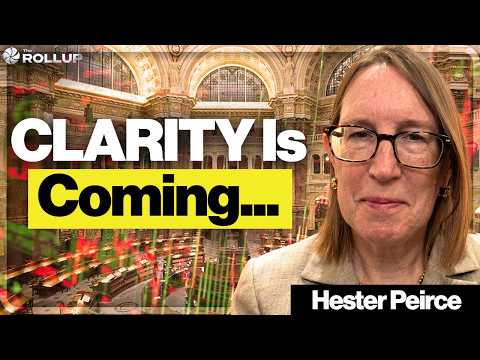
🏛️ Commissioner Peirce on Tokenization, Rule 611, and the Path Forward for Digital Assets
📊 A Watershed Moment for Digital Asset Regulation
The regulatory landscape for digital assets is undergoing a fundamental transformation. In a wide-ranging conversation, SEC Commissioner Hester Peirce outlined the commission's evolving approach to tokenization, market structure reform, and the practical steps being taken to integrate blockchain technology into traditional finance.
With the crypto task force actively working on multiple fronts and legislative clarity potentially on the horizon, the SEC is laying groundwork that could reshape how securities are issued, traded, and custodied in the digital age.
🔧 Rule 611: Dismantling a 20-Year-Old Market Structure Constraint
The SEC recently proposed eliminating Rule 611, the trade-through rule that has governed equity markets for two decades. This rule requires trades to execute at the national best bid or offer (NBBO) or improve upon it — effectively preventing trades from executing at inferior prices across different venues.
Commissioner Peirce, who originally dissented on this rule's adoption in 2005 alongside then-Commissioner (now Chairman) Paul Atkins, explained the rationale for reconsideration: "Markets don't need a rule to bind them together. That's what arbitrageurs do. That's what markets are all about."
Why this matters now:
- When Rule 611 was adopted, the New York Stock Exchange and other venues were using outdated technology
- Modern markets have upgraded to extremely sophisticated technology with extensive interconnections
- The rule has contributed to market fragmentation and the proliferation of complex order types
- The current regulatory structure creates challenges for automated market maker (AMM) structures used in on-chain exchanges
The proposal represents more than just regulatory housekeeping — it acknowledges that technological evolution has fundamentally changed how markets operate and opens pathways for on-chain trading infrastructure to develop without being constrained by rules designed for a different technological era.
🪙 The Innovation Exemption: What It Is (and Isn't)
Perhaps no initiative has generated more speculation than the forthcoming innovation exemption for tokenized securities. Commissioner Peirce moved quickly to dispel misconceptions that have circulated in recent weeks.
Key clarifications:
- The exemption has not yet been released, despite news reports suggesting otherwise
- It will not cover synthetic securities — products that provide exposure to securities without actually holding them
- The focus is on on-chain finance, not decentralized finance — permissioning will still be involved
- The goal is to enable controlled experimentation with tokenized securities trading
As Commissioner Peirce explained: "What we're trying to do is allow people to do controlled experiments using on-chain finance to help us — to help obviously the market think through whether tokenization makes sense, see what it looks like to try to do this not fully at scale, but at least to be able to try it in the real world."
The exemption is designed to serve two critical functions:
- Market experimentation: Allow companies to explore tokenization in real-world conditions
- Regulatory learning: Give the SEC an opportunity to observe how tokenized securities function and identify appropriate regulatory touchpoints
Commissioner Peirce emphasized the pragmatic approach: "It's not even that big of a step frankly. I think it's important but it's not that big of a step." This measured perspective suggests the SEC is taking an incremental approach — establishing foundational infrastructure for on-chain securities before moving toward more decentralized models.
📋 The Tokenization Taxonomy: Three Distinct Categories
The SEC staff has established a clear taxonomy for tokenized securities, breaking them into three categories:
1. Natively Tokenized Securities
Securities issued directly on blockchain infrastructure by the issuer or on their behalf.
2. Custodied Entitlements
Traditional securities held in custody, with tokens representing entitlements to those underlying assets.
3. Synthetic Exposure
Structures (often involving SPVs) that provide economic exposure to securities without direct ownership of the underlying assets.
The innovation exemption, as currently conceived, targets the first two categories. The third category — synthetic securities — would require traditional registration processes. This distinction is crucial for market participants evaluating their tokenization strategies.
Commissioner Peirce was explicit: "Those would not be in my mind — were not ever something that we were thinking about including in the innovation exemption. Now someone could come and register those kinds of securities in the United States if they wanted to."
💡 The Case for Tokenization: Beyond Efficiency Narratives
While market efficiency often dominates tokenization discussions, Commissioner Peirce outlined a broader range of potential benefits:
Collateral and Lending:
Tokenized securities could enable more seamless collateral posting and securities lending without traditional intermediaries. This could reduce costs and provide returns to security holders who choose to lend their assets.
Programmable Compliance:
Smart contracts can enforce restrictions automatically — for example, lock-up periods for company founders or accredited investor requirements — without requiring ongoing manual verification.
Direct Investor Communication:
Issuers could communicate with token holders by dropping NFTs directly into wallets, enabling engagement without necessarily knowing investor identities. This has implications for proxy voting and shareholder communication.
Treasury Management:
For companies holding tokenized money market funds, treasury operations become more precise and flexible — enabling intraday liquidity management with greater granularity.
Combating Naked Short Selling:
Blockchain's transparency could strengthen locate requirements for short sellers, creating an immutable record of share availability and potentially reducing instances of naked shorting.
These applications move beyond the common refrain of "efficiency" to highlight specific operational improvements that tokenization enables.
🚀 Encouraging Earlier Public Listings: A Multi-Pronged Strategy
One of Commissioner Peirce's key priorities involves creating conditions that encourage companies to go public earlier in their lifecycle. This matters because retail investors primarily access growth opportunities through public markets, while extended private market stays concentrate wealth among institutional and accredited investors.
The current problem:
Companies are raising later-stage rounds (including "Series M" financing rounds) and staying private longer, depriving retail investors of participation in significant value creation.
Why companies stay private:
- Abundant private capital availability (a positive development)
- Burdensome disclosure requirements that investors don't value
- Shareholder litigation risk
- Insufficient research analyst coverage affecting trading liquidity
The SEC's response:
- Reviewing disclosure requirements to eliminate mandates that provide little investor value
- Enabling companies to use arbitration agreements if they and their shareholders agree
- Taking steps to facilitate research analyst coverage
- Exploring how exchanges might experiment with trading mechanisms
Commissioner Peirce acknowledged the tension: "I hear all the time, the SEC requires these disclosures. Our investors never ask us about them. We spend a lot of time putting these disclosures together. We don't get one question from investors about them."
The connection to tokenization becomes clear when considering how blockchain infrastructure could streamline compliance, reduce disclosure costs, and enable more direct investor relationships — all factors that could make public listings more attractive to earlier-stage companies.
⚖️ CFTC-SEC Coordination: Harmonizing Oversight for Hybrid Products
As digital asset products increasingly blur traditional regulatory boundaries, coordination between the SEC and CFTC has become essential. Commissioner Peirce highlighted this as a major focus area, particularly for products that may touch both securities and commodities jurisdictions.
Key coordination areas:
- Product classification — determining which agency has primary jurisdiction
- Registration requirements for entities offering products across both jurisdictions
- Joint rulemaking in areas of overlapping authority
The approach is collaborative rather than territorial. As Commissioner Peirce noted: "We're doing a lot of joint work to think through these issues, to look at different products and discuss them, but we're also looking for people to help us do that."
For perpetual contracts — a product category that has flourished offshore — the agencies are working to create pathways for compliant onshore offerings. Some perpetual structures may fall under CFTC jurisdiction, while others could potentially be securities products under SEC purview.
📚 The Crypto Task Force Agenda: Priorities and Progress
Beyond the innovation exemption and Rule 611, the SEC's crypto task force is advancing work across multiple dimensions:
Legislative Implementation:
If the Clarity Act passes, it will create significant rulemaking obligations for both the SEC and CFTC. The agencies are preparing for coordination requirements this legislation would entail.
Token-Based Capital Raising:
Work is underway to clarify how tokens can be used in fundraising and capital formation — a long-standing priority for Commissioner Peirce.
Infrastructure Development:
- Transfer agent interaction with blockchain systems
- Custody of crypto assets (both investment adviser and broker-dealer contexts)
- Clearing agency infrastructure (including DTCC's recent no-action letter for experimentation)
Definitional Work:
The staff is examining fundamental definitions including what constitutes a "broker" in blockchain environments. The recent staff statement on user interfaces is temporary, designed to provide breathing room while the commission considers how broker-dealer regulation applies to digital asset interfaces.
Vault Protocols:
Vault structures represent another area receiving attention, with potential securities law implications that market participants should carefully consider.
🛡️ Core Principles: Privacy, Self-Custody, and Developer Freedom
Commissioner Peirce articulated three foundational principles she hopes will guide future regulation:
1. Self-Custody Rights
"The ability of people to self-custody is very important that should not be compromised."
2. Financial Privacy
"The ability of people to protect their privacy in their financial transactions is very important should be protected."
3. Developer Freedom
"The ability of developers to develop code and put it out there without having to get permission from someone to do so."
On privacy specifically, Commissioner Peirce pushed back against the framing that treats privacy as inherently suspicious: "I think we really do need to switch the framing to say that it is natural, as you said, it is we should expect people to want to protect their privacy."
She advocated for a layered approach where the base blockchain layer remains neutral, with compliance features built at application layers: "Keeping the base layer neutral is a good way to start. You can build on top of it things that are consistent with regulatory requirements."
This architectural principle — neutrality at the protocol level with compliance capabilities at higher layers — could inform how regulation approaches privacy-preserving technologies while maintaining law enforcement capabilities.
🎯 Practical Guidance for Market Participants
For companies navigating this evolving landscape, Commissioner Peirce offered straightforward advice:
Engage early and thoughtfully:
"Think about what you're trying to do, what you need to do to make that commercially viable, and then what kind of regulatory relief you need."
Get specialized counsel:
This is complex legal territory requiring expertise in securities law as applied to blockchain technology.
Don't panic about registration:
If your activity might fall under broker-dealer, investment adviser, or investment company definitions, that's not necessarily prohibitive. The staff is open to discussing what sensible registration might look like and whether certain requirements make sense given blockchain transparency.
Come prepared with specifics:
The crypto task force and broader SEC staff are eager to engage, but productive conversations require clear articulation of what you're building and what relief you need.
Commissioner Peirce acknowledged a persistent frustration: "Things don't move fast, right? When you're dealing with a regulatory regime that's complicated, you've got a lot of people taking different approaches to looking at things. Things can move very slowly."
The SEC recognizes this creates challenges for companies with commercial timelines. While Commissioner Peirce expressed a desire to accelerate processes, she also emphasized the complexity of getting novel regulatory frameworks right.
🔮 Looking Ahead: Momentum Beyond Individual Tenures
Commissioner Peirce's term ended in June of the previous year, though she can remain until the end of the current year unless a replacement is confirmed. She indicated she will be leaving before that deadline to return to teaching law.
Despite the approaching transition, she expressed confidence in continued progress: "As long as Chairman Atkins is here, the pace will continue. He's very committed to getting clear rules in place."
She emphasized that momentum extends beyond any single regulator: "There's real momentum here at the CFTC, in Congress, at the banking regulators to really think about these issues, try to come up with rules that are appropriate and make sense."
Her advice to the industry remains consistent: build things people want and need. Products that deliver genuine value create their own constituency — users who will advocate for sensible regulation when necessary.
✅ Key Takeaways
Rule 611 elimination signals openness to market structure evolution that accommodates on-chain trading infrastructure
The innovation exemption will focus on permissioned on-chain finance for tokenized securities — not decentralized finance or synthetic products
Tokenization taxonomy provides clear categories: native issuance, custodied entitlements, and synthetic exposure (with different regulatory treatment)
SEC-CFTC coordination is advancing to address products spanning both jurisdictions
Core principles — self-custody, privacy, and developer freedom — should guide regulatory development
Market participants should engage early with clear proposals and specialized counsel
Regulatory momentum extends across agencies and branches of government, creating durability beyond individual appointments
The regulatory infrastructure being built today will shape digital asset markets for years to come. While challenges remain and timelines can frustrate market participants, the direction is increasingly clear: toward sensible integration of blockchain technology into regulated financial markets, with appropriate safeguards for investors and preservation of innovation.
More from TheRollupCo

The Convergence of AI, Fintech, and Blockchain: Who Wins in the Agentic Economy?
💡 The Three-Way Collision Reshaping Finance The financial services landscape stands at an unprecedented inflection poi...

Epic Knicks Comeback, SpaceX Pre-IPO Action & Hyperliquid's Treasury Strategy —
📊 Market Overview: Sideways Action Ahead of SpaceX LaunchMarkets remained range-bound Thursday, with Bitcoin up approxi...
Inside Frax Finance: Stablecoin Strategy, Revenue Model, and the Coming Step Fun
🎯 Executive SummaryAs the crypto industry enters what some are calling the "revenue meta" era, Frax Finance is position...

Markets Get Crushed, But the Real Story Isn't Crypto's Fault — A Deep Dive Into
Markets delivered a brutal reality check this week. The NASDAQ dropped 4%, the S&P shed 2%, and Bitcoin fell below $60K,...

The NEAR Protocol Thesis: How Privacy, AI, and Intents Created a 170% Rally Whil
📊 The Unprecedented DivergenceSomething unusual is happening in crypto markets. Over the last 30 days, NEAR Protocol an...

The New Crypto Paradigm: Revenue, Privacy, and AI While Bitcoin Bleeds
📉 Bitcoin Can't Find Its Footing — But Something Strange Is HappeningBitcoin is stuck below $66,000, struggling to hold...