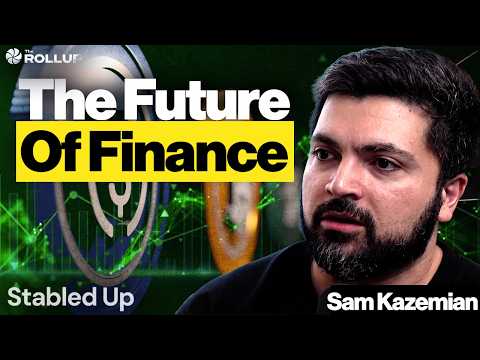
🏦 The Frax Playbook: Building Durable Revenue in the Institutional Era
🎯 Executive Summary
As the crypto industry enters what some are calling the "revenue meta" era, Frax Finance is positioning itself at the intersection of regulatory clarity, institutional adoption, and DeFi innovation. With the GENIUS Act creating a path to compliant stablecoin issuance and traditional finance looking to embrace digital dollars, Frax is building what founder Sam Kazemian describes as a "stablecoin operating system" — a verticalized stack designed to capture value across the entire monetary lifecycle.
The conversation covers Frax's business model, token economics, go-to-market strategy, and a contrarian thesis: stablecoin supply won't grow linearly, but in dramatic step functions as institutions deploy capital at scale.
📜 GENIUS Act: The Regulatory Foundation
The GENIUS Act has technically become law, though implementation details remain pending. Federal agencies including the OCC must still finalize guidance and application procedures for payment stablecoin issuance licenses. The timeline for operational readiness is estimated at Q1 2027.
What makes this legislation particularly innovation-friendly is its default acceptance model. Unlike previous regulatory frameworks where applications faced indefinite review periods (a "default no" posture), the GENIUS Act operates on a 120-day approval window. Unless regulators provide specific objections within that timeframe, applications automatically achieve compliance status.
"Unless you're doing something extraordinarily wrong, and you're going to know, it's a default yes, whereas the FMA and Fed Master Account and all that stuff, it's a default no."
This regulatory clarity creates a fundamentally different environment for stablecoin innovation compared to the years-long limbo that characterized earlier attempts at regulated crypto financial services.
💰 The Frax Business Model: Verticalized Revenue Capture
At its core, Frax operates what Kazemian calls a "verticalized stablecoin stack" — a full-spectrum approach to digital dollar issuance and deployment that captures value at multiple layers.
FRX USD: The Base Layer
The flagship product, FRX USD, is designed as a GENIUS-compliant stablecoin that maintains full redeemability at T+1 for cash or one-to-one with major stablecoins. The entire outstanding supply can be redeemed simultaneously without systemic risk, backed by economically risk-free assets (primarily T-bills).
The distribution strategy focuses on integration with DeFi infrastructure hubs rather than competing directly in established markets. Current major integrations include:
- Aave V4 — FRX USD is currently the largest stablecoin on the newly launched platform
- Curve Finance — over 20 liquidity pools pegged to FRX USD
- Partnerships with Aerodrome, Uniswap, and 1inch for intent-based liquidity
The key differentiation: Frax streams the risk-free rate to these DeFi hubs as a baseline yield for active participation, rather than idle holdings. This creates a structural advantage under the proposed Clarity Act framework, which would permit yield only for activity-based participation rather than interest on static balances.
"If you lend Frax USD you'll get streamed the risk-free yield as a baseline instead of other stablecoins. It's not like a campaign that's done in a month or something. It's actually a mechanism."
🏦 Revenue Streams: From Monetary Premium to Vault Spreads
Frax's revenue model operates across several complementary mechanisms:
1. Monetary Premium Capture
Not all outstanding FRX USD supply has the risk-free rate streamed to it. Approximately half flows through DeFi hubs with yield distribution, while the other half generates revenue through monetary premium — the value captured when stablecoins are held for payments, treasury functions, or other non-yield-seeking purposes.
2. Savings Vault Spreads (sFRXUSD)
The sFRXUSD savings vault deploys capital into higher-yielding strategies including Aave lending, carry trades, and RWA strategies. While the vault might pay out 6% to depositors, the actual earnings could reach 6.5-7%, with that spread captured by the protocol and directed toward FRAX token burns.
3. Lending Protocol Revenue
Frax Lend, currently being revamped with curation features, creates another revenue stream by facilitating debt creation with FRX USD as the floor collateral, capturing fees throughout the lending stack.
4. Off-Chain Payment Deals
Frax has signed multiple payment platform partnerships and corporate payout arrangements that generate revenue not visible on-chain. These deals represent partnerships with publicly traded companies seeking to hold stablecoins for treasury and payout functions — businesses that specifically require GENIUS-compliant, economically risk-free digital dollars rather than yield-bearing alternatives.
"A lot of these public traded companies want to actually hold stablecoins on their treasury for payouts, not just accepting pay-ins. And obviously the first thing they want to make sure is is the stablecoin they hold on their treasury, on their balance sheet for payouts, is it genius compliant? Is it economically risk-free?"
🎯 Go-To-Market: Capturing Tomorrow's Assets
Rather than competing head-to-head with established players like Tether and Circle in legacy markets, Frax is pursuing a first-mover strategy in emerging on-chain asset categories and next-generation DeFi protocols.
The philosophy: don't chase yesterday's pairs and integrations. Instead, become the default digital dollar for new assets and protocols.
Target categories include:
- New-generation yield-bearing stablecoins and synthetic dollars
- Real World Assets (RWAs) under 18 months old
- Tokenized equities and novel on-chain financial instruments
- Next-generation lending protocols like Aave V4
- Intent-based liquidity systems and new AMM designs
The goal is straightforward: in two to three years, assets launched within the past 18 months should have their predominant liquidity against FRX USD, similar to how most established crypto assets primarily trade against USDC today.
"The new ones should be FRX USD. In 3 years, if you look around, it should be billions in Frax USD with the same definition of sticky liquidity, lending, right? Like Aave V4 in 2 years, hopefully, is twice as big or three times as big as Aave V3. Hopefully, half of the stable coins in there are Frax USD."
📊 The Path to Token Value Accrual
Beginning in Q3, Frax will implement quarterly investor reporting — formalized financials, growth metrics, product roadmaps, and data room access similar to traditional equity reporting. This represents a maturation of crypto token governance toward institutional-grade transparency.
Revenue allocation follows a prioritized framework:
- Operational expenses (salaries, licenses, compliance)
- Strategic reinvestment into business development and product lines
- FRAX token burns from remaining profits
Currently, the protocol is one to two quarters away from shifting larger revenue percentages toward token burns rather than reinvestment. The timing is potentially advantageous — many DeFi tokens are trading at or near historical lows despite massive TVL growth, creating opportunities for efficient buybacks.
An alternative being considered: rather than immediate burns, the protocol could buy back and hold tokens at current depressed prices, then reallocate to growth initiatives when valuations recover. This would maximize capital efficiency while still reducing circulating supply.
"Counter-intuitively, maybe these two quarters are the right time to buy back and burn and then maybe reinvest it actually in three, four quarters when the price is actually a reasonable speculative market cap."
🔄 FRX USD vs. Yield-Bearing Stablecoins: Different Categories
A critical distinction exists between redeemable digital dollars (FRX USD, USDC, USDT) and yield-bearing synthetic dollars (Ethena's USDE, Sky's USDS).
FRX USD is built as M1 money — economically risk-free, fully redeemable, designed for monetary premium and payment rails. The sFRXUSD savings vault is the appropriate comparison to yield-bearing alternatives, as it deploys capital into higher-yield strategies with accompanying balance sheet risk.
For institutional adoption and corporate treasury use cases, this distinction matters enormously. Companies evaluating stablecoin holdings for balance sheet payouts prioritize:
- GENIUS compliance status
- Economic risk profile (T-bills vs. carry trades or lending)
- Redemption guarantees
- Regulatory clarity
These requirements naturally favor pure stablecoins over yield-bearing alternatives for core treasury functions, while yield products serve different portfolio allocation needs.
🚀 The Step Function Thesis: Institutional Capital Deployment
Perhaps the most provocative element of Frax's strategy is a contrarian view on stablecoin growth patterns. Rather than anticipating smooth, linear expansion, Kazemian expects dramatic step functions driven by institutional deployment.
Stablecoin supply has largely oscillated between 100-200 billion since DeFi summer. The thesis: this range will persist until a catalyst triggers rapid institutional adoption, potentially doubling supply to 600-700 billion in a six-month period.
Potential catalysts include:
- Banks allocating 10% of deposits to stablecoin strategies
- Major corporations establishing stablecoin treasury operations
- Payment processors integrating digital dollar rails at scale
- Regulatory clarity enabling institutional participation
A single Fortune 500 company deciding to hold a stablecoin treasury could mint 5-15 billion in supply overnight — enough to create a top-five stablecoin position instantly.
"I think it'll keep going like this until in like a six-month period the supply will double. It'll just go to like 600 700 billion and then it'll stay there. What we're building at Frax is making sure that we benefit one of the most in that step function."
This thesis fundamentally shapes Frax's buildout priorities: optimize for explosive, lumpy growth from large institutional players rather than gradual retail accumulation.
🛡️ The Lindy Effect: Brand as Moat
In conversations with Web2 companies and traditional finance institutions, one unexpected advantage has emerged: brand recognition and reputation. Many potential partners have already heard of Frax and hold positive views of the protocol's security, longevity, and technical competence.
This Lindy effect — the idea that future life expectancy is proportional to current age — creates tangible business development advantages:
- Easier partnership conversations and faster deal cycles
- Reduced due diligence friction with institutional counterparties
- Credibility in regulatory discussions
- Trust during security reviews and technical assessments
As Frax moves into the institutional era, the unsexy reliability of no exploits, minimal de-peggings, and consistent execution becomes increasingly valuable compared to higher-risk, higher-reward experimental protocols.
💡 Durability Over Growth: The AI Commoditization Parallel
An underlying theme throughout the discussion is the concept of durable revenue — income streams that survive technological disruption and competitive pressure.
The cautionary example cited: Salesforce has beaten revenue forecasts yet seen equity prices decline. The market's interpretation: uncertainty about whether SaaS business models remain viable once AI commoditizes software development and deployment.
Frax's response to this threat environment: build network effects and sticky integrations that cannot be easily replicated by AI agents or automated away by new tooling. Monetary premium, liquidity depth, regulatory compliance, and institutional relationships represent moats that compound over time.
"One thing that I think Frax is very very good at is this monetary premium and this verticalized ecosystem that is growing. Very similar to things like Tether, things that are sticky that have a moat. You can't vibe code liquidity or integrations."
🎬 Final Thoughts
Frax Finance is executing a multi-layered strategy that aligns with broader industry maturation: regulatory compliance, institutional-grade operations, diversified revenue streams, and positioning for step-function growth rather than linear expansion.
The key bets:
- The GENIUS Act creates a durable regulatory framework favoring compliant issuers
- The Clarity Act (if passed) will favor activity-based yield distribution models
- New DeFi protocols and on-chain assets will prefer FRX USD over established alternatives
- Institutional adoption will arrive in dramatic waves rather than gradual accumulation
- Sticky integrations and monetary premium create durable competitive advantages
As traditional finance continues its gradual embrace of digital dollars, protocols with strong fundamentals, regulatory positioning, and proven track records stand to capture disproportionate value in the coming institutional wave.
For investors evaluating DeFi tokens through an increasingly equity-like lens, Frax represents a case study in building sustainable business models that generate real revenue, maintain regulatory compliance, and create structural advantages that compound over time — exactly the kind of durability the market increasingly demands.
More from TheRollupCo

The Hidden Constraint: Inside the GPU and Memory Shortage Reshaping AI Economics
The AI market narrative has shifted dramatically in recent weeks. Following the release of DeepSeek's Kimi K3 model, man...

Inside Robinhood Chain: How 105M Transactions in Three Weeks Signals the Next Wa
Three weeks into mainnet, Robinhood Chain has emerged as one of the most successful blockchain launches in recent memory...

Inside Wisdom Tree's Tokenization Strategy: Building the Future of 24/7 Asset Ma
📊 The Convergence Thesis: Why Tokenization Is No Longer OptionalThe financial industry is witnessing a structural shift...

Irresponsibly Long Crypto: Why the Four-Year Cycle Isn't Dead and What's Really
📊 Portfolio Positioning: Still All-In on CryptoDespite widespread institutional skepticism, veteran crypto investors re...

The Convergence of Intents, AI, and Privacy: Inside Near's Vision for Agentic Co
💡 The Big Picture: Privacy, Intelligence, and Commerce Are MergingThe evolution of crypto infrastructure is no longer j...

Ethereum's License to Win: Inside the Institutional Supercycle Driving Trillions
The institutional crypto supercycle isn't coming — it's already here. And while market sentiment remains subdued, the un...