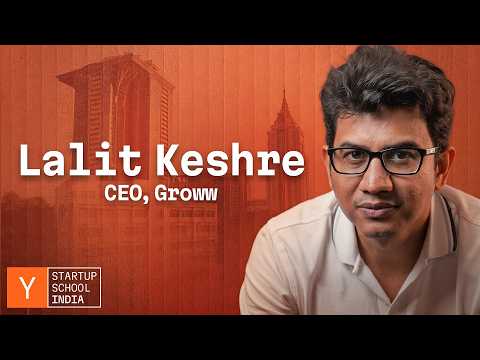
🚀 How Grow Built India's Largest Consumer Fintech Through Customer Obsession & Zero Revenue
📊 From Zero Revenue to Public Markets
Grow's journey represents one of the most compelling case studies in consumer fintech execution. The company, which went public in November after launching through Y Combinator's Winter 2018 batch, built India's largest investment platform by making a series of counterintuitive strategic choices that defied conventional wisdom.
The core thesis was simple yet ambitious: enable everyone in India to invest. But the execution required navigating failed pivots, regulatory complexity, and a four-year period of zero revenue—all while maintaining product quality and customer obsession that would eventually drive almost entirely organic growth.
🔄 The Critical Pivot: When Robo-Advisory Failed
Grow didn't start as the platform users know today. The initial concept, launched in May 2016, was a robo-advisor—a product category gaining significant traction in the US market through companies like Wealthfront and Betterment.
The market opportunity seemed clear: in a country of over a billion people, with hundreds of millions shopping online at Flipkart, fewer than 20 million people were actually investing. The numbers didn't make sense, and the founding team believed automation could bridge that gap.
The robo-advisor model failed.
Customer behavior revealed the disconnect. Users consistently asked the same questions: "Why this product? Why not that one?" They wanted to understand their options, see alternatives, and make informed choices—not receive automated recommendations in a black box.
"Most of the time you would not build what customer is directly asking, but you read between the lines. Customer did not say okay show me all the products and then show me all the products in transparency and make the payments frictionless and so on."
This insight connected back to the team's experience at Flipkart, where selection and transparency were fundamental to the value proposition. Customers wanted the same approach for investments.
💡 The Hypothesis: Full Transparency + Zero Friction
After a full year of iteration, Grow relaunched in May 2017 with a radically different product. The new platform offered:
- Complete product selection across all investment options
- Full transparency on pricing, performance, and features
- Seamless onboarding and payment flows
- Zero commission structure (direct mutual funds)
The team projected modest adoption—perhaps 100 customers in the first month would signal success.
They acquired 600 customers.
Within 10-15 days, the signals were unmistakable. Customers weren't just signing up—they were talking about the product, creating organic buzz, and referring friends and family. Customer acquisition costs approached zero as word-of-mouth drove almost 100% of growth.
"Organic growth—when you don't need to pay to acquire customers, when customers are coming themselves—that is product market fit."
The platform demonstrated exceptional metrics across every dimension except one: monetization remained an open question.
⚖️ The Strategic Bet: Reduce Risk to One Variable
Grow made a calculated decision that would define its trajectory for the next four years. With strong signals across customer acquisition, engagement, retention, and Net Promoter Score (NPS), the team identified that only one critical variable remained uncertain: revenue.
The framework was deliberate:
"In a startup there will always be multiple question marks. If you can reduce it to one question mark, that's reducing risk—especially in consumer business."
The bet was grounded in observation of successful consumer products globally. When a product demonstrates:
- Near-zero customer acquisition cost (CAC)
- High retention and engagement
- Strong customer love (measured through NPS)
- Significant transaction volume
...it becomes extremely difficult for that product not to generate revenue eventually.
This conviction allowed Grow to operate as a zero-revenue company for four years while building distribution, trust, and product excellence.
🎯 Customer Obsession as Competitive Moat
Grow's approach to customer feedback went far beyond standard product development practices. In the early days, the founding team created WhatsApp groups for every cohort of users, participated in forums like Quora, and even approached people outside movie theaters to discuss their needs.
"We used to talk to customers a lot. We created WhatsApp groups, we would go to Quora, sometimes me and my co-founders would go to movie theaters before people are watching movies and talk to customers there."
This intensity hasn't diminished even post-IPO. The CEO personally uses the product more than two hours daily and spends another two hours talking directly with customers—particularly power users who provide the most valuable feedback.
The quality bar is uncompromising. Every release is evaluated by a simple test: customer reactions should be strongly positive or strongly negative. Indifference is the real failure signal.
"I should start getting two kinds of messages: some people should say 'this is just awesome, I love it' or they should say 'this is terrible, I hate it.' Both of these are okay. If it is 'don't care,' that is the problem—because then it means the customer does not care about what you launched."
🏛️ Regulatory Strategy: Choosing the Narrow Path
One of Grow's most consequential strategic choices was made at the outset: operate only in regulated zones.
In financial services, the opportunity landscape typically breaks down into three categories:
- Unregulated areas
- Gray zones (ambiguous regulatory status)
- Fully regulated domains (requiring licensing and compliance)
Combined, unregulated and gray zone opportunities represented approximately 40% of the potential market. Grow deliberately excluded them from consideration.
"We made some very strong strategic choices early on. One of them was that we will play only in regulated zone. When you start, you should have some very strong choices—because you're basically removing variables. Once you remove the variables, decision making and execution becomes much easier."
This choice reduced optionality but dramatically simplified the strategic landscape. It eliminated entire categories of regulatory risk and allowed the team to focus execution on a narrower, more defensible opportunity set.
💰 Unlocking Monetization: The Power User Pivot
The path to revenue emerged from an unexpected source: customer demand that would reduce Grow's income to zero.
Initially, Grow earned modest commissions from mutual fund products. But power users—the most engaged, vocal customers who drove word-of-mouth growth—began asking a pointed question: "Why regular mutual funds? Why not direct mutual funds?"
Direct mutual funds carry zero commission for the platform, passing all cost savings directly to investors. For most companies, this would represent an existential threat to the business model.
Grow leaned into it.
The decision was based on the same framework that justified four years of zero revenue: if the core metrics (CAC, retention, engagement, NPS, transaction volume) remained exceptional, monetization would eventually follow through adjacent products or services.
That unlock came through equities trading. As customers grew more sophisticated and wealthy—a natural consequence of successful investing—they demanded access to individual stocks. Stock trading provided the revenue model while maintaining the transparency and selection that defined the platform.
🎨 Design as Commandment
Grow operates under ten internal commandments. One stands out as foundational to the consumer experience: Obsess over design.
This isn't aesthetic obsession for its own sake—it's recognition that in consumer fintech, design quality directly impacts trust, comprehension, and decision-making confidence. Users are entrusting their financial futures to the platform; every interaction must reinforce that trust.
The approach follows Paul Graham's advice: "If you're building a consumer product, build for yourself." The founding team remains power users of their own platform, ensuring they experience every friction point, every delay, every interface decision exactly as customers do.
"Be the power user of your own product. Every release or every app that goes out, we use it a lot. Personally I use my product more than two hours a day. The real feeling comes when you are actually user of your own product and then you're in direct touch with the customers—especially the power customers."
🤖 AI's Impact: Lowering the Barrier to Zero
As AI tools proliferate across product development, Grow's leadership has been experimenting extensively with coding assistants and automation platforms. The CEO personally codes using tools like Claude, finding them transformative for ideation and execution speed.
The impact on startup formation is profound:
"In the internet world—our world, the past world—how would you build a product? You would hire maybe three engineers, then a product manager to tell engineers what to do, then a designer, then operations folks, then a business guy. By the time you build a startup you have 10-15 people. But now, one person who thought about what needs to be built can sit down with some free credits and do design, product management, coding, and write automation tasks for operations. The barrier to doing something has just gone down so significantly."
For consumer product builders, this changes the equation dramatically. The what—understanding customer needs—remains as critical as ever. But the how—execution speed and resource requirements—has compressed by an order of magnitude.
👥 Four Co-Founders: Alignment at Scale
Grow's founding team is unusual: four co-founders who've maintained alignment through multiple pivots, four years of zero revenue, hypergrowth, and a public offering.
The framework for managing this complexity is deliberately structured:
1. Value System Alignment (Written in Pen)
- Created a comprehensive document defining core values and principles
- First principle: Always be customer first, customer obsessed
- Values are permanent; they eliminate entire categories of potential conflict
"Strategy can continue changing year on year—it's written in pencil. But if value system is the same, if there are no conflicts in decision making for the next 10-20 years, you are good."
2. Clear Ownership (Even When Everyone Does Everything)
- Defined accountability for each domain (tech, finance, operations, etc.)
- In practice, everyone contributed across functions—finance people coded, tech people did customer support
- But decision rights were unambiguous
3. Genuine Enjoyment of Working Together
- Weekends are the only time the founders don't see each other—but they're still constantly messaging
- Monday mornings remain exciting because they're working with people they genuinely enjoy
"You need to enjoy their company. Even today, weekends—the only time when we don't get to see each other—we are chatting continuously on WhatsApp. Monday you still feel like going to office, even if sometimes in the founder's journey there are ups and downs. If on Monday you still are going to work with somebody whom you love working with, that's the ideal co-founder relationship."
📈 What's Next: Wealth Management & The Next Generation
As Grow's customer base matures, the platform faces a classic challenge in consumer finance: customer needs evolve with age and wealth accumulation.
Users who joined at 25 are now 35. Those who started at 27 are approaching 40. Beyond natural aging, Grow's customers—characterized as particularly prudent and smart—are growing wealth faster than typical demographics.
Wealthy customers require different products and services. The platform must evolve to serve sophisticated wealth management needs or risk losing its most valuable users to specialized competitors.
Simultaneously, Grow is focused on capturing the next generation: 18-year-olds just beginning their investment journey. In India, investment accounts can be opened at 18, creating a clear entry point for a new cohort.
The challenge is serving both ends of this spectrum—mature wealth management and first-time investors—without compromising the clarity and simplicity that drove initial adoption.
💭 Parting Wisdom: Ignore Advice, Follow Energy
When asked for actionable guidance for aspiring founders, Grow's CEO offered deliberately contradictory counsel:
"Don't listen to older folks like me when you do a startup. The world is changing just so fast and all the advice that is given is from the context of what we saw. Younger folks have much better context now."
But then, one piece of advice anyway: Do something where you don't feel like you're working.
Time should feel like a blur. Work should feel like play. When asked about sacrifices made while building Grow, the response was immediate: "I can't think of any. Everything was fun."
"Do something where you don't feel like doing work. Time should just be a blur and you should enjoy it. We always enjoyed building Grow. I can't think about sacrifices—of course there are low times, but everything was fun."
For a company that spent four years with zero revenue, navigated multiple pivots, and scaled to become India's largest investment platform, that perspective isn't naive optimism—it's the sustainable fuel that powers decade-long journeys through uncertainty.
🎯 Key Takeaways
- Product-market fit manifests as organic growth: When customers start talking about your product without prompting, acquisition costs approach zero
- Reduce variables to one: In early-stage consumer products, achieving clarity across all dimensions except one (e.g., monetization) dramatically reduces risk
- Transparency can be a business model: Counterintuitively opening up the entire market—even at the cost of initial revenue—can build trust and distribution
- Stay close to power users: The most engaged customers provide the signal; everyone else provides noise
- Strategic constraints create focus: Choosing to operate only in regulated spaces, or serving only specific customer needs, eliminates distractions
- Founder alignment requires structure: Clear values (permanent), clear ownership (even in chaos), and genuine enjoyment of collaboration
- Use the product obsessively: The best product leaders are power users of what they build—experiencing every friction point personally
- Enjoy the work: Sustainable company-building requires that the work itself is intrinsically rewarding, not just the outcome
More from Y Combinator

From Protein Folding to Agentic Coding: The New Frontiers of AI Research
🔬 Scaling Laws Hit Biology — And They WorkOne of the most compelling developments in applied AI comes from the biology ...

Pedro Franceschi on Refounding Brex for the AI Era — and Why Every CEO Must Beco
⚡ The Electricity AnalogyPedro Franceschi, co-founder and CEO of Brex, opened with a powerful historical lens: "Electric...
How Emergent Became the World's Fastest-Growing AI Company by Democratizing Soft
💡 The Democratization of Code is Here For the past three decades, software companies have driven nearly all economic g...

How a Swedish Legal Tech Startup Went from $1M to $100M+ ARR in 12 Months
In one of the more unconventional startup stories to emerge from the latest AI boom, Lorra — a legal technology company ...
Why the Biggest Companies of the Next Decade Won't Be Software — They'll Be AI-N
The next wave of trillion-dollar opportunities isn't in building better SaaS tools or smarter co-pilots. It's in rebuild...
From Rejected EdTech Idea to AI Unicorn Territory: Inside GigaML's Playbook
💼 The $550K Job Offer That Never Got CashedNot many 21-year-old engineers turn down a $550,000 job offer from a leading...