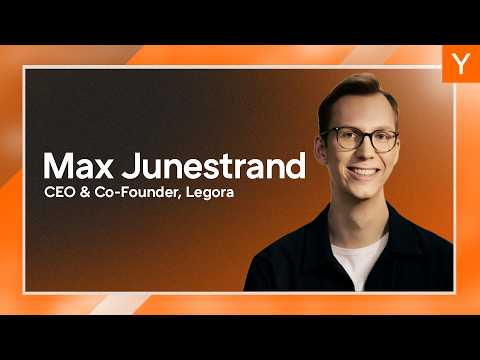
🚀 From Jude Law to 500 Employees: The Lorra Playbook
In one of the more unconventional startup stories to emerge from the latest AI boom, Lorra — a legal technology company born in Stockholm — has scaled from roughly $1 million in annual recurring revenue to over $100 million ARR, expanding from 40 employees to nearly 500 across seven global offices. The company's trajectory offers a masterclass in founder conviction, tactical execution, and capitalizing on the precise moment when AI capabilities unlock entirely new product categories.
🎬 The Jude Law Effect: Marketing That Actually Works
Legal technology marketing is notoriously bland — "it makes automotive parts look hot," as the Lorra team puts it. But after what was reportedly at least one bottle of wine in the office, the idea emerged: what if Jude Law became the face of an AI-powered legal platform?
The initial pitch to agencies was met with skepticism. Jude Law was deemed "impossible to get," particularly given the current Hollywood climate where major actors and screenwriters have grown deeply skeptical of AI due to its encroachment on scriptwriting, color grading, and cinematography. For an A-list actor to endorse an AI company would be a significant industry statement.
After six months of pursuit, Law initially declined. The breakthrough came when the Lorra team shifted tactics — instead of celebrity endorsement, they focused on product validation. They compiled customer testimonials from their Slack channel called "customer love," featuring quotes like:
"I used Lorra to review a thousand agreements in one day and got home to see my family in time for the weekend."
Law responded: "This is amazing, I can get behind this — but it's really important for me that I stay Jude Law. I don't want to be a person, I don't want to be Lorra, I want to be Jude Law." The solution: a campaign around the tagline "there's a new phase of law," with Law bringing his own screenwriter (from Saturday Night Live) and the cinematographer from Oppenheimer. The result was a high-production campaign that blanketed Stockholm with 17 touchpoints and even generated leads through word-of-mouth — including one prospect whose mother recommended Lorra after seeing the Jude Law ad.
📚 From Student to Founder: The Optionality Trap
Before founding Lorra, the team took a deliberately exploratory approach: computer science coursework, business studies, consulting at McKinsey, and stints at two other Y Combinator startups. The founder describes the philosophy as "I just tried to do as much as possible." One notable moment: completing only one week at a startup with Anton before being recruited, but declining the offer to finish a degree.
The key insight on risk management: it didn't seem particularly risky to work on Lorra over the summer when there was still a full-time McKinsey offer as a fallback. The real commitment came when the team was accepted into Y Combinator's winter batch — an AI-focused early applicant program — prompting the call to McKinsey: "I'm not coming back."
Interestingly, this pattern repeated across the company. Lorra now employs 10-15 people who similarly turned down McKinsey offers, including the CTO Jake (himself a prior YC founder) who held onto his McKinsey offer for six years before finally declining.
🏗️ The YC Grind: Work Camp Mode
Contrary to expectations of arriving at Y Combinator and being surrounded by PhDs from MIT and Google with "figured out" businesses, the Lorra team found they had among the highest revenue in the batch. What they did differently: they brought the entire company — about 10 people — to live and work in an Airbnb during YC.
The schedule was punishing: sales calls ran from 1:00 AM to 10:00 AM every day (managing time zones between the US and Europe), followed by a few hours of sleep, then attending YC sessions. The team used ring lights on their laptops for video calls and subsisted on "really shitty food." Meanwhile, back in Stockholm, the founder was literally running around the city with a briefcase, pitching legal partners who had "never seen somebody be excited about selling them technology ever."
The pitch was unconventionally aggressive:
"This is the [ __ ] future and you have to work with us and we're going to make you win. And by the way, the biggest firm in the Nordics already works with us. So if you don't, you're kind of a loser."
Midway through YC, the teams executed a "tactical hot swap" — the US-based engineering team returned to Stockholm to handle customers, while the founder flew to San Francisco for fundraising.
💰 Fundraising: The Benchmark Moment
YC provided crucial advantages for first-time founders with limited networks: investor reach, signaling value, and structured inbound. The team scheduled 80 meetings in a single week leading up to Demo Day. However, the practice round didn't go well — the team was "tired, unprepared, bad."
But when it counted, performance shifted dramatically. In a meeting at Benchmark — one of Silicon Valley's most legendary VC firms — the team delivered a 30-minute pitch to Peter Fenton and Chetan (now a board member). Walking out, Fenton reportedly turned to Chetan and said:
"The guy is perfect. The only problem is that he's from [ __ ] Sweden."
The founder's response: "I'll tell you what, I don't think that's going to be a problem anymore. We are [ __ ] showing them."
The fundraising process became a domino effect, but maintaining momentum proved difficult as rejection notes accumulated. The lesson: investors can smell lack of confidence, and founders must project conviction even when facing doubt. The deciding factor for Lorra: the team had made an existential commitment that "this is our life's work."
📊 The Product Bet: Three Features, All Best-in-Class
In October 2024, at roughly 30 employees, Lorra reached general availability with three core features:
- Chat assistant (competing with ChatGPT)
- Tabular review (competing with a specialist doing 50x Lorra's revenue)
- Word add-in (competing with another focused competitor)
The strategy, outlined in a three-page product manifesto: become best-in-class at all three and bundle them. At the time, Lorra was doing $1 million ARR while the tabular review specialist was doing nearly $50 million ARR — a 50x difference.
The insight: avoid over-optimizing for the present. While competitors focused narrowly, Lorra took a longer time horizon, believing bundled superiority across all three would ultimately win. Today, the company has "enormously surpassed" the specialist competitors and continues converting their clients.
🤖 The Agent Revolution: From Augmentation to Automation
The recent model improvements over Christmas 2024 represented a "big step change in intelligence and capabilities." This unlocked a fundamental shift in Lorra's product philosophy — moving from augmenting lawyers in individual tasks to building proactive agents that complete end-to-end workflows.
Previously, Lorra helped with discrete tasks. Now, with access to clients' complete document repositories, email systems, and matter files, agents can work autonomously. An example workflow:
- Law firm partner has 500 emails from the previous day
- Lorra agent reviews emails in context of all active matters
- Agent completes work proactively before the lawyer even opens their inbox
- Bottleneck shifts from individual tasks to evaluating end-to-end work products
In M&A due diligence, agents now:
- Restructure entire data rooms according to template folder structures
- Analyze transaction type and generate appropriate diligence questions
- Identify missing content
- Execute tasks that take 20-30 minutes in parallel
The interaction model has shifted from real-time collaboration to giving "broader instructions" and letting agents work autonomously — similar to how developers now use Cursor or Claude for code. Notably, Lorra sees itself as "six months behind code" in terms of AI capability deployment, as coding is naturally easier (binary, well-defined context, models trained out-of-the-box). This provides a useful leading indicator for where legal AI is headed.
🛡️ The OpenAI Question: What Happens When Models Get Smarter?
Every AI startup faces the existential question: what if OpenAI, Anthropic, or Google simply builds this themselves?
The Lorra perspective draws parallels to the database and infrastructure wars against AWS. Companies like MongoDB succeeded by asking: what is our moat when models continue getting smarter? The question isn't whether big platforms will compete — it's what remains defensible assuming continuous improvement in base model intelligence.
If models eventually become so capable they can instantly write all code, gather all data, and solve any task on the fly, "we should all go have a piña colada instead." But assuming that's not the end state, defensibility comes from:
- Proprietary data and content libraries
- Workflow moats — embedded processes and integrations
- Learned behavior — training users in specific interaction patterns
- Enterprise trust and access — permissions to company documents, emails, and systems
For Lorra, the realization was simple: "We had to get big."
🌍 Global Expansion: Europe's Moment
Lorra's geographic footprint now spans San Francisco, Chicago, Texas, New York, London, Stockholm, Germany, India, and Australia — a reflection of the universal nature of legal work. The company's ambition extends beyond legal tech entirely.
The founder draws inspiration from Google's evolution: success in search and advertising funded moonshots like self-driving cars under the Alphabet umbrella. Similarly, Facebook's core business ("kind of fumbling the ball") at least enabled Meta's VR experiments. The vision: "One day we'd love to erase that 'legal' in front of legal tech Lorra."
This ambition carries geographic significance. Europe's largest tech company remains SAP — a legacy enterprise software firm. The founder's response: "[ __ ] SAP, are you serious?" The argument: AI represents a unique moment where leverage and power can shift. Just as AI lets a 150th-ranked law firm compete with top-10 firms, it enables European startups to build globally dominant platforms.
Lorra's engineering and product organization is 15% ex-YC founders, creating what's described as intense "founder mode energy" across the company. Different product departments are run by former CEOs, all operating at "full speed ahead."
⚡ Key Takeaways
On risk management: Strategic optionality (keeping the McKinsey offer) reduced perceived risk during the exploration phase. Real commitment came only after validation (YC acceptance).
On fundraising: YC's value for first-time founders is primarily about structured access and signaling. But execution under pressure — delivering when it matters — remains the deciding factor. Maintaining confidence through rejection is critical, as investors "can smell" doubt.
On product strategy: Avoid over-indexing on current competitive positioning. Lorra was outgunned 50:1 in revenue by specialists but bet on bundled superiority over a longer time horizon. That bet paid off.
On AI moats: The real question isn't "what if OpenAI does this?" but "what's defensible as models get smarter?" Proprietary data, workflow integration, enterprise trust, and user behavior create compounding advantages that foundation model providers can't easily replicate.
On geographic ambition: AI democratizes access to technology and talent. The constraint is no longer location — it's ambition. Europe's moment may finally be arriving.
As the Lorra team puts it: "We've proven to ourselves that we could do this part of the journey, but nobody is content. We're about to hit base camp and now the real climb is about to begin."
More from Y Combinator
From Protein Folding to Agentic Coding: The New Frontiers of AI Research
🔬 Scaling Laws Hit Biology — And They WorkOne of the most compelling developments in applied AI comes from the biology ...
Pedro Franceschi on Refounding Brex for the AI Era — and Why Every CEO Must Beco
⚡ The Electricity AnalogyPedro Franceschi, co-founder and CEO of Brex, opened with a powerful historical lens: "Electric...

How Emergent Became the World's Fastest-Growing AI Company by Democratizing Soft
💡 The Democratization of Code is Here For the past three decades, software companies have driven nearly all economic g...

Why the Biggest Companies of the Next Decade Won't Be Software — They'll Be AI-N
The next wave of trillion-dollar opportunities isn't in building better SaaS tools or smarter co-pilots. It's in rebuild...

From Rejected EdTech Idea to AI Unicorn Territory: Inside GigaML's Playbook
💼 The $550K Job Offer That Never Got CashedNot many 21-year-old engineers turn down a $550,000 job offer from a leading...
The Dawn of Organizational Superintelligence: Inside YC's Radical AI Transformat
🔬 The AI-Native Organization: A Case Study in Real-World Transformation While most companies remain trapped in legacy ...