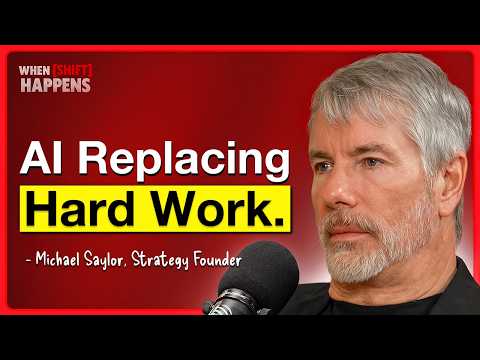
The conventional wisdom around hard work and talent is facing its most serious challenge yet—not from laziness or entitlement, but from the relentless march of artificial intelligence and automation. The traditional formula of success through grinding hours and mastering skills is rapidly becoming obsolete, replaced by a new paradigm where leverage, not labor, determines outcomes.
💪 The John Henry Fallacy
There's an old American folk tale about John Henry, the strongest railroad worker who competed against a steam-powered hammer. He won the contest but died immediately afterward, his heart bursting from the effort. It's a story often told as heroic—but it misses the point entirely.
The real lesson isn't about heroism. It's about futility.
As one observer noted, drawing on a quote from General Heinland: "You don't win wars by dying for your country. You win wars by making the other guy die for his country." Applied to modern productivity, this translates to a simple principle: don't try to outwork a forklift.
Working 3,000 hours a year for ten years straight, beating one's head against the wall, can produce exactly zero progress if the effort is misdirected. The question isn't about work ethic—it's about choosing the right tools for the job.
🌍 The Translation Test
Consider a practical example: A content creator wants to expand into Chinese and Japanese markets. The traditional approach would be spending ten years and $500,000 learning both languages fluently, then manually re-recording every piece of content three times over.
The AI approach? Instant translation into Japanese, Chinese, Portuguese, Spanish, French, German, Russian, Ukrainian, and even regional dialects—in a split second.
While mastering ten languages would certainly be impressive, it's simply not a good business decision anymore. The same principle applies across countless domains:
- Legal documents: AI can draft 100-page legal briefs and explain complex regulatory reasoning
- Content creation: AI can write a ten-chapter book in a hundred languages from a single paragraph prompt
- Business strategy: AI can generate 25-page briefing documents explaining strategic decisions to teams
📚 When Genius Becomes Commoditized
Voltaire was considered the greatest thinker of the 1700s—so influential that historian Will Durant literally named his book about that era "The Age of Voltaire." Voltaire's collected works would fill an entire bookshelf, and his ability to produce perfect French prose on any topic marked him as a hyper-genius of his time.
Today, that capability is worthless.
The robots are doing the work. The cars are driving themselves. The AIs are drafting the legal documents. Being able to produce content, in itself, is no longer a differentiating contribution to civilization.
This isn't an argument against work—it's an argument for working smart rather than hard. If you work in a warehouse, use the forklift. If you own a warehouse, deploy a hundred robots. If you create content, harness AI to create and distribute better content.
⚡ The Productivity Multiplier
The productivity gap between traditional methods and AI-enabled approaches isn't incremental—it's exponential. These tools offer productivity gains measured in the hundreds or thousands of times improvement.
The alternative—going back to school, spending a decade and a million dollars to gain expertise that AI already possesses—would leave someone one-tenth as effective after all that investment. Meanwhile, asking an AI for help produces answers in two minutes.
"Everybody ought to be thinking, how do I use technology, digital technology, digital assets, digital capital, digital intelligence, digital media, digital something to create a product or a service your parents didn't have. They couldn't create. Nobody imagined it back then."
🔄 The Demonetization of Labor
AI is systematically demonetizing labor across the economy. Just as people stopped pulling plows when tractors were invented, countless tasks that defined careers for generations simply won't be done by humans anymore.
The strategic response isn't to compete with machines—it's to identify what didn't used to be possible that can be done now, using tools that didn't exist 20 years ago. Almost certainly, these opportunities will involve digital leverage in some form.
🚀 Breaking Conventional Wisdom
The hallmark of this approach is that conventional wisdom will be against it. The response will always be: "We didn't do it. We don't do it that way. We never did it like that."
But success increasingly requires breaking conventional wisdom, thinking independently, and embracing innovation. The pattern is visible across multiple industries:
- Elon Musk rethinking the auto industry
- Palmer Luckey reimagining defense technology
- Countless others inventing solutions that nobody had shown before
The way to recognize genuine innovation? Someone invents something new that nobody showed you before—and when you try it, it works.
🎯 The Bottom Line
The economy is entering an era where traditional notions of hard work and skill mastery are insufficient—and in many cases, counterproductive. The winners won't be those who work the hardest or accumulate the most credentials.
The winners will be those who:
- Recognize the exponential leverage available through digital tools
- Create products and services that were previously impossible
- Work smart by harnessing AI and automation rather than competing against them
- Think independently rather than following conventional wisdom
- Focus on outcomes rather than hours worked
The future doesn't belong to the person with the shovel—it belongs to the person with the forklift. Or better yet, the person who deploys a fleet of autonomous forklifts while focusing on higher-order strategy.
As AI continues to advance, this dynamic will only intensify. The question isn't whether to adapt to this reality—it's how quickly one can make the shift.