The case for Bitcoin isn't just about number-go-up. It's about time preference, the behavioral economics that shape civilizations, and the structural flaws of fiat money that keep society locked in short-term thinking. A recent conversation with a long-time Bitcoin advocate offers a sharp reminder: sound money isn't just an investment thesis—it's a civilizational correction.
💼 All-In on Bitcoin (But Not Reckless)
The speaker holds 98-99% of liquid net worth in Bitcoin, keeping only enough euros for day-to-day expenses. This isn't dogma—it's conviction paired with pragmatism. Bitcoin isn't treated as a payments rail for buying bread; it's a store of value and a hedge against monetary debasement. When life requires it—holidays, experiences, real needs—Bitcoin gets sold. The goal isn't to "die with your Bitcoins," but to live meaningfully while building wealth in an asset that holds its purchasing power over time.
"I'm here to live my life. If I have something to buy because I want to do something, then I will sell Bitcoins. I'm not the Michael Saylor of France."
The distinction is important: this isn't about hoarding for hoarding's sake. It's about aligning capital with long-term thinking while remaining flexible enough to enjoy the present.
🍬 The Marshmallow Experiment: A Lesson in Time Preference
The concept of time preference starts with a famous Stanford study—the marshmallow experiment. Children aged 4-6 were given a choice: eat one marshmallow now, or wait 15 minutes and receive a second one. The results were telling. Kids who delayed gratification tended to perform better academically, avoid addiction, and build wealth over time. Those who ate immediately? They showed patterns of impulsivity and short-term decision-making that followed them into adulthood.
Time preference isn't just individual—it's societal. Civilizations with long time horizons build cathedrals, infrastructure, and enduring institutions. Civilizations with short time horizons consume, borrow, and defer problems to the future.
💸 Money Shapes Civilization
The form of money a society uses directly influences its time preference. When money loses value quickly—through inflation, debasement, or monetary expansion—people are incentivized to spend now rather than save. Consumerism flourishes. Debt accumulates. Long-term planning erodes.
Conversely, when money holds its value, the incentive flips. Saving becomes rational. Capital formation becomes possible. People invest in the future rather than fleeing into consumption.
"If you have money that doesn't keep its value, the invitation is to spend it now—to buy things you don't need. A money that can hold its value invites you to keep it, to build your assets, to wait."
The 19th century gold standard era is cited as one of the most productive periods in modern history—not by coincidence, but because sound money aligned incentives with long-term value creation. Today's fiat regime does the opposite, encouraging governments and individuals alike to borrow against the future and kick problems down the road.
⚡ Bitcoin as the Remedy
Bitcoin reintroduces hard money into a world dominated by easy money. With a fixed supply of 21 million coins, it cannot be inflated away. It's neutral, decentralized, and resistant to political manipulation. In a system where debt is ballooning and currency debasement is policy, Bitcoin offers an escape hatch—a way to store value across time without trusting central banks or governments.
"Bitcoin is going back to sound money and money with a long time preference. It's healing the civilization. That's why, as a civilization, we need Bitcoin—it can realign your needs with the future."
This isn't hyperbole. It's a structural argument: broken money breaks society. Fixing money fixes incentives. And fixing incentives allows individuals and institutions to think beyond the next quarter, the next election, or the next stimulus package.
📉 The Volatility Problem—And the Only Solution That Works
For all its theoretical elegance, Bitcoin's volatility remains a stumbling block. The promise of sound money is hard to reconcile with 50% drawdowns in two months. For someone living paycheck to paycheck, that's not a store of value—it's a gamble.
The speaker's advice is blunt and practical:
- Think long-term only. Bitcoin is not a short-term trading vehicle.
- Don't put in what you need. Day-to-day money should stay liquid and stable.
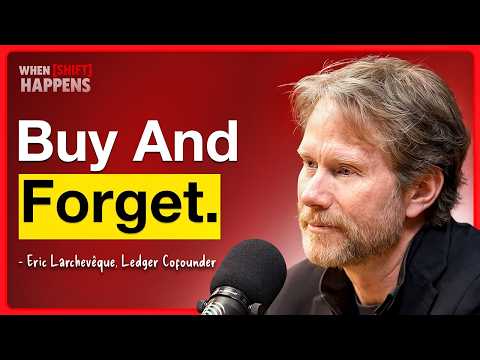
- Dollar-cost average (DCA). Buy a small, fixed amount weekly or monthly and forget about it.
- Zoom out. Volatility is noise. The signal is the trend over years, not months.
"The only people I know who had success with Bitcoin investment are the ones who forgot about it. 100% of the people who tried to beat the market—by selling, going to shitcoins—they all lost everything."
This isn't just anecdotal. It's a behavioral truth. Winners in Bitcoin are the ones who did nothing—who held through the drawdowns, ignored the hype cycles, and resisted the urge to trade. Losers are the ones who tried to be clever, who added leverage, who chased pumps and sold bottoms.
🧩 The Paradox of Early Adoption
Many people fantasize about buying Bitcoin in 2010 or 2011, when it traded for pennies. But here's the reality: most people who bought early sold early. A 10x gain feels like a windfall. A 50x gain feels like a miracle. At some point, human psychology kicks in, and the urge to lock in profits becomes overwhelming.
The only ones who held? The "crazies"—the true believers who saw Bitcoin as the future of money, not just a trade. And the ones who literally forgot they owned it.
"The people who bought Bitcoin at 1 cent—when it did 10x, 15x, 50x—they sold everything. The only ones who didn't sell are the crazies, or the ones who forgot."
It's a humbling reminder that conviction matters more than timing. The best entry point is meaningless if the holder exits too early.
🔑 The Takeaway: Align Money with Time
Bitcoin isn't just an asset. It's a tool for realigning incentives—personal, societal, and civilizational. It forces holders to think long-term, to resist the impulse to consume, and to build wealth in an asset that can't be debased by policy whims or political expedience.
For individuals navigating a world of wage stagnation, asset bubbles, and monetary instability, Bitcoin offers a way out—but only if approached with discipline, patience, and realistic expectations. The volatility is real. The drawdowns are brutal. But the alternative—holding cash that loses 5-10% of its purchasing power annually—is a slow bleed with no upside.
Sound money doesn't guarantee prosperity. But broken money guarantees decline. And in that context, Bitcoin isn't just an investment—it's a bet on a future where time preference matters again.