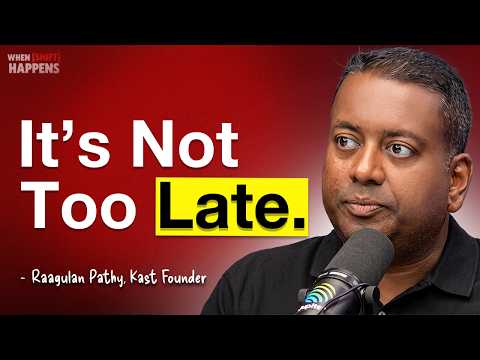
🏦 The $600M Neo-Bank Built on Stablecoins – Inside Cast's Bold Strategy
🔥 The Thesis That Launched a Company
Most of crypto hasn't delivered much real-world value yet — but hundreds of millions of people could benefit from a fintech built on crypto rails. That core belief drove Ragulan Pathy, former Circle executive and founder of Cast, to leave his corporate role and build what he envisions as the global neo-bank of the future.
Cast is a stablecoin-powered financial platform enabling users to hold, move, earn, and spend money across 170+ countries. It connects digital assets with everyday finance through virtual accounts, physical cards, and instant cross-border payments. The company has grown from zero to approaching $100 million in annualized revenue in under three years — a pace that rivals or exceeds the early growth of fintech giants like Revolut and Nubank.
"The biggest thing you could do was build a fintech or a bank on top of those rails. I had that thesis, built Cast on that thesis. I think it's playing out now."
Despite market turbulence — Bitcoin down roughly 50% from highs — Cast's business has tripled over the past several months. More than half of Cast's users are not crypto-native; they're remote workers, solopreneurs, and global citizens who need better tools to move money globally.
💰 The $80 Million Raise and What Comes Next
Cast recently closed an $80 million Series A at a reported valuation in the $600 million range, growing from near-zero to this mark in less than two years. The capital is being deployed toward:
- Infrastructure Acquisition: Buying companies with licenses and building proprietary payment rails
- Regulatory Expansion: Securing licenses in key markets to ensure long-term viability
- Product Diversification: Rolling out a business product (competing with Ramp and Brex) and a lighter consumer app called Castro targeting Latin America and Africa
Ragulan emphasized that Cast operates responsibly: the company ran break-even or near-profitability for its first two years on minimal funding. Now, with capital in hand, the team is investing aggressively — but expects to return to profitability by 2026.
"We always had to run break even because we only had $10 million for most of the first two years. Now we're building a lot, acquiring companies, doing licensing — and $80 million doesn't seem like nearly enough when you're competing against multi-billion dollar competitors."
The long-term ambition? Ragulan expects Cast will raise up to $1 billion over the next several years to fully execute on the vision of becoming a generational fintech company.
🏗️ The Hidden Complexity Behind "Just a Card"
From the outside, attaching a card to a crypto wallet looks simple. But Ragulan made it clear: payments infrastructure is brutally complex. Cast works with dozens of providers — banks, payment processors, custodians — and each one introduces potential friction.
The company now has a team of 100+ people dedicated solely to building the infrastructure that allows instant payments across 50+ countries. This involves navigating:
- Compliance and regulatory frameworks in every jurisdiction
- Technical integration with legacy banking systems
- Customer support for declined transactions, refunds, and edge cases
- Partnerships with multiple card issuers and payment rails
"Consumers should never see how painful it is tying together so many different banks, payment service providers, all the negotiations, the contracts, the wires, the moving of money. It's just super freaking complex, grindingly difficult."
Cast's strategy involves owning more of this infrastructure rather than relying entirely on third-party providers. This is a massive competitive moat — once built, it's extremely hard for others to replicate.
📉 Why Many Neo-Banks Are Shutting Down
The neo-bank space is crowded, but Ragulan predicts that the majority of competitors will give up within 12 months. Why? They can't make the economics work.
Cards alone are not a profitable business. Companies that launch cards as standalone products — often using third-party infrastructure — struggle to generate meaningful revenue. They face:
- High operational costs with thin margins
- Complex user experiences that lead to low retention
- Difficulty raising follow-on funding without a clear path to profitability
Cast's approach is different. The company expects that by next year, more than 50% of revenue will come from non-card products, including:
- Cross-border money movement infrastructure
- Business accounts and financial services (Cast for Business)
- Wealth products and trading capabilities
- Credit and lending offerings
"Cards are really just an entry point so that people can experience your product, but ultimately they're not the way that you make money."
🔐 Trust, Custody, and Self-Custodial Options
One of the most sensitive topics in crypto fintech is custody. What happens to user funds if Cast goes out of business?
Ragulan acknowledged that Cast's original terms and conditions weren't as clear as they should have been — a misstep that was corrected. The company now explicitly states that:
- Cast holds customer funds with licensed custodians
- Bankruptcy-remote structures are in place to protect user assets
- A self-custodial or non-custodial option is being rolled out, allowing users to hold their own keys
For users who prioritize self-custody, Cast is introducing the ability to fully own and control funds — though this comes with trade-offs in user experience. For most users, the custodial model remains simpler and more seamless.
"If Cast goes out of business and you have a self-custodial wallet, you have access to your money. That's what we're building."
🪙 The Token Decision: Why Cast Chose Equity Over a Token Launch
One of the most controversial moves Cast made was the decision not to launch a token — and instead offer tokenized equity to the community.
Early users earned points through cashback incentives, expecting a future token launch. But after observing the market, Ragulan concluded that launching a token would be a short-term play that undermines long-term value.
His reasoning:
- Nearly every fintech or neo-bank token has declined 90-95% from launch
- Tokens create misalignment: founders and investors hold equity, while users hold a depreciating asset
- Supporting a token requires massive buybacks, starving the business of capital for growth
- Tokenized equity aligns everyone — users, employees, investors, and founders — to the actual business performance
"The way that tokens are done is complete BS. Founders own equity, then create a token which has no linkage to the equity. It's a mirage. I took a harder path — one that's better for the community in the long term."
Cast plans to convert points into tokenized equity at the valuation of the next fundraising round. While the equity won't be publicly tradable, the company expects to facilitate periodic buybacks — similar to how private companies like Stripe and Revolut allow secondary sales.
🎨 Design, Brand, and the Premium Experience
Ragulan places enormous emphasis on design and brand. Cast's cards are visually striking, and the app interface is meticulously crafted. Why?
"Life is meant to be lived in richness and color and beauty. Humans don't look at features or usability alone. They like things that are beautiful."
Cast is building a design studio in Singapore and collaborating with sports stars, musicians, and fashion brands to create a lifestyle brand — not just a financial product. This strategy mirrors the success of premium brands like Ferrari and Apple, where customers willingly pay a premium for quality and aesthetics.
⚖️ The Cost of Building: Velocity, Sacrifice, and the Founder's Toll
Running Cast is a 24/7 operation. Ragulan candidly described the personal cost:
- He works from the moment he wakes up to the moment he sleeps
- He barely sees friends or family, skipping weddings and funerals
- He struggles to exercise or watch sports — activities that once brought him joy
- He uses GLP-1 medications to manage weight due to the relentless travel and stress
"The thing I don't talk about publicly is just the massive toll it takes on you to do this 24/7 and not take holidays and not sleep. It's intense. But I'm pretty bulletproof to do this for extended periods."
Despite the grind, Ragulan remains deeply committed. He has never sold a single share of his equity — instead, he invested over $5 million of his own money to buy out early investors. His strategy is to stay fully aligned with the business until it reaches escape velocity.
🌍 The Vision: A Hundred-Billion-Dollar Company
Ragulan believes Cast can become a $100 billion+ company. Bold? Absolutely. But the thesis is grounded in a simple truth:
"The TAM of crypto is like $2.5 trillion. The TAM of the US dollar is 20 times that. Stablecoins are digitizing that broader market."
Cast is not just a crypto company — it's a global fintech built on stablecoin rails. The team is seasoned, the infrastructure is being built, and the velocity of product launches is accelerating. Over the next five years, Ragulan predicts that crypto neo-banks will break out and compete at the same level as the largest crypto exchanges and fintechs.
🔮 Market Outlook: The Bottom Is Near
On the state of the crypto market, Ragulan shared his view:
- Bitcoin is down roughly 50% from highs, trading around $60K
- Altcoins are down 80%+, even strong assets like Solana are down 65%+
- The market is boring, despondent, and distracted by AI — classic signs of a bottom
"I think the worst is behind us. Bitcoin may dip toward $50K, but here or hereabouts is roughly going to be the low. When people are despondent and don't care about crypto, that's the base for a fantastic rebound."
Ragulan expects Bitcoin to return to $100K by mid-2027, driven by renewed interest as AI hype cools and crypto fundamentals reassert themselves.
✅ Final Takeaway
Cast is building the boring, essential infrastructure that makes money movement seamless for global citizens. It's not the flashiest story in crypto — but it may be one of the most enduring.
"Cast is going to become a hundred-billion-dollar company. You should not believe me because I encourage people to be deeply skeptical — but the team is phenomenal, and we will not relent until we deliver the absolute greatest fintech to be built out of crypto."
Time will be the judge.
More from When Shift Happens
Tokenizing the World: How Real World Assets Could Unlock a $600 Trillion Market
The crypto industry has captured global attention for over a decade. Yet despite the hype, the entire market capitalizat...
Beyond the Buzzwords: Understanding Bitcoin's Purpose in a World of Financial Co
🧭 Reframing the Bitcoin QuestionWhen central bankers and financial authorities dismiss Bitcoin, they often frame the de...
Why Bitcoin Fixes Broken Money—And Why Most People Still Get It Wrong
The case for Bitcoin isn't just about number-go-up. It's about time preference, the behavioral economics that shape civi...
The Great Transition: How Financial Services is Finally Getting Its Internet Mom
📊 The Software Revolution Comes for FinanceEvery transformative technology follows a predictable arc. When the internet...

The Shift That Happens: Learning Risk from Cohen, Robertson, and Druckenmiller
💡 The 15-Year Rule of Investing MasteryBecoming a truly confident portfolio manager isn't a sprint — it's a marathon th...

The Art of Conviction: How One of Crypto's Sharpest Investors Navigates Volatili
📊 Market Psychology as a Buy SignalThere's a contrarian playbook quietly guiding some of the most successful crypto all...