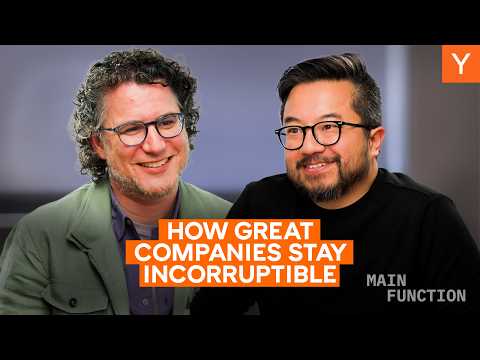
🏛️ The Hidden Corruption of Modern Capitalism — And How to Build Companies That Last
💡 The Core Problem: Value Creation vs. Value Extraction
The modern economy faces a fundamental crisis: many ways of getting rich create zero value. Builders are told that all forms of profit are equally legitimate, yet this narrative ignores a critical distinction between creating genuine value and merely extracting it from others.
Eric Ries, author of The Lean Startup and the forthcoming Incorruptible: Why Good Companies Go Bad and How Great Companies Stay Great, argues that founders have been systematically deprived of the tools needed to protect what they build. While The Lean Startup taught a generation how to achieve product-market fit, it didn't address what happens next: how to prevent the inevitable forces that seek to corrupt successful companies.
"The more successful your organization, the more valuable it is as a target. That's what makes it worth taking over. That's what makes it worth stealing from you — the fact that it is successful."
🎯 The Paradox of Success
Conventional wisdom tells founders that success brings protection — that product-market fit leads to power, which grants freedom. This is dangerously wrong. Success makes companies more vulnerable, not less. The greater the value created, the stronger the incentive for outside forces to seize control and redirect that value toward short-term extraction.
Consider the story of "the professor" — a brilliant founder building transformative AI biotech. He carefully recruited talent by promising the technology wouldn't be weaponized. But when employees asked tough questions about investor control, VCs dismissed his concerns with a patronizing, "Don't worry about that. If you're serious about business, this isn't what you should focus on."
Meanwhile, Ries was attending a memorial event for a founder who had built a wildly successful company and made extraordinary returns for investors — only to be betrayed and removed at the earliest opportunity. Over a thousand people flew in at their own expense, including former employees he had laid off, to honor him. When Ries explained this to the professor, the response was telling:
"Wow, respect. That's the kind of company I want to build someday."
"You're not listening to me. He doesn't work there anymore. This isn't a party. It's a wake."
⚖️ The Delaware Trap: Shareholder Primacy as Default Reality
Most founders never read their corporate charter. Those who do discover a shocking clause: their Delaware C-Corp is legally structured to maximize shareholder value above all else — not to serve customers, not to fulfill a mission, not even to create great products.
This is the doctrine of shareholder primacy, and contrary to popular belief, it's not an ancient pillar of capitalism. Adam Smith never advocated for it. It dates only to the 1980s, pushed by a small group of academics, judges, and legal scholars — most prominently Milton Friedman — who declared that "the social purpose of a corporation is to increase its profits."
Here's the disturbing part: shareholder primacy has never been subject to a vote, referendum, or legislative action. It's not technically "the law" — legal scholars describe it as a "legal obligation, not a legal duty." Yet courts enforce it as if it were law, and any director who violates it faces termination and lawsuits.
"We're in an era where we have temporary organizations being led by temporary managers on behalf of temporary investors. Then people ask, 'Why is trust down? Why doesn't anyone trust anybody anymore?' Because we've built an economy that runs this way."
📉 The Empirical Failure of "Best Practices"
The irony is profound: the so-called "best practices" of corporate governance are empirically value-destroying. Ries' book includes an entire chapter documenting this failure.
Case Study: Twilio
Jeff Lawson built Twilio from nothing to $4 billion in revenue, with the stock up 390% since IPO. When he took the company public, advisors convinced him to agree to a seven-year sunset on his super-voting shares. "Don't worry," they said. "You can always extend it."
Seven years passed. The shares expired. Less than 200 days later, he was out. The stock had fallen from its pandemic peak (though revenue continued growing), and that was enough. A founder who created billions in value for investors didn't even earn one year of grace beyond his protection expiring.
Case Study: Polaroid
When Edwin Land was fired from Polaroid, Steve Jobs called it "the dumbest thing he'd ever heard." Polaroid had been an R&D powerhouse with 1,500 research scientists on staff. After Land's removal, the company never invented another significant product.
Case Study: Philip Morris
Philip Morris reports approximately $8 billion in annual net income. But studies calculate the company generates $600 billion per year in costs borne by others — $300 billion in direct healthcare expenses and $300 billion in lost productivity. Some estimates suggest the tobacco industry makes $6,000 from every customer that dies.
"In order to call Philip Morris profitable, you have to take an incredibly narrow view of profit."
🛡️ The Solution: Mission-Controlled Companies
Ries proposes a third way beyond the binary of investor control versus founder control: mission-controlled companies where the mission itself has sovereignty.
The formula is simple: Ethos + Integrity = Incorruptible
- Ethos: A clear principle or higher purpose that guides decision-making
- Integrity: Structural protections that defend that purpose from external pressure or internal temptation
📜 The Legend of Saul Price and the Birth of Costco
Saul Price, widely considered the father of modern retail, offers a masterclass in mission-controlled business. Before becoming an entrepreneur, Price was a lawyer who understood fiduciary duty — putting the client's interest before your own.
When he founded FedMart in 1950s San Diego, he asked a simple question: Who is my client? His answer: the customer. This led to a clear fiduciary hierarchy: Customers first, employees second, shareholders third.
Price's commitment was radical. He would literally put up signs in his own stores telling customers where to buy products cheaper from competitors. This built extraordinary trust — customers drove miles out of their way to shop at FedMart.
But after taking FedMart public, Price faced relentless pressure from investors who wanted higher prices and lower wages. Even after bringing in a new controlling shareholder to escape public market pressure, the board eventually changed the locks on his office and fired him.
The Natural Experiment:
FedMart's investors got what they wanted. They converted the company to "traditional business practices." It was bankrupt within seven years — destroying in seven years what took 20 years to build.
Price took two weeks off, then leased office space directly above FedMart and started Price Club. One FedMart employee who quit in protest when Price was fired started his own company. The two eventually merged to form Costco.
"Costco today still embodies that Saul Price fiduciary-to-the-customer idea, protected by a governance fortress that shields it from outside attacks."
🧬 The Novo Nordisk Model: 100 Years of Scientific Integrity
In the 1920s, Marie Crowne received a fatal diabetes diagnosis. Her husband, August (a Nobel Prize winner), took her on a North American lecture tour where they learned Canadian researchers had isolated insulin for the first time.
When they returned to Denmark to commercialize the technology, they foresaw a critical problem: if a for-profit company sells life-saving medicine, what prevents it from eventually charging patients anything it wants? Patients become effectively enslaved to the product.
Their solution: build the Nordisk Insulin Laboratorium as a for-profit subsidiary of a nonprofit foundation. Two entities instead of one — nonprofit trustees overseeing for-profit directors. This became Novo Nordisk.
The $500 Billion Intervention:
In the early 2000s, Novo Nordisk's for-profit board pursued a merger following pharma "best practices." They secured a signed agreement offering a substantial premium. The final step: get foundation approval.
The nonprofit trustees asked: "What problem are we solving?" Novo Nordisk had been profitable for 10 consecutive years, growing approximately 20% annually. The bankers argued it was "necessary for survival" — eat or be eaten in modern pharma.
The trustees said no. Merger over.
The counterfactual is clear: the company they nearly merged with was acquired by Merck two years later, and all major R&D programs were cancelled. One of those programs — in year 11 of a 13-year timeline with no evidence of success — was GLP-1.
Because the trustees blocked the merger, the research continued. Twenty years later, Novo Nordisk's valuation exceeded $600 billion — more than Denmark's entire GDP. The delta between what they would have sold for and their actual worth represents more than $500 billion in shareholder value created by nonprofit trustees.
"Companies with this industrial foundation structure are six times more likely to live to year 50 — a 60% probability versus 10% for traditional structures."
🤖 Anthropic: AI Safety Through Structural Strength
When Anthropic's founding team left OpenAI, they had extraordinary talent alignment and carefully curated investors (including, ironically, Sam Bankman-Fried). But they understood that AGI technology worth trillions would face irresistible takeover pressure.
They spent two years designing and defending a long-term benefit trust — a perpetual purpose trust with outside trustees empowered to appoint for-profit board directors. This wasn't a nonprofit foundation, but achieved the same structural protection.
The result? When Anthropic turned down a $200 million contract on principle, Claude went to number one. The sidewalks around their San Francisco headquarters were chalked with "thank you" messages — remarkable for a city where tech companies face significant skepticism.
"When companies stand up and do the right thing — acting consistently with their own values in ways consistent with human flourishing — they get counterintuitive benefits."
⚙️ Practical Steps: The PBC and Governance Fortress
1. Convert to a Public Benefit Corporation (PBC)
This is the easiest and most critical step. It's a two-page legal filing in Delaware. If you only have SAFEs and no equity investors, you can do it tomorrow without anyone's permission.
A PBC restores "purposeful incorporation" — the historical norm where companies were chartered to accomplish a specific mission. For centuries, corporate charters specified an actual purpose. "Maximize shareholder value" would have been considered a crime — courts would have voided the charter and imposed a "corporate death penalty."
The PBC doesn't prevent firing, but it gives directors a legal shield when investors pressure them to prioritize short-term returns over mission.
2. Never Sunset Founder Protections
If you have dual-class super-voting shares, do not agree to a seven-year sunset. "You can always extend it" is a trap — it's always too early until it's too late. Better yet, write into the documents that if founder control is ever defeated, an alternative structure (like an industrial foundation) automatically springs up in its place.
3. Rethink "Independent" Directors
Independent directors are supposedly "fair" because they have no stake in the outcome. In reality, they're doubly conflicted: they have no financial incentive for mission endurance, but strong career incentives to appear pro-investor (since investors recommend them for future board seats).
Research shows independent directors do not accomplish their intended purpose. Consider creating dual accountability structures where directors answer to both the company and mission-aligned trustees.
4. Use a Poison Pill
This defensive tactic — used successfully to fight hostile takeovers since the 19th century — can simply be written into your documents. Ask your lawyer to include it. If you don't have it, why not?
5. Read Your Corporate Charter
Most founders have never read their governing documents. Do it now. You'll likely find a clause stating the company exists to pursue "any lawful act or activity" — which courts interpret as shareholder primacy. This is fixable, but only if you know it's there.
🚀 The Normative Consensus Is Breaking
Shareholder primacy survives because it's a "normative consensus" — everyone agrees that everyone agrees this is how companies should work. But when you ask individual founders privately, virtually none of them actually agree.
The system persists because founders stay silent, fearing professional consequences for dissenting from "best practices." But if enough builders reject these norms, the consensus collapses.
"If it's a controversy, it can't be a consensus, can it?"
Younger generations have grown up watching institutional collapse and ethical failure under shareholder primacy. They're ready for something different. The evidence is clear that mission-controlled structures create more durable value. The tools exist. The only thing missing is founders willing to say: "This isn't for me. I'm building something different."
🔑 The Builder's Birthright
The best way to make money remains what it's always been: create more value than you capture. Build something people want. Yet the current system actively works against this principle, enabling wealth extraction without value creation.
Founders don't need a social movement to change this (though that would help). They need to reclaim their birthright — the knowledge that alternatives exist, that "best practices" often destroy value, and that mission-controlled companies can last for decades or centuries rather than quarters.
The choice is stark: build a temporary organization for temporary investors under temporary management, or build something genuinely worth protecting — and then actually protect it.
"We shouldn't be building just investor-controlled or founder-controlled companies. There's a third way: mission-controlled companies where the mission itself has sovereignty. These companies can last a lot longer."
Incorruptible: Why Good Companies Go Bad and How Great Companies Stay Great provides the playbook. The rest is up to builders willing to be punk rock about governance — to reject the pressure to conform, to insist on structural integrity, and to create companies their grandchildren won't be embarrassed to be associated with.
More from Y Combinator
Why Middle Management Is Over and How to Build Self-Improving AI Loops Into Your
The organizational playbook for building companies hasn't meaningfully changed in decades. Hierarchies, middle managemen...

How Two 17-Year-Olds Built a $1B+ Quick Commerce Empire in a Pandemic Bedroom
Most billion-dollar companies don't start in a co-founder's apartment. Most don't begin as a WhatsApp group serving 30 n...

The Eternal Question: Why Every Ambitious Founder Should Experience the Center—A
For centuries, ambitious people working on cutting-edge pursuits have faced the same fundamental question: Should I move...

The Return of the Builder: Token Maxing, Agentic Engineering, and the Personal A
In a span of just a few months, Y Combinator President Gary Tan went from a 13-year coding hiatus to shipping hundreds o...

The Razorpay Story: When Regulatory Hurdles Become Moats and Conviction Beats Ca
📌 Introduction: From Oil Fields to India's Payments GiantFew companies embody the journey from zero to generational win...

Solving the Billion-to-One Problem: How a Diagnostics Platform Is Rewiring Healt
Key Takeaways One in 11 babies born in America this year will be screened by a genetic test that didn’t exist a decad...